
Equilateral Triangles and Incircles in a Square
Here is an elegant sangaku that requires both geometric and algebraic skills and some perseverance:
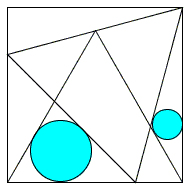
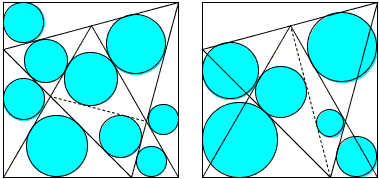
Two equilateral triangles are inscribed into a square as shown in the diagram. Their side lines cut the square into a quadrilateral and a few triangles. Find a relationship between the radii of the two incircles shown in the diagram.

|Contact| |Front page| |Contents| |Geometry| |Up|
Copyright © 1996-2018 Alexander Bogomolny
Two equilateral triangles are inscribed into a square as shown in the diagram. Their side lines cut the square into a quadrilateral and a few triangles. Find a relationship between the radii of the two incircles shown in the diagram.
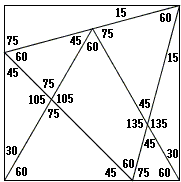
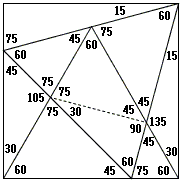
At first sight, the problem may appear surprising: do indeed equilateral triangles form such a configuration in a square? As a matter of fact they do so even in a more general setting. As a result, we may find all the angles in the diagram as shown below (in degrees):
For the sake of convenience we label relevant points:

and add four more: the projections of M, P, and Q on the sides of the square.
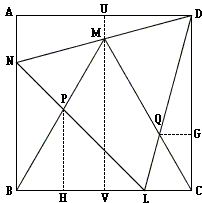
Assume the side of the square equals 2:
By the Pythagorean theorem,
| MD2 | = UD2 + MU2 |
| = 1 + (2 - √3)2 | |
| = 1 + 4 - 4√3 + 3 | |
| = 8 - 4√3 | |
| = 2·(4 - 2√3) | |
| = 2·(1 - √3)2 |
so that finally
Thus we can find sin 15° and cos 15°:
| sin 15° | = UM / DM |
| = (2 - √3) / (√6 - √2) | |
| = (√6 - √2) / 4 and, similarly, | |
| cos 15° | = (√6 + √2) / 4. |
Now continue. ΔDAN is a doubled replica of ΔDUM so that
After these preliminaries we are in a position to tackle triangles BLP and CDQ. Because of a proliferation of radicals it is a convenience to begin with similar triangles B'L'P' and C'D'Q' in which B'H' = 1 and G'Q' = 1. The other lengths come out as follows:
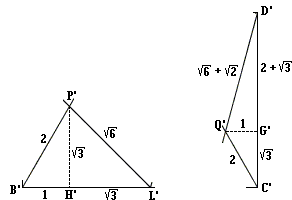
We apply the same standard formula as in another sangaku:
where r, p, S, a, h are respectively the inradius, perimeter, area, a side and the altitude to the side in a triangle. In ΔB'L'P', the inradius is found to be
The inradius r1 of ΔBLP relates to r' as the ratio of the sides, e.g. BL/B'L' which is
from which
| (1) | r1 = 2(√3 - 1) / (1 + √2 + √3). |
Similarly, the inradius r2 of ΔCDQ can be found to be
| (2) | r2 = 2 / (4 + 2√3 + √6 + √2). |
With an additional effort, we conclude that (1) and (2) imply
And this is the relationship we were supposed to surmise from the diagram.
It goes without saying that any use of calculators (direct or implicit via dynamic geometry software) to solve this problem is rather inappropriate as the calculations would conceal rather than help discover patterns between various elements of the diagram. Check a remark on another page and the last chapter of an exceptional book by D. Niederman and D. Boyum.
An anonymous visitor to the site has observed that the original diagram contains great many triangles, each with the incircle. The visitor drew attention to a pair of equal ones and conjectured that there are more such pairs of twin circles.
The visitor has surmised that line PQ is perpendicular to LQ which shows that in the right ΔLPQ, angle at P is 30°, so that the hypotenuse LP is twice as long as the leg opposite angle P:
Additionally triangles CQL and BLP are similar:
In the similar triangles CQL and BLP a pair of corresponding sides
It follows that the incircles of triangles CQL and CDQ are equal. One then wonders whether another sangaku would not be more natural.

However, simple comparison of the computed radii of various circles shows that besides the pair ADN and CDL of equal triangles, the diagram contains no twin circles in addition to the pair CQL and CDQ. Following is the collection of the radii of all the circles that appear in the double diagram above:
15.44871237025661
21.847778555217914
20.843374709207808
21.020708950586016
15.448712370256642
29.844620522684522
26.757954736802247
34.75479670426888
20.358888551841012
37.52222553867126
20.358888551840977
25.527816277595395
13.850936587751294
28.47257935337593
Most of the differences between the numbers in the list are sufficiently large to be explained by the accuracy (or the lack thereof) of calculations. Thus here is an example where the mathematical truth, albeit negative, can be established with the help of calculators.
References
H. Fukagawa, D. Pedoe, Japanese Temple Geometry Problems, The Charles Babbage Research Center, Winnipeg, 1989
Write to:
Charles Babbage Research Center
P.O. Box 272, St. Norbert Postal Station
Winnipeg, MB
Canada R3V 1L6D. Niederman and D. Boyum, What The Numbers Say, Broadway Books, 2003
Sangaku
- Sangaku: Reflections on the Phenomenon
- Critique of My View and a Response
- 1 + 27 = 12 + 16 Sangaku
- 3-4-5 Triangle by a Kid
- 7 = 2 + 5 Sangaku
- A 49th Degree Challenge
- A Geometric Mean Sangaku
- A Hard but Important Sangaku
- A Restored Sangaku Problem
- A Sangaku: Two Unrelated Circles
- A Sangaku by a Teen
- A Sangaku Follow-Up on an Archimedes' Lemma
- A Sangaku with an Egyptian Attachment
- A Sangaku with Many Circles and Some
- A Sushi Morsel
- An Old Japanese Theorem
- Archimedes Twins in the Edo Period
- Arithmetic Mean Sangaku
- Bottema Shatters Japan's Seclusion
- Chain of Circles on a Chord
- Circles and Semicircles in Rectangle
- Circles in a Circular Segment
- Circles Lined on the Legs of a Right Triangle
- Equal Incircles Theorem
- Equilateral Triangle, Straight Line and Tangent Circles
- Equilateral Triangles and Incircles in a Square
- Five Incircles in a Square
- Four Hinged Squares
- Four Incircles in Equilateral Triangle
- Gion Shrine Problem
- Harmonic Mean Sangaku
- Heron's Problem
- In the Wasan Spirit
- Incenters in Cyclic Quadrilateral
- Japanese Art and Mathematics
- Malfatti's Problem
- Maximal Properties of the Pythagorean Relation
- Neuberg Sangaku
- Out of Pentagon Sangaku
- Peacock Tail Sangaku
- Pentagon Proportions Sangaku
- Proportions in Square
- Pythagoras and Vecten Break Japan's Isolation
- Radius of a Circle by Paper Folding
- Review of Sacred Mathematics
- Sangaku à la V. Thebault
- Sangaku and The Egyptian Triangle
- Sangaku in a Square
- Sangaku Iterations, Is it Wasan?
- Sangaku with 8 Circles
- Sangaku with Angle between a Tangent and a Chord
- Sangaku with Quadratic Optimization
- Sangaku with Three Mixtilinear Circles
- Sangaku with Versines
- Sangakus with a Mixtilinear Circle
- Sequences of Touching Circles
- Square and Circle in a Gothic Cupola
- Steiner's Sangaku
- Tangent Circles and an Isosceles Triangle
- The Squinting Eyes Theorem
- Three Incircles In a Right Triangle
- Three Squares and Two Ellipses
- Three Tangent Circles Sangaku
- Triangles, Squares and Areas from Temple Geometry
- Two Arbelos, Two Chains
- Two Circles in an Angle
- Two Sangaku with Equal Incircles
- Another Sangaku in Square
- Sangaku via Peru
- FJG Capitan's Sangaku
|Contact| |Front page| |Contents| |Geometry| |Up|
Copyright © 1996-2018 Alexander Bogomolny
74431041