
Book Reviews
| 'For Christ's sake don't let's discuss reviews and reviewers. They're the most boring subject on earth. I expect I'll be writing just the same sort of crap myself after a week or two.' |
|
Anthony Powell |
Recommended Books
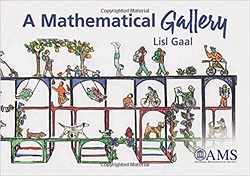 by Lisl Gaal
The greatest part of Introduction is an assay by author's granddaughter, written when she was eleven years old. It is precious. Not to belittle my impression of the book proper, I would buy it just to have a chance to revisit that assay at will. What if math were a color? What if math were a sound? What if math were a taste, an emotion, a texture? The girl asked and gave her answers to those questions; imaginative, insightful answers. Math teachers should internalize the spirit of the assay and aspire to enrich their students with that sensation of familiarity and appreciation of what mathematics is. This is what the book does gently, with beautiful lithographs, colorful diagrams, simple explanations, and always from unexpected angles. The small book consists of 13 chapters, charmingly illustrated. Like Kinko's book, comprising small pieces that lack a story line, and are only connected by the personality of the author and his historical background, so the 13 chapters of the present book are unrelated to each other but linked with the refined taste, imagination and artistic mastery of the author. | |
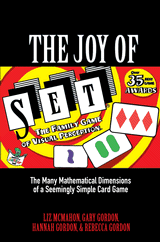 Liz McMahon et al
SET is one of the most popular games of the last 25 years. Since its release in 1991, it has been recognized repeatedly as an outstanding educational game (the Set Enterprises website lists at least 37 awards spanning more than 20 years.) The game of SET uses a special deck of cards. Each card has symbols characterized by four different attributes:
Initially, 12 cards are placed on the table. Three cards form a SET if they all are the same or all different in each of the four attributes independently. Players scan the cards, the first to see a SET calls "SET!" and removes those cards, which are then replaced. The winner is the person at the end with the most SETs. A few questions pop up almost right away. How big is the deck? Does a set of 12 cards always contain a SET? If not, what is the minimal amount of cards that is assured of having a SET? It looks like there's a good deal of counting questions, and this is not surprising. What may be surprising is the amount of mathematics, besides the counting, that is relevant to the game of SET. Even more surprising are the depth and the breadth with which related mathematics is covered in the book. | |
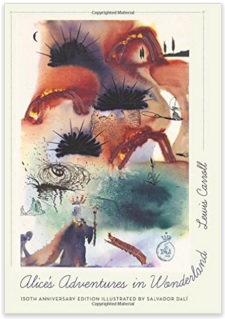 Lewis Carroll
with illustrations by Salvador Dali Lewis Carroll announced his credo for writing children's book in the opening paragraph of his Alice's Adventures in Wonderland: ... once or twice she had peeped into the book her sister was reading, but it had no pictures or coversations in it, "and what is the use of a book," thought Alice, "without pictures or conversations." Conversations - even if the great part of them are Alice's soliloquies - naturally play a major part in Alice's Adventures in Wonderland, while Carroll himself illustrated the manuscript. The first published (1865) edition of the book carried 42 illustrations by John Tenniel. There were dozen attempts to illustrate the book, but - for me - Tenniel's illustrations were the definitive ones. In my imagination I used to identify Carroll's characters with Tenniel's images. Holding the latest, 150th Anniversary, edition published by the Princeton University Press with illustrations by Salvador Dali proved to be a novel, rather ovewhelming experience which almost feels like holding a new book, or, perhaps, a book in a book. | |
 Dick Hess
At first glance, the author of the book, Dick Hess, is fully justified to refer to the book as a collection of mathematical puzzles. And this is not only because the problems in the book - the puzzles - need some kind of mathematics to be solved successfully, but also because the author exhibits a remarkably "mathematician's attitude" in his approach to generating the puzzles. Many a problem in the book come as modifications of each other or of various better known puzzles. This is pretty uncommon for a puzzle book. Some readers might want to have a greater puzzle variety, but in my view, having problems turned around, seen from different angles, even munched under slightly modified conditions, makes the book a valuable resource not just for puzzle fans, but for teachers of mathematics who may want to introduce their students to problem solving strategies and instill in them the right kind of attitude to problem solving in general. | |
 Mircea Pitici (editor)
This is the sixth book in "The Best Writing on Mathematics" anthological series. This will be the first time that I shall offer any critique on the essay selection. The book starts with a humorous panegyric to the blackboard which is convincingly shown to be an indispensable implement of mathematical research, notwithstanding the drawbacks of using the chalk. The whimsical character of the first chapter creates the mood for a smooth transition to the second one that starts with a multiple choice puzzle: Multiply together the number of fingers on each hand of all the human beings in the world - approximately 7 billion in all. Is the answer approximately: A) $5^{7,000,000,000}\;$ B) $10^{7,000,000,000}\;$ C) $5^{14,000,000,000}\;$ D) Something else entirely? | |
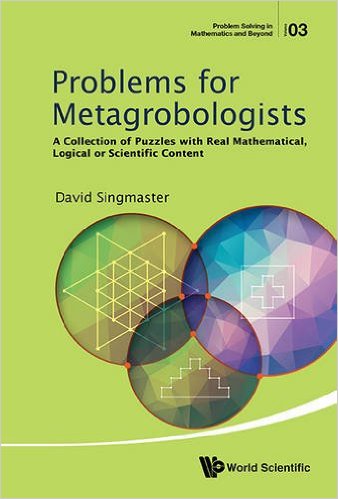 David Singmaster
As a verb, the English word puzzle has two conflicting meanings: 1) to surprise, confuse; 2) to solve, resolve one's confusion. David Singmaster - the author of the new puzzles book - may have had that in mind by naming his book "Problems for Metagrobologists". While he began referring to himself as a metagrobologist years ago, outside the limited circle of professional puzzlists, the term is not well known. So the title is both surprising and inviting to puzzle out what might the book be about. David helps the reader in the first paragraphs of Introduction: In case you don't already know, the Oxford English Dictionary's (OED) entry for METAGROBOLIZE describes it as humorous. Rabelais used metagraboulizer and Cotgrave (1611) translates it as "to dunce upon, to puzzle, or (too much) beate the braines about." The OED gives: To puzzle, mystify To puzzle out. As an expert puzzle historian, David continues with two more paragraphs and additional references - these you'll have to consult for yourself. | |
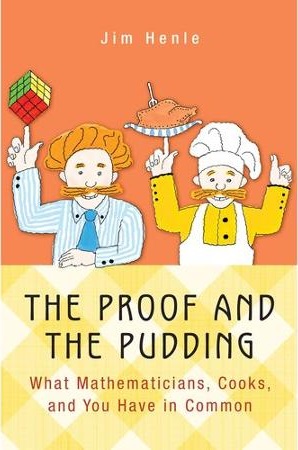 Jim Henle
This is an unusual book by a gourmet mathematician and a self taught cook. The title "The Proof and the Pudding" is most certainly a double entendre. On the face of it, about half of the book is filled with recipes for the author's chef-d'oeuvres while the other half is devoted to mathematics - the author's puzzlings and mathematical doodlings. The exact proportion is hard to estimate, for the text is interspersed with musings pertinent to both subjects, including instructive confessions of the author - both in the role of a mathematician and a chef - being guilty of all seven deadly sins, gluttony being the most serious offense, naturally. But what is the second, concealed (or implied) meaning of the book's title? This is quite certainly a tribute to the well known phrase "The proof of the pudding is in the eating!" or even more so to its more recent variant "The proof is in the pudding!" One has to eat the pudding to appreciate and enjoy its taste. It's the same about cooking and mathematics: you can't enjoy either unless you try doing it. | |
 Marc Chamberland
The book is a caboodle carrying an eclectic assortment of short mathematical stories clustered by association with integers 1 through 9. Sometimes the association is loose as, for example, when in Chapter 1 the measure of the complement of the ternary Cantor set is shown to be 1, the quadratic rate of convergence of the Newton method is discussed in Chapter 2, the angle trisection and Morley's theorem in Chapter 3, the Ducci sequences in Chapter 4, the Platonic solids in Chapter 5, the six degrees of separation phenomenon in Chapter 6, the Seven Bridges of Köningsberg problem is mentioned in Chapter 7, the Game of Life in Chapter 8 (due to a cell having 8 neighbors), or Casting out 9s in Chapter 9. Thus the book does not exactly fit with, say, Lure of The Numbers by Joe Roberts (MAA, 1992) or The Kingdom of Infinite Number by Bryan Bunch W.H. Freeman & Co, 2000) that deal exclusively with properties of integers. This in no way makes the book any less interesting. On the contrary, the scope of the book is broader, with the author highlighting many a fascinating fact from various fields of mathematics, not just number theory. | |
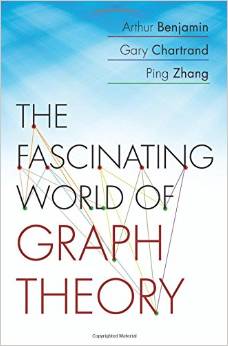 Arthur Benjamin
Gary Chartrand Ping Zhang The preface to the book which the authors open with a lamentation over a state of affairs of American math education, in general, and a small number of young Americans choosing math as a vocation, in particular, filled me with apprehension. Have the authors really thought that a book might change the attitude of a generation towards mathematics. Even, a more modest goal of writing a book that could stir up interest in the subject might have proven a tall order. Yes, it might. It might also have been a bad day for me to browse a book for review, but, whatever the reason, and even though I own and love Arthur Benjamin's other books, on that first encounter with the book, I set out to find out its faults. I sought and I found. On page 132, $k_{o}(G)$ is introduced to denote the number of odd components of graph $G$ and immediately used in Tutte's theorem on perfect matching, where it is mistyped as $k_{0}(G).$ To continue in the mood of the first paragraph, I should now write that to my chagrin nothing else caught my eye. But the fact is that along the way I simply forgot about my original intent, my mood has also changed. The bottom line is I began liking the book (and never stopped.) Authors write that While the main purpose of the book is to illustrate how interesting and intriguing (and sometimes mysterious) just one area of mathematics can be, this book can also be used as a textbook. | |
 Mircea Pitici (ed)
The fifth book in "The Best Writing on Mathematics" series adheres the standard of excellence set up by its predecessors. Fortunately for the readers, it also reverses the trend of diminishing size exhibited by the series so far. This is also the first book in the collection to feature color inserts. The collection consists of 24 articles of which all are recent, except one, but which still has significant relevance to today's educational logistics. D. Gale and L. S. Shapley's "College Admissions and the Stability of Marriage" (1962) offers an optimal strategy and algorithm that would satisfy both colleges and students: colleges in their search of worthy candidates, students in their attempt to be admitted to a college of their choice. The problem is solved by abstracting to a less than practical problem of insuring a stable set of marriages between equal number of men and women. The authors conclude their article with the following observation: ... it may be convenient to have an illustration at hand to show that mathematics need not be concerned with figures, either numerical or geometrical. For this purpose, we recommend the statement and proof of our Theorem 1. The argument is carried out not in mathematical symbols but in ordinary English; there are no obscure or technical terms. | |
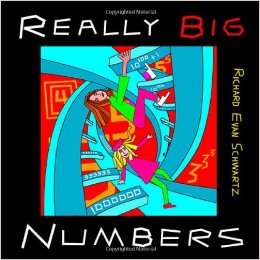 Richard Evan Schwartz
It's common to describe mathematics as a formal, meaningless game with abstract symbols (often in the wake of Bertrand Russell's observation). Mathematicians, of course, know better. They know that mathematical language is a tool so powerful that it lets them imagine unimaginable. Symbols are invented for a purpose, to a great extent with an objective to make mathematical concepts easier to handle. Who then, if not a working mathematician, may more convincingly weigh to rectify the popular delusion. Richard Evan Schwartz - the Chancellor's Professor of Mathematics at Brown University - does this with exceptional flair, in a clear and entertaining manner. The book is about the most basic mathematical concepts - that of counting and numeration. Indeed, there would not be big numbers if there were no small ones. So this is where the book starts - with small numbers. With wonderful illustrations, Schwartz makes it clear that the same number describes a property of various sets, regardless of how the elements of those sets are arranged or grouped. Next, grouping elements by 10s and 100s the book leads fast to bigger numbers. But on the way up there the book dwells on origins of big numbers, with such hands-on and humorous examples as the number of minutes in a week or the number of hours lived by a 114 year old fellow. | |
 David Reimer
Count like an Egyptian?! Have not we learned something in more than 3000 years to make emulating the ancient Egyptians a waste of time? David Reimer, the author of the book under review, offers an answer: There are a number of reasons to learn Egyptian mathematics. Puzzle lovers will find it fun and challenging. History lovers will gain insight into the Egyptian mind-set. However, I believe the most important reason to study Egyptian mathematics is because it is so different. We're taught throughout our entire education that math simply is. (...) When you're exposed to a different system, you're forced to reconsider the immutability of "the math." After reading and enjoying the book I'd like to expand on Reimer's arguments. (I prefer, though, to use the term "arithmetic" rather than "mathematics", because this is what it is.) Not only the Egyptian arithmetic is different, in some respects it is plainly better - simpler, more natural, and more powerful - than what the kids are being taught in grade school. Egyptian arithmetic allows for more direct estimates - both the values and the errors. For example, $\displaystyle\frac{2}{5}=\frac{1}{3}+\frac{1}{15}$ which conveys the idea that $\displaystyle\frac{2}{5}$ is close to $\displaystyle\frac{1}{3}$ and $\displaystyle\frac{1}{15}$ is a measure of their proximity. | |
 Tim Chartier
Traditionally, a bookjacket tells the reader a little about the book contents and the author whose short bio is often accompanied by a photograph. In the photo, mostly universally, authors smile. Tim Chartier managed to put his second smiling photograph within the book. This is in the chapter where he explains an algorithm of approximating a picture as a weighted sum of the photographs of several celebrities. (This is an entertaining way to introduce the least squares approximation and the related linear algebra.) Now, what the author's smile has to do with a book review? Here it is: on reading the book, I got the feeling that Tim never let go of that smile of his while writing the book. Both the style and selection of the material leave no doubt that the author has been enjoying writing that book from the first page to the last. There is no pretense, no attempt to endear mathematics in general, or any specific topic in particular, on the reader. The author's humanistic, sincere enjoyment of communicating his selections permeates and I think defines the book. The book consists of fourteen chapters, covering mathematical (in a very broad sense) topics whose treatment may benefit from using computers - most, but not all; the first chapters simply deal with big numbers and history of computing. The choice of topics and exposition details make the book entertainingly relevant. | |
 Anthony Lo Bello
Let me state at the outset that, notwithstanding the deficiencies of my own vocabulary, I am very fond of browsing dictionaries, thesauri, history of languages, and the like. Languages have rules, words origins - and together they form a thread in our cultural heritage. The new book by Anthony Lo Bello will not exactly fill a gap in my library, but it will occupy a deservedly prominent place on my bookshelves. Lo Bello mentions one other etymological dictionary of mathematical words: The valuable work of Schwartzman (The Words of Mathematics, MAA, 1994) may be consulted with benefit by anyone who looks into this book, and such an investigator will notice the ways in which I differ from the learned colleague: I have retained the Greek and Arabic alphabets to avoid the dark and doubtful consequences of transliteration, I have sat in judgment on the correctness of the words I explain, and I have used my license to be discursive to discuss not only the function of mathematics in liberal education but also English usage among mathematicians and their colleagues in the learned world. An example of literary license is the entry "Mathematics," pages 199-207. This is a well-written, engaging essay on mathematics and mathematicians. One can hardly stay unmoved by the following paragraph: Mathematicians who are teachers regularly adopt the bureaucratic mentality as they function within their colleges and universities. By doing so they torpedo their own ship and demonstrate that they do not understand the meaning of their own profession. They thereby contribute to the decline in the estimation in which the society holds their profession. | |
 Steven Skiena, Charles Ward
Years ago, when I was a student at MechMat (Department of Mechanics and Mathematics) at the Moscow State University, my brother-in-law used to pester me with questions, like who - in my opinion - was a better mathematician, Andrey Nikola'ivich Kolmogorov or Pavel Serge'evich Alexandrov. Although I would usually have an idea who that might be, I never saw a point in pondering such questions, let alone answering them. I could not fathom why would anybody be interested in putting a worthless tag on a couple of great mathematicians. Times change: if my brother-in-law were alive today, he would be able to easily satisfy his curiosity without bothering anybody personally. Steven Skiena and Charles Ward - the two authors of the book Who's Bigger? - have set up a web site whoisbigger.com that has a tool (whose rationale and workings are described in the book) where the user can enter a person's name and receive a few calculated ranking attributes for that person. E.g., this is what one would have if asking about "Pavel Alexandrov" and then "Andrey Kolmogorov" ... This tells us that, according to Skiena and Ward, Kolmogorov beats Alexandrov (the smaller the number the higher the ranking) on all the indicators they employ. All emotions aside - which is a convenience - this is probably right. Alexandrov made major contribution to topology, Kolmogorov is a founder of modern probability, with fundamental contributions to complexity, algorithmic information theory, turbulence, logic, and also topology. Cool, unemotional numbers. Where do they come from? | |
 Paul J. Nahin
The book is the third of Paul Nahin's collections devoted to probability. (Duelling Idiots and Digital Dice.) It follows the format of the previous two: 25 essays - each with a problem or two and solutions - follow enthusiastic Preface and Introduction. In Preface Nahin does a superb job conveying his passion for the puzzles generously supplied by probability theory. His style is articulate and enticing; if a reader had any interest in picking up the book in the first place, he or she would find it hard to put it back without turning a page or two and, perhaps, browsing the rest of the book. As in the previous books, Nahin uses the opportunity to take to task Marilyn von Savant - a popular Parade magazine's columnist - for the mistakes she made. The book assumes a certain degree of acquaintance with the basic probability and also a reasonably mature study habits, so that the reader should be able to find the definitions or other probability related notions not explained in the book on his/her own. Some problems are naturally more difficult than others; several go beyond the level of mere puzzles. Many, if not most, require a level of comfort with probability methods beyond that associated with casual audience. Some are intended to a reader with a one-two years Calculus experience. | |
 Sotirios E. Louridas, Michael Th. Rassias
Problem-solving is an activity of solving problems; the skill of problem-solving is the ability to approach solving problems in a systematic manner. The skill - either innate or acquired - may fade unless exercised. Sotirios E. Louridas and Michael Th. Rassias, the authors of the book at hand, put together an excellent collection of problems to practice, and detailed solutions to follow the masters exposing that skill. If the title of the book is any indication, they set out to achieve more - probably, to instruct in problem-solving, or, at least, outline their problem-solving methodology. The structure of the book also points in this direction. The short first chapter consists of two sections: "The Origins of Geometry" and "A Few Words About Euclid's Elements", each two-pages long; the former including the motivation and statement of Fermat's Last Theorem. The short second chapter also consists of two parts. In the first part, the authors introduce logical connectives and truth tables; use these subsequently to define the relation between a theorem and its inverse, converse, and contrapositive statements and also introduce the concepts of the necessary and sufficient. In the second part, they describe four methods of proof: proof by analysis, proof by synthesis, proof by contradiction, and proof by induction. | |
 Xiong Bin, Lee Peng Yee
In the combined seventeen pages of Preface and Introduction the authors outline the history of mathematical olympiads around the world and, in particular, in China. Two paragraphs concerning the situation in China are especially revealing: "In the era of Cultural Revolution, the whole educational system in China was in chaos. The mathematical competition came to a complete halt. In contrast, the mathematical competition in the former Soviet Union was still on-going during the war and a time under difficult political situation." In 1985 China took part in an IMO for the first time. The two Chinese contestants shared between them one bronze medal - a less than encouraging performance for the most populous country in the world. "From 1986 onward, other than the year when IMO was organized in Taiwan, China had been sending a 6-member team to IMO. Up to 2011, China had been awarded the overall team champion for 17 times." | |
 Vito Volterra,
Angelo Guerraggio
Vito Volterra,
Angelo GuerraggioVito Volterra (3 May 1860 - 11 October 1940) was a public figure of tremendous prestige and influence. He was a Senator of the Kingdom, Dean of the Faculty of Sciences at the Universities of Pisa and Rome, co-founder of the Italian Physical Society, founder and the first president of the Italian Society for the Advancement of Science, the first president of the National Council for Research, President of the Accademia dei Lincei. Vito Volterra was a physicist and a mathematician whose stature in the mathematical world was compared to that of David Hilbert. His work on integral and integro-differential equations and "functions of functions" led to the development of functional analysis. He worked in geophysics, hereditary mechanics, biomathematics, population dynamics, in particular. He is credited (along with Alfred J. Lotka) with the development of the first predator-prey model. Vito Volterra gave keynote lectures at four International Congresses of Mathematicians (1900, 1908, 1920, 1928.) He was a member of practically all important world science academies. Later in his life he became known as "Mr Italian Science". | |
 Anna Burago
The arrival of Mathematical Circle Diaries by Anna Brag has invoked a memory of the last scene in a 2004 science fiction movie The Day After Tomorrow. During a cataclysmic storm, with temperatures dropping to sub-freezing, a small group led by Jake Gyllenhaal survives by burning the vast book collection in the New York Public Library. The movie clearly leads one to believe that this may be the only remnant of the city population. However, when the worst is over, and the survivors are being flown away to the less affected Mexico, they are surprised to see numerous groups of people emerging on rooftops and waiting for transportation. (One may of course wonder what kept them warm but this is besides the point.) This last scene is a forceful tribute to the human race adaptability, the ability to survive even in the face of an unimaginable adversity. | |
 Xu Jiagu
The two books by Xu Jiagu constitute Volume 8 in the Mathematical Olympiad Series published by the World Scientific. Each of the books contains 15 chapters, called lectures - I am not sure why. Chapters open with a short introduction (notations, important notions, basic theorems), followed by several examples, with detailed solutions, and lists A and B of practice problems to be solved independently. Solutions to all the problems in both lists appear at the end of the book. Some of the example problems, most from List A, and practically all problems from List B have been plucked from various national (with emphasis on China's) mathematical competitions and the IMO. There is noticeable correlation between sample problems and those in List A, such that the latter are clearly intended for practicing techniques the author discusses in the sample problems. Problems in List B require more experience and originality. It is obvious that the author went to a considerable length gathering and organizing the problems according to the solution techniques and difficulty. | |
 Victor H. Moll
Many a mathematical book grow out of a collection of notes made on various occasions by their author. So had the book Numbers and Functions by Victor Moll. Moll prepared the notes to be given to the participants of several - broadly spread over the curriculum - courses he taught at Tulane University. What, perhaps, sets the book aside from other note collections is the author's intention in preparing the notes, in the first place. According to the author, Part of the motivation for bringing together a large collection of notes on diverse topics was to provide the reader with some fun while learning interesting pieces of mathematics. There are 16 chapters, and probably not every reader will find all of them exciting, but reading, or even browsing, the book is nothing less than fun. The book - if one may characterize a mathematics text in such terms - is warm and cosy and often delightful. As the French writer Georges Perec - a member of the Oulipo group - wrote about reading, You don't just read anyhow, any time, any place, even if you read anything. The fact is I've been smiling much of the time while holding the book. | |
 Michael Henle
My first - and wrong - impression of the book was that it might be a modernized version of Edmund Landau's classic Foundations of Analysis. After all, both books expose constructions of nothing else but several number systems. On closer inspection, though, I saw my error; the differences were significant. Landau constructs an expanding chain of number systems: natural numbers, integers, fractions, real and then complex numbers. The understanding of algebraic tools, say equivalence relations and classes, is taken for granted; the book is intended to be read (at least by a novice) from the beginning to the end. Henle, on the other hand, delves into the equivalence relations and equivalence classes at the beginning of the book. Integers and rationals are assumed to be known, but the constructions of rational numbers is well outlined. The number systems Henle describes are essentially different from Landau's: real numbers, complex numbers, quarternions, constructive reals, hyperreals, and surreal numbers. Except for the first two chapters that serve as the basis for the rest of the book, the remaining chapters are very much self-contained and could be read independently. | |
 M. I. Krusemeyer, G. T. Gilbert, L. C. Larson
The book is an expanded version of "The Wohascum County Problem Book" published by the MAA in 1993. While the title has changed, some problems - old and new - still draw from the (un)reality of that locality. There are now 208 problems vs 130 in the older edition. This is unabashedly a problem collection in which the Solutions part takes about 85% of the book. The book is very thoughtfully organized. Each problem is followed by a solution page number; there are also three indices (a thorough term index, prerequisites by problem number, and problem numbers by subject); that and the fact that about 25% of the problems come with more than one solution, attest to the effort made by the authors and the sincerity of their desire to accommodate diverse skills and interests. On the whole, the book is very easy to work with. The metaphorical title A Mathematical Orchard is supposed to "evoke images of such good things as vigorous growth, thoughtful care, and delectable fruit..." | |
 Ralph Grimaldi
The book is a comprehensive introduction into the subject of the Fibonacci and Catalan numbers and their many properties and uses. It is a tastefully written and well organized textbook that could be used for self study and easy references. The book consists of two parts: the first seventeen chapters cover the Fibonacci and Lucas numbers, followed by 19 chapters that cover the Catalan numbers; both touch on generalizations: the alternate Fibonacci, Narayana, Motzkin, Schröder, and Generalized Catalan numbers. The two parts have a similar structure. A short historical background, the traditional motivating problems, additional examples that lead to the discussed families of numbers, more theory and more examples, generalizations, a final example, bibliography. The index at the end of the book is common to the two parts as is the collection of solutions to the odd-numbered exercises. (Each chapter ends with a good deal of those.) | |
 Károly Simonyi
I have to admit a difficulty I had in reviewing this book, even though, after initial browsing, I felt that it had to be straightforward. Indeed, some features of the book manifest themselves at first glance. It is rich, probably comprehensive, lavishly illustrated, beautifully executed, with a tremendous number of quotations and unabashed use of equations. The author - of an unquestionably uncommon talent for illustrating and organizing his ideas - made a tremendous effort to convey his extensive knowledge to potential readers. As chance would have it, I even stumbled on a curious morsel that reminded me that my physics notions needed a refresher - of this later. Writing a book like that had to be an arduous, yet intellectually rewarding and deeply satisfying experience for the author. It had to be a man's life's work. My first impression was confirmed in the Foreword by the author's son, Charles Simonyi, An exceptional book such as this could have been created only under exceptional circumstances. ... in the politically charged atmosphere of the 1960s in Hungary ... he (my father) progressively lost his directorship at the Physics Research Institute, his post as department head, and finally his teaching position altogether. ... The break in his career at midlife did not drive him to dispair; his humanism instead commanded him to work on the subject he had perhaps always wanted to work on: the history of the interplay of science and the humanities. His first notes became a lecture series, first given off campus, in the evenings at the invitation of student organizations. ... The success of these lectures gave rise to the present book that he continued to revise and extend until his death in 2001. | |
 John A. Adam
Is mathematics all around us? Why, if you want to see it, it is; if you do not, you may also pass by and think of anything else. John A. Adam chose to espy mathematics in many aspects of urban life. His new book X and the City consists of 25 chapters, each ending with the words "the city", for example, Getting into the city, Eating in the city, Sex and the city, Nighttime in the city - all 25 of them. John A. Adam - professor of mathematics at Old Dominion University - is a coauthor of an admirable book Guesstimation. Some of the questions he asks - and answers - while strolling in the city, could have come right from the latter: How many fast food restaurants may one expect in a city, how many barber shops? How many leaves are on that lonely tree you stroll by? How many tomatoes are eaten in the city every year? These have to do with figuring out estimates under rough, simplified assumptions. Posing and analyzing such questions is an entertaining activity in itself but also helps develop a skill frequently employed when it comes to making on-the-spot-decisions. | |
 Dana Mackenzie
I just finished reading Dana Mackenzie's book The Universe in Zero Words. The reading was interrupted by the necessary sleep, meals, perfunctory answering email - and that's about it. It was a very absorbing reading, even though most of the material was not new to me. The subtile of the book The Story of Mathematics as Told Through Equations gives one a pretty good idea what the book might be about. The book presents a rather coherent story in 24 chapters that runs through more than 2500 years. Dana Mackenzie is indeed a very good story-teller. The book engagingly lays down historical and cultural aspects of mathematical evolution, starting with the significance of simple equations 1+1=2 and 1-1=0, and reaching to the modern times when math equations gained predictive powers in physics (Dirac's equation) and explained and even influenced economic developments (Black-Scholes equation.) | |
 Florin Diacu
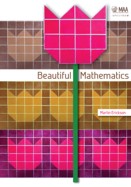
There is probably no mathematician who has never been surprised by a mathematical statement or has not been delighted in a mathematical argument. For those who know, mathematics has beauty, elegance, mystery, and, of course, surprise. Most mathematicians chose this endeavor after having experienced such a moment of enlightenment. The book "Beautiful Mathematics" by Martin Erickson offers ample opportunity for such an experience to everyone with even a slightest interest in mathematics. The science of chronology are arguably hard. Few historical sources reached us in their original form. When they do, it is not always possible to establish their exact age. The copies, on the other hand, are suspect of accidental and deliberate mistakes and of misrepresentation. Thus, it is not uncommon to question reliability of historical sources. Even the Bible has its detractors who thinks it is pure mythology. In this spirit Diacu describes the work of Fomenko: Fomenko has raised legitimate questions and devised ingenious methods to obtain the answers. Some of his assertions are patently false, some warrant continued attention. In the Afterword written especially for the second edition of the book, the author indicates that in the intervening years he was able to discover two additional sources: one that supports one of Fomenko's conclusions, the other that refutes another of his claims. There remain many as yet unsettled points that require further investigation. The book expertly leads the reader to understanding of what the controversy is about. As it becomes clear, uncertainties and disagreements permeate the science of chronology. Fomenko poured some oil into the fire, but there were many others who kept the fire burning and others who wanted it contained. As I intimated earlier, this wonderful book is more about chronology in general than about one man's work. I would say that had not Fomenko existed, he should have been invented to give Florin Diacu motivation for writing that book. | |
 Martin Erickson
There is probably no mathematician who has never been surprised by a mathematical statement or has not been delighted in a mathematical argument. For those who know, mathematics has beauty, elegance, mystery, and, of course, surprise. Most mathematicians chose this endeavor after having experienced such a moment of enlightenment. The book "Beautiful Mathematics" by Martin Erickson offers ample opportunity for such an experience to everyone with even a slightest interest in mathematics. The book is a collection of short (1-2 pages long) vignettes that illuminate mathematical beauty from various angles. Mathematicians use imaginative words: lemniscate (a woolen ribbon used in fastening a garland to someone's head), waterfall of primes, golden ratio, triangular numbers ... They visualize intriguing images: binary trees, projective plane, two-colored graph, and come up with captivating formulas: series and products for π, the Riemann Zeta function, the Jacobi identity. Mathematicians prove delightful theorems: Morley's, Monge's, Minkowski's. Mathematics has pleasing proofs and elegant solutions; to pose an interesting problem requires creativity; all of that stands on harmonious foundations. The book ends with eye-opening explorations and these come with solutions, to boot. If pressed for an extra rubric, I would consider a separate part "Engaging Games", as this is something that mathematicians are preoccupied with - literally and metaphorically. | |
 Roberto Casati and Achille Varzi
Indeed, is it possible to miss the New Year moment? The question is not meant to account for a possible tragic circumstance and is being asked plainly and candidly. Assuming you are in good health on December 31 of one year and remain healthy on January 1 of the next year, is it possible to have missed the New Year moment? The answer is Yes, and a delightful book Insurmountable Simplicities by Roberto Casati and Achille Varzi, shows how this may happen. Imagine boarding a plane flying from New York to London some time on a New Year's eve, say 10:45 pm. It may so happen that an hour later at 11:45 pm the plane will cross the boundary of a time zone, such that instantaneously you would find yourself in the 00:45 am time zone. Simple? Still curious - the tricks the presence of time zones may play with an uninitiated. | |
 William J. Cook
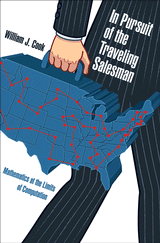
It's a rare pleasure to get a good book ahead of its planned publishing date. In Pursuit of the Traveling Salesman by William Cook that was expected at the beginning of 2012, was delivered yesterday right to my door. My first impression is that this is the sort of a book that are read in one sitting, from cover to cover. The book is clearly intended for the "general audience" and is sweetly written. The author has an obvious writer's streak. The book narrates the history of the so called "Traveling Salesman Problem", TSP for short. Occasionally (and rather suitably for Christmas time) it is also known as the Santa Claus Problem. In its TSP incarnation, the problem is to find the shortest route that passes through a given number of cities. For Santa Claus it may be important to make the planned visits in the shortest time possible. When it comes to drilling points of contact on a printed board or a computer chip, it's crucial - to make the cheaper chips - that the robot arm that drills the holes moves in a shortest possible path. | |
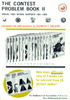
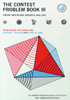
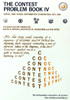
by C. T. Salkind (I-II), J.M. Earl (III), R. A. Artino et al (IV) When I was a school boy in Moscow in the 1960s, there were two mathematical olympiads that addressed different audiences of school children. The Moscow City Mathematical Olympiad was intended to attract a broad stratum of middle and high school students. The Moscow State University Mathematical Olympiad was intended for brighter students with interest in mathematics. Problems at the City Olympiad required fluency in the school curriculum and some of them a little ingenuity; all the problems at the University Olympiad went beyond the curriculum and could only be solved with talent and practiced ingenuity. The winners of the latter received certificates and mathematical books - the higher the achievement, the more books have been awarded. A special committee selected the team for the International Olympiad from among the University Olympiad winners. The winners of the City Olympiad received recognition in the form of official certificates and a due respect from their school mates and administration. The participants in the University Olympiad would usually take part in one or two math circles of which there were many; one run by the graduate students at the Mathematics Department of the Moscow State University. The City Olympiad had two streams, one for the middle, the other for the high school. The University Olympiad, while open to all, was realistically intended for high school students. | |
 Joseph O'Rourke
How To Fold It is a splendid little book that grew out of the more demanding monograph Geometric Folding Algorithms by J. O'Rourke and E. Demaine. According to the author, both of them had experience presenting aspects of the material in the monograph at various educational levels - from fifth grade to high school. Both found that the tangibility of the topics made them accessible through physical intuition. The book is - in my view - a very successful attempt to capitalize on the readers' intuition in introducing several beautiful facets of contemporary mathematics. The book, however, should not be perceived as a collection of hands-on activities, nor could it. The author successfully weaves a synergetic combination of do-it-yourself activities and see-why-it-works theory. The do-it-yourself portions could be performed by middle schoolers; and so might some of the mathematical expositions which never require experience beyond common high school curriculum. The author goes to a considerable length to make the book accessible to a broad audience. Some of the ancillary mathematics - vectors, mathematical induction, triangle inequality, the theorem of the incidence of the angle bisectors in a triangle, convexity - are conveniently framed in blue boxes and stand out to be easily found or skipped, depending on the reader's level. | |
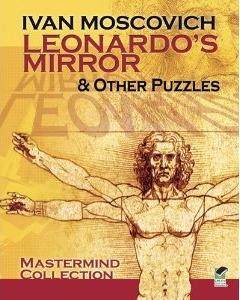
 Ivan Moscovich
Ivan Moscovich, the author of the two books under review is a well known and much respected puzzlist and toy creator. The books - one of which first appeared in 1994, the other in 2004 - have been recently republished by Dover. Both books are lavishly and beautifully illustrated in full color and would make a memorable present. Both books are more than mere collections of puzzles. Most of the puzzles are preceded with background information that sometimes is sufficiently comprehensive to occupy a whole page or two. The reader is treated to the shapes of planetary trajectories, a short biography of Leonardo da Vinci, and that of Leonardo of Pisa; the ideas of mechanical linkages and sphere packing; the Golomb rulers; paper-and-pencil games; and the Ramsey theory. The breadth of the collections and occasional depth are quite staggering. | |
 Dierk Schleicher and Malte Lackmann Dierk Schleicher and Malte LackmannThis little book - An Invitation to Mathematics edited by D. Schleicher and M. Lackmann - is a delightful collection of articles from 14 leading mathematicians, each introducing a direction of current mathematical research. The remarkable aspect of all the articles is that they all start at a level that could be appreciated by a curious high school student and then gently lead the reader to the frontiers of the Unknown. The book is an outgrowth of the events that took place in Germany in 2009 at the 50th International Mathematical Olympiad. During the celebrations of the 50th anniversary six former IMO gold medalists (Béla Bollobás, Timothy Gowers, László Lovász, Stanislav Smirnov, Terence Tao, Jean-Christophe Yoccoz) were invited to give presentations about mathematics, their personal IMO experiences, and their research. All six had accepted the invitations, and their talks have been included in the golden IMO jubilee and the present volumes. Three other contributions (Michael Stoll, Marcel Oliver, Dierk Schleicher) have their roots at the IMO 2009. They grew out of the talks given to the contestants while the solutions were being evaluated. As the editors observe, Whatever their inspirations, all the contributions (to the present book) were specifically written for this occasion. | |
 John MacCormick John MacCormickComputing is transforming our society in ways that are as profound as the changes wrought by physics and chemistry in the previous two centuries. Indeed, there is hardly an aspect of our lives that hasn't already been influenced, or even revolutionized, by digital technology. Given the importance of computing to the modern society, it is therefore somewhat paradoxical that there is so little awareness of the fundamental concepts that make it all possible. The study of these concepts lies at the heart of the computer science, and this new book by MacCormick is one of the relatively few to present them to a general audience. Chapter-by-chapter, the book covers search engine indexing, the PageRank algorithm, public key cryptography, error-correcting codes, pattern recognition, data compression, databases. These are followed by a general discussion on the limitations and the mundane performance of computers. | |
 Donald J. Albers and Gerald L. Alexanderson Donald J. Albers and Gerald L. AlexandersonThis is a beautifully illustrated collection of interviews and biographical etudes of 16 mathematicians of different backgrounds, varied professional interests, diverse level of achievement - all incredibly interesting as human beings. The sixteen interviewees lived and were active in the 1900s, though some are yet alive; the stories throw light - if only in the form of personal perspectives - on many aspects, events and personalities of the 20th century. Lars Albers came first to the US at the time of the Great Depression (find out how much a Harvard professor was making at the time,) but then at the outset of the WWII felt that his place was at home when his country - Finland - was at war. Towards the end of the war the moods had changed and he and his family were secretly flown to Scotland by the British. Tom Apostol was the first-born of an immigrant shoemaker father and a mail-order bride. During the Depression his mother took in laundry to help out but also in exchange for piano lessons for him and his sister. | |
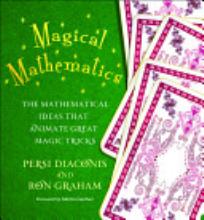 P. Diaconis and R. Graham P. Diaconis and R. GrahamMany book authors end their book Introduction expressing the hope that readers will enjoy reading the book as much as the author(s) enjoyed writing it. Persi Diaconis and Ron Graham do not. Nonetheless, their book - Magical Mathematics - oozes their enjoyment at writing it. The authors are master storytellers. Movingly, Martin Gardner wrote Foreword in April 2010 - probably just a month before he died - where he highly praised the book. The book is about mathematics of some card tricks, shuffling and juggling. Curiously, one of the authors started his career as a magician, the other as a juggler. Both were drawn into mathematics while in search of explanation for the artistic acts. After proving the book's first theorem that explained the workings of a card trick in Chapter 1, the authors remarked, Did the proof we just gave ruin the trick? For us, it is a beam of light illuminating a fuzzy mystery. It makes us just as happy to see clearly as to be fooled. | |
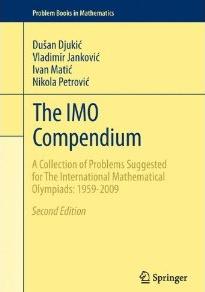 Dusan Djukić et al Dusan Djukić et alThe IMO Compendium is in its second edition; the first one appeared in 2006 and covered problems from the Intenational Mathematical Olympiads starting with the very first one (1959) through the 45th IMO (2004). The new edition adds 143 problems submitted in the following 5 years, 2005-2009. The selection of the problems for an olympiad proceeds in several steps. To start with, the participating countries send their proposals to the IMO organizers. These form the so-called long-listed problems. The Problem Committee selects some of the long-listed problems to submit to the IMO Jury that consists of team leaders. These problems are known as short-listed. From the short-listed problems the Jury chooses 6 problems for the IMO. For most olympiads run in the 1960-1980s, the book includes long-listed, short-listed and the olympiad problems. Starting with 1993, only short-listed (which still form a long list) and olympiad problems have been included. This explains the enormous size of the collection and the strange number - 143 - by which the second edition of the book differs from the first one. All short-listed (in particular, the olympiad) problems come with solutions - many with multiple solutions. More ... | |
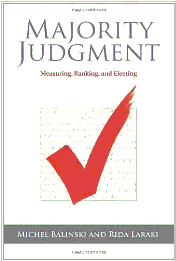 Michel Balinski and Rida Laraki Michel Balinski and Rida LarakiThe new book by Michel Balinski and Rida Laraki is a veritable encyclopedia of voting methods, even though its declared aim is to advance just one of them - Majority Judgement (MJ). The authors undertake a sweepingly comprehensive effort; not only they introduce and discuss the advantages and drawbacks of their favorite procedure, but also introduce and discuss - for the argument and comparison's sake - the advantages and drawbacks of the competing ones. The arguments in favor of the MJ are theoretical, empirical and experimental. The author indeed made a thorough study of the voting and grading situations. Chapter 2 is devoted to the social choice methods employed in several countries. In Chapter 7 they gather information on grading used in various competitions: wine contests, figure skating, music contests, and the like. They actually tested their method at the polling stations in the 2007 French presidential election. Their theoretical investigation was even more thorough. Chapters 3-7 cover traditional voting methods and Chapters 17 and 18 the newer approval voting and its extension point-summing methods. One thrust of the investigation is to discern the fallacies built - according to the authors - into the traditional methods. They prove 5 variants of Arrow's Impossibility Theorem and Gibbard-Satterthwaite's theorem as well. The conclusion?. More ... | |
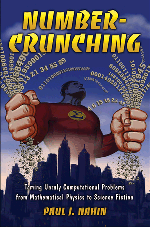 Paul H. Nahin Paul H. NahinIn the preface to his previous book Mrs. Perkins's Electric Quilt author Paul Nahin has advised: If you think, as I recently heard a TV commentator claim, that you'll save gas by driving as fast as possible because you'll get where you are going sooner, then there is simply no hope for you as an analyst, and you shouldn't buy this book - save the money for the extra gas you'll use! This advice applies to the book under review which is to a great extent is a continuation of the previous one, with one marked difference. Concerning the technical side of the books, both deal with mathematics applied to solving physical problems. Nahin includes analysis and calculations that are often skipped over; the level of details reached usually exceeds that of most other books intended for a more or less general audience. More ... | |
 Keith Devlin Keith DevlinLittle is known of the life of Leonardo Pisano that also goes by the names of Leonardo of Pisa and Leonardo Fibonacci. His life has straddled the transition between the 12th and 13th centuries but neither the date of birth or death are known exactly. Leonardo wrote several books in the very first of which Liber Abbaci (dated 1202) he included a recreational puzzle whose solution - the present day Fibonacci numbers - made his name famous in mathematical circles. Fibonacci numbers and the associated Golden Ratio have an uncanny ability to pop up rather unexpectedly in various circumstances. There is even a mathematical periodical (The Fibonacci Quarterly) that is devoted entirely to the properties of the Fibonacci numbers. Emphatically, Keith Devlin's book is not about the Fibonacci numbers. More ... | |
 Hans-Dietrich Gronau, Hanns-Heinrich Langmann, Dierk Schleicher Hans-Dietrich Gronau, Hanns-Heinrich Langmann, Dierk Schleicher50th IMO - 50 Years of International Mathematical Olympia is a pleasant, entertaining, and informative volume. This lovely book "is aimed at students in the IMO age group and seeks to demonstrate that mathematics is an active and lively subject, thousands of years old and yet young and fresh, as ever" (Preface). I am pretty sure the book will be enjoyed by a wider audience. The book lists the organizational structure of the olympiad, its regulations and schedule; the latter in a formal table format followed by the colorful newspaper-style Daily News. Chapter 3 explains the source for the official olympiad poster that showed Gauss' 1820 map of the Kingdom of Hanover. This map - together with Gauss' likeness and an image of a sextant - appears also on the 10 Deutsche Mark bill. Along the way, the chapter outlines several of Gauss' contributions, including the Gaussian curvature being an intrinsic property of a surface and Gauss-Bonnet Theorem on the value of the integral over the surface of the Gaussian curvature (which is 2π for closed oriented surfaces homeomorphic to a sphere.) More ... | |
 Shai Simonson Shai SimonsonShai Simonson begins his book Rediscovering Mathematics: You Do the Math with A Guide for the Reader and an Introduction: How to Read Mathematics, where he lays out the pedagogy behind the book. He writes, Math can be hard, the fundamentals challenging, and other pursuits are easier and more fun. So why bother? Significantly, in the answer, he does not mention the everyday utility of mathematics or its importance flashed out by the 21st century technologies: The answer is because mathematics is an intrinsically beautiful subject. The study and practice of mathematics can raise your spirits, gladden your heart, and put a smile on your face. More ... | |
 Zvezdelina Stankova and Tom Rike Zvezdelina Stankova and Tom RikeMath circles are weekly math programs that attract middle and high school students to mathematics by exposing them to intriguing and intellectually stimulating topics, rarely encountered in classrooms. Math circles are voluntary, extracurricular, after-school programs. The students who are there are much less likely to be motivated by the need to satisfy an academic requirement, prepare to a career, or enhance resumé. They are, for the most part, there because they love mathematics. The teachers encounter students who are willing and hungry to learn, while students encounter teachers with expertise and enthusiasm far beyond the usual classroom experience. Teachers and students look forward with anticipation to the next meeting. More ... | |
 A. Soifer A. SoiferThe first edition of the book came out with warm recommendations from Paul Erdös, Branko Grünbaum, and Cecil Rousseau. Rousseau is among 10 top Erdös' coauthors. The Russian translation of Grünbaum's own Etudes in Combinatorial Geometry and in the Theory of Convex Sets was a bestseller among young mathematicians when it appeared in 1971, right when Alexander Soifer was an undergraduate student. (Among other accomplishments B. Grünbaum has distinguished himself by detecting in 1985 a defect in the geometry of the MAA logo that was introduced in 1972.) The first edition of the book received a glowing review from Don Chakerian (The American Mathematical Monthly, Vol. 99, No. 5 (May, 1992), pp. 486-489) More ... | |
 T. Andreescu, D. Andrica, I. Cucurezeanu T. Andreescu, D. Andrica, I. CucurezeanuDiophantus' Arithmetica is a collection of problems each followed by a solution. My first thought on picking up a book with the subtitle "A Problem-Based Approach" was that this is quite an appropriate way to treat the Diophantine equations: to follow in the footsteps of Diophantus himself. But the book actually goes beyond the classic format. The statements in the book are of the three sorts: theorems, examples, and exercises and problems. All come with solutions (proofs for the theorems) in the spirit of Diophantus, but the distinction makes it easier for a student to grasp the essential followed up by the first applications and then the means to verify his/her understanding of the material. The book also contains some historical information on Diophantus himself (in Preface), occasional remarks, while, in case of Pell's equations, a whole section in the third chapter offers a historic sketch of the treatment of quadratic equations in integers. More ... | |
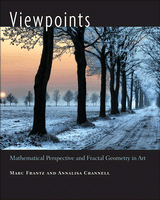 Marc Frantz & Annalisa Crannell Marc Frantz & Annalisa CrannellThis is a textbook intended for undergraduated mathematics courses with orientation to fine arts majors. The mathematical content revolves around two subjects: perspective projection and fractal geometry. The brick-and-mortar topics include 2d and 3d coordinates (Ch 1), similarity (Ch 2), central and inscribed angles (Ch 5), existence of orthocenter (Ch 6), self-similarity (Ch 8) and exponents and logarithms (Ch 9). On these, the authors build an edifice of perspective projection (Ch 1-7), with a spacious attic of fractal geometry (Ch 8-9). Perspective projection is covered gently and at a considerable length. One-, two-, and three-point perspective drawings are treated in separate chapters and extend to anamorphic art (Ch 7) and painting where a sphere replaces the picture plane (Ch 6). More ... | |
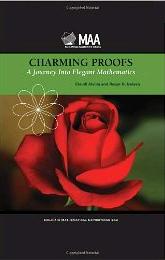 C. Alsina and R. B. Nelsen C. Alsina and R. B. NelsenThe aim of this book is to present a collection of remarkable proofs in elementary mathematics (numbers, geometry, inequalities, functions, origami, tilings, ...) that are exceptionally elegant, full of ingenuity, and succinct. By means of surprising argument or a powerful visual representation, we hope the charming proofs in our collection will invite readers to enjoy the beauty of mathematics, to share their discoveries with others, and to become involved in the process of creating new proofs. I can confidently confirm that the authors have achieved the stated goal admirably. They put together in access of 100 mostly elementary mathematics facts--quite curious in their own right--proved by elegant and often surprising arguments. More ... | |
 G. Szpiro G. SzpiroUntil about 20 years ago, the 1-2 math courses the Liberal Arts majors had to take as a requirement for graduation came traditionally from the Calculus sequence: Precalculus or Calculus I, at best. The dismal retention rate for Calculus topics led to a reevaluation of course offerings. Mathematics does not lack in more current and relevant topics that require minimum preparation and offer insight into the depth and beauty of the subject. Among these are the theories of Social Choice. Voting systems, the problem of seat apportionment in national assemblies, and power and ability to form coalitions among parties and popular representatives became a staple of Liberal Arts Mathematics. George Szpiro's recent book covers in depth the theories of voting and apportionment. Szpiro's volume is far from being a textbook that usually would include a greater variety of topics, come in sizes that exceed 700-800 pages and at a hefty price in a vicinity of $100, if not more. The book may of course be used as supplement in a Liberal Arts course. Both instructors and students will find it a rich source of information, with a sensibly exhaustive coverage of main topics. But completeness of coverage is not the strongest point of the book. The author skillfully placed the development and evolution of the Social Choice theories in a broad historical context. The book shines in weaving the emergent math theories with historical circumstances. More ... | |
 P. Lockhart P. LockhartThe best recommendation I can make for a book is to say that every one should own it and read it. Paul Lockhart's A Mathematician's Lament is one such book that I unreservedly recommend to teachers, math educators, state and federal senators and congressmen, parents and even children. The author decries on the state of math education, focusing on school mathematics. His point of departure is the idea that mathematics is the purest form of art and should be taught as such. What he proposes is not another reform but a revamping of the whole of the educational system. Realizing that the system is part and parcel of the cultural atmosphere, he soberly laments the impossibility of achieving his goal. However, Paul's view is only partially utopian. A professional mathematician, he left a university professorship to devote himself to teaching K-12 level students. He taught at St.Ann's School in Brooklyn, NY since 2000. In the book he not only offers his passionate critique of the state of education but also shares his experience as a teacher and outlines his view of what teaching of mathematics should be. More ... | |
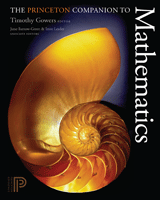 T. Gowers, J. Barrow-Green, I. Leader (eds) T. Gowers, J. Barrow-Green, I. Leader (eds)This is an unusual book targeting a broad audience ranging from (even young) fans curious about the present state of mathematics to the professional mathematicians seeking to have a glimpse at the areas of mathematics not directly related to their special interests. The book is unusual in many respects and, first of all, in its composition. It is not an encyclopedia, but rather like The World of Mathematics by James R. Newman is a huge collection of essays on various aspects of mathematics, its history, important concepts, evolution, including biographies of its movers and shakers and its relevance to and impact on other branches of sciences and human culture. Unlike Newman's book which is a collection of excerpts from mathematical literature, all articles in The Companion have been written specifically for that book. More ... | |
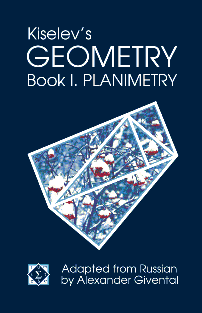 Adapted from Russian by Alexander Givental Adapted from Russian by Alexander Givental The book under review is an expanded translation of a unique phenomenon in the Russian mathematical literature. If nothing else, its staying power may serve an enticement to anyone interested in, or involved with, high school geometry. First published in 1892 by A. P. Kiselev as Elementary Geometry, by 1940 it underwent more than 40 revisions and eventually became a measuring rod for geometry education in Russia against which all other textbooks had to be judged. Its introduction to the English speaking student and teacher is more than welcome. The effort by Professor A. Givental who translated the book from Russian and combined pieces of the many editions of the original deserves a wholehearted recognition and sincere praise. The early history of the book is murky. In the Tsarist Russia Kiselev's Geometry competed successfully against other textbooks. Its 23 | |
 Adapted from Russian by Alexander Givental Adapted from Russian by Alexander Givental The Stereometry book adapted from Russian by A. Givental is the second part of the legendary Kiselev's Geometry. It first appeared in 1892 as a second half of a single textbook and, for a long time, the two co-existed between the same covers. Indeed, the idea of a plane was introduced on page 1 while the last chapter of the book (that followed the stereometry part) was devoted to the geometric constructions in two dimensions. Kiselev's Geometry has demonstrated an unusual staying power, being in an uninterrupted circulation for a good part of a century. (For the historic outline, see the review of the first part.) As a matter of fact, the first part of the book met with stiffer competition so that, while its rule was weakened in the 1960s, the second part reigned in the textbook market well into the 1970s. The combined 1980 edition came out under the title Elementary Geometry for teacher colleges with a Forward by A. N. Tikhonov who observed, albeit with some reservations, that the pedagogical mastery with which the book was written, the simplicity and consistency of the exposition, kept the book from becoming obsolete. More ... | |
 Ron Aharoni Ron AharoniThe book is an outcome of a rare experiment: an university math professor (a high caliber professor at that from one of the best universities in the world) who has responded to a challenge to teach in elementary school shares the acquired insights about teaching young children and their mathematics. The book is a very enjoyable read, the advice proffered is sound, the pedagogy is illustrated by numerous examples. I highly recommend the book to the grown ups concerned with young children education. (The subtitle A Book for Grownups about Children's Mathematics reflects better than the title Arithmetic for Parents on the intended audience.) The book includes Foreward, Introduction, three Parts (Elements, Principles of Teaching, Aritmetic from First to Sixth Grades) and an Appendix. In the Foreward, the author explains the structure of the book ... More ... | |
 Jerry Slocum and Dic Sonneveld Jerry Slocum and Dic Sonneveld The book adds intrigue to the humanistic background of Sam Loyd's puzzle: as the authors have found, Sam Loyd has not invented the puzzle, but managed to fool the contemporaries and following generations into believing otherwise. It took five quarters of a century for the truth to be revealed. By painstakingly wading through thousands of newspapers found in dozens of locations throughout the United States and Europe, the authors uncovered the true origins of the puzzle and its winding itinerary to the market and into the history. The book itself is of the gift quality, well written and exquisitely illustrated. The text is authenticated with photographs and newspaper clips. Interspersed among bits and pieces related to the puzzle, many illustrations build up the historic background and help recreate and sense the cultural atmosphere of the last two decades of the 19th century. More ... | |
 Chris K. Caldwell, G. L. Honaker Jr. Chris K. Caldwell, G. L. Honaker Jr.This is a dictionary of prime number trivia, an eclectic collage of miscellaneous facts. A few of these tidbits have deep mathematical significance, but many are simple observations which require no mathematics. For example, in what year did England make it illegal to jail a jury for returning the "wrong" decision? What was Jenny's phone number in Tommy Tutone's hit song? What is the highest number of votes a candidate received for the U.S. Presidency while incarcerated? The answers are all prime, and in this book. Other results are quasi-mathematical, such as those having to do with the shape or representation of a number. Consider the prime 18181: This number is the same forwards, backwards, and even upside down--do you know how many of these primes there are? Can a prime be small and even, and at the same time, large and odd? More ... | |
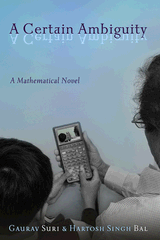 G. Suri and H. Singh Bal G. Suri and H. Singh Bal A mathematical novel! Is this a new genre? Is there any justification for such a subtitle? Well, this is a novel and a novel with a captivating plot at that. Then it is also a book about mathematics, about its philosophy, its beauty and about its relevance to the human understanding of the surrounding world. There is not a page where mathematics or mathematicians are not mentioned. Mathematics is woven inextricably into the story line itself and I would say that the plot evolves with the mathematical precision. The story begins with a nostalgic flashback experienced by the main character, Ravi Kapoor, to the time his mathematician grandfather gave him a math problem to try on a calculator. The manner in which the problem was given suggests gentleness in the grandfather's relationship with his grandson and appreciation of the magical effect a solution might have on the boy. The grandfather died the next day, but the reader is left with the realization of the importance the memory of the grandfather played in Ravi's life. It is noteworthy that in the absence of the grandfather's wise guidance the boy grows indifferent to mathematics. More ... | |
 Arturo Sangalli Arturo SangalliA mathematical mystery Pythagoras - a mystic, a philosopher, a brilliant mathematician, a secretive, religious leader - who lived 2500 years ago left no written work and still his name is remembered today as it is sure to be remembered yet for many generations to come. Who did not hear of the Pythagorean theorem, a theorem that fascinated young children, mature mathematicians and grown-ups from all walks of life, the US presidents included? A theorem that gathered more proofs that any other known to the mankind. Such a man left no written works, or so we learn from history books. But what if? What if a man like that were to write a book? What mystery, what message to the future generations would it contain? Just try to don Pythagoras' hat and put on his shoes, or rather sandals. This probably what the author Arturo Sangalli did when devising a plot that spans 2500 years of history. A math Ph.D. and a freelance science author, Sangalli weaves a story in which mathematics places an integral part. More ... | |
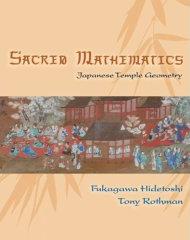 Fukagawa Hidetoshi and Tony Rothman Fukagawa Hidetoshi and Tony RothmanA result of an unusual collaboration of two authors who never met, this is a glamorous book which will be treasured by all mathematics fans and especially by lovers of geometry. The period that began in the early seventeenth century and lasted a little past the mid-nineteenth holds fascination for any student of Japanese history. During this period of roughly 200 years the country was almost entirely closed to foreign influence; travel to and from the West was banned and considered a capital offence. Trade with the West was channeled through the man-made miniature island of Deshima in Nagasaki harbor. (However, trade with China and Korea was not so obstructed.) Deshima was surrounded by a wall and joined to the mainland by a guarded bridge. More ... | |
 Joseph Mazur Joseph MazurThe book which I enjoyed reading left me with a mixed feeling. For, it reminded me of a homeschooling mother who assigned her children to learn by heart a list of words that they should not be using. The author powerfully and passionately forwards the thesis of utter unreasonableness of the expectations to win and the sense of control over one's fortunes and fate commonly proclaimed by individual gamblers. The author is quite unequivocal and outspoken about gambling being obsessive and destructive. And yet the reader gets so much information about the gambling and specifics of the games that it undoubtedly might compete with other volumes exclusively devoted to presenting particular games. |  B. S. Everitt & A. Skrondal B. S. Everitt & A. SkrondalI am glad to have this handy reference on my bookshelves. The fourth edition has been revised and expanded; in its present state the book is a reasonably complete collection of definitions, with a good deal of illustrations, examples, formulas and equations where necessary. Also included are short biographies of mathematicians and statisticians who made an impact on the development of theory of probability and statistics. The book also contains descriptions of pertinent software packages. Almost all entries have source references to follow up if so desired. |
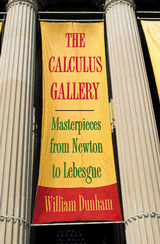 William Dunham William DunhamHave you ever tried to plough through the early Calculus texts, say, those of the founding fathers, I. Newton and G. W. Leibniz? Truly, this undertaking is not for a light hearted. Derek Whiteside, editor of Newton's mathematical papers, aptly characterized a proof that the area under the graph of Come The Calculus Gallery: Masterpieces from Newton to Lebesgue by William Dunham, the master storyteller. More ... |
 Ross Honsberger (editor) Ross Honsberger (editor)Mathematical Plums is the fourth book in the Dolciani Mathematical Expositions series. The first three have been authored by Ross Honsberger; for this one, he served as an editor. The book consists of 10 chapters by various authors. The chapters are absolutely independent; some have been probably plucked by Honsberger from periodical publications, some may have been written specifically for the book. I can't say. Except for the Chapters 3, 8, and 10 by R. P. Boas that at least partly came from the MAA magazines, and Chapter 9 that grew out of the notes Honsberger took at a lecture given by A. W. Tucker, I am not aware of other sources. More ... |
 David Ruelle David RuelleA philosopher would like to see how the human mind, or we may say the mathematician's mind, comes to grips with mathematical reality. My ambition is to present here a view of mathematics and mathematicians that will interest those without training in mathematics, as well as the many who are mathematically literate. The author achieves the set goal admirably providing a very enjoyable read along the way. At the outset, I was misled by the title into expecting an attempt to explain how a mathematician's mind works. And, in a sense, the reader does get a glimpse into the working of a mathematician's mind, albeit indirectly. As the author - a notable mathematical physicist, an expert in non-linear dynamics (chaos and turbulence) - wrote in the first chapter... More ... |
 K. Bezdek K. BezdekDiscrete and Combinatorial Geometry are two (often interchangeable) designations of a branch of mathematics that deals with finite combinations of geometric objects. If there is any distinction, the appellation "discrete" is associated more with the subject of optimal combinatorics than with the combinatorial questions per se. I still own a small 1965 paperback Theorems and Problems of Combinatorial Geometry by V. G. Boltyanski and I. Z. Gohberg that I was fascinated with in high school. Most of the problems admitted simple formulations, with a minimum of mathematical jargon, and were of engagingly visual character. The simplicity of the formulations was rather deceptive. Even though the book was intended for high school students, it ended up with a list of unsolved problems. More ... |
 H. M. Enzensberger H. M. Enzensberger Hans Magnus Enzensberger is a well known German poet and essayist, author of The Number Devil which is, in my view, one of the best mathematics books ever written for children. His small book Drawbridge Up: Mathematics - a Cultural Anathema is based on the invited talk he gave at the 1998 International Congress of Mathematicians in Berlin. In the book, he laments the current state of education whose ills he sees as a cultural phenomenon. Instead of focusing, as quite common, on specific math topics or educational technology, he deplores the culture tolerant of the proud display of innumeracy. Enzensberger's ideas are very close to what I wrote years ago in my Manifesto. The author offer no quick fixes but sees the need in overhaul of the educational framework that confines a teacher to operate at the end of a bureaucratic tether. On the whole, it is a beautifully written essay that should be read and pondered over by all math educators. |
 L. Hathout L. HathoutCrimes and Mathdemeanors is a collection of 14 math problems framed into entertaining yarns featuring a teenage math prodigy Ravi. Each comes that a complete and well explained solution. In every story Ravi manages to reduce a complicated crime to a math problem. Each chapter consists of a story, followed by analysis and motivation for the solution, solution and occasionally extension where the author looks into possible generalizations. Remarkably the author himself is a high school student from California who began participating in math competitions from the age of 9. He won numerous awards in the national competitions and achieved a perfect score at the California Math League exam. The problems are entertaining, explanations clear, and the book is a pleasure to read. The book should inspire a high school student bored with classroom word problems. It is a valuable resource for high school teachers as well. |
 T. Andreescu and D. Andrica T. Andreescu and D. Andrica The book reaches to about the same audience of (I quote from the back cover) "undergraduates, high school students and their teachers, mathematical contestants ... and their coaches, as well as anyone interested in essential mathematics," as some other books on the market, notably L.-s. Hahn's Complex Numbers & Geometry from the MAA, with which it has a nonempty overlap, naturally. ... The book is a real treasure trove of nontrivial elementary key concepts and applications of complex numbers developed in a systematic manner with a focus on problem solving techniques. Much of the book goes to geometric applications, of course, but there are also sections on polynomial equations, trigonometry, combinatorics ... More ... |
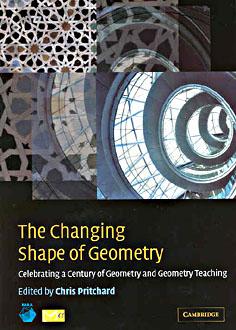 C. Pritchard C. Pritchard The book is an expanded collection of 57 articles published in Mathematical Gazette and Mathematics in School — two journals of The Mathematical Association, a British organization for teachers of mathematics — over about one hundred years. The Mathematical Association is the name taken by the Association for the Improvement of Geometrical Teaching in 1897. The latter was created in 1871. At the time, school and university geometry curricula were entirely based on Euclid's Elements and geometry was universally "viewed as the ideal vehicle for developing an understanding of formal proof". More ... |
 Paul. J. Nahin Paul. J. Nahin The book is a collection of 21 essays, each built around one or two probability problems. The author plays with the problems: solving them, modifying them, simulating them on a computer. Indeed simulations constitute a considerable part of the book. (MATLAB scripts take up 65 out of 270 pages, with additional 22 pages devoted to the history and theory of random number generators.) All discussed problems come with solutions - some with solutions at the text proper, some at the end of the book. Most of the essays follow a definite plan: a problem, its solution, a modification, its solution. More ... |
 Paul. J. Nahin Paul. J. Nahin This is a wonderful book - a sequel to Nahin's earlier An Imaginary Tale: the Story of √-1. This one is more advanced. And the author clearly sets up requirements: "... two years of calculus, a first course in differential equations, and perhaps some preliminary acquittance with matrix algebra and elementary probability. Third year math majors would certainly haev the required background." I would low the bar if a little. An intelligent second year student will enjoy the book, even if it takes a little more effort. Doubt not: the extra effort will pay off. The scope of the book is astonishing. True, the starting point is indeed the formula |
More Reviews
T. Apostol, A Century of Calculus.
There are many conversations, committee meetings, etc., today about the modernization of the undergraduate calculus course; but all too often the attack on the problem falls short of being comprehensive. So begins a 1958 article Bringing Calculus Up-to-date (AMM, 65 (1958), pp. 81-90) by M. E. Munroe. Too young at the time to be interested in Calculus, I first ran into the article while browsing the first volume of the collection A Century of Calculus. It's a remarkable two-volume set -- a small library in fact. A library of 310 papers selected from the American Mathematical Monthly, Mathematics Magazine and College Mathematics Journal. More ...
J.-P. Allouche & J. Shallit, Automatic Sequences: Theory, Applications, Generalizations.
The book combines concepts and results from mathematics and computer science related to the generation of sequences by simple computational model called the finite automaton. More ...
S. Benson, Ways To Think About Mathematics.
The book is intended for teachers of mathematics in professional development and preservice settings. This is one part of a triptych that also includes the Facilitator's Guide and the Further Explorations CD-ROM. In the absence of the latter two pieces, the review relates only to the one book at hand. More ...
J. E. Goodman, J. O'Rourke, Handbook of Discrete and Computational Geometry.
This laptop of a handbook is a tremendous collection of 65 articles on discrete and computational geometry. The second edition, at 1539 pages, is more than 500 pages longer than the first. The organization of the book is superb. Each article/chapter begins with an introduction and ends with lists of recommended surveys and related chapters, as well as comprehensive references. In addition, each chapter contains one or more glossaries. More ...
M. G. Kendall, A Course in the Geometry of n Dimensions.
The title of the book, A Course in the Geometry of n Dimensions, is a misnomer on two accounts. First, the book is too small -- 63 pages in all -- for even a 1-semester course. Second, the book is not about geometry per se. A longer title, say, Basic Elements of the Geometry of n-Space and Their Application to the Advanced Theoretical Statistics: An Intuitive Approach, would better relate the contents of the book to a potential reader. But that, of course, would be too long a title for such a small book. More ...
S. B. Maurer and A. Ralston, Discrete Algorithmic Mathematics.
To paraphrase the memorable speech given by Bilbo Baggins on the occasion of his eleventy-first birthday, I liked less than half of the book half as well as it deserves. Let me explain. More ...
G. M. Phillips, Mathematics Is Not a Spectator Sport.
In the Preface to the book the author wrote
... there is nothing in the world of mathematics that corresponds to an audience in a concert hall, where the passive listen to the active. Happily, mathematicians are all doers, not spectators. Doing is much more fun than merely watching or listening, and I celebrate this in the title of the book.
Unfortunately, the celebration does not seem to propagate into the body of the book leaving the title quite detached from the contents and the manner in which the book has been written. More ...

|Contact| |Front page| |Contents|
Copyright © 1996-2018 Alexander Bogomolny
74633231