
Heron's Problem: What is it?
A Mathematical Droodle

|Activities| |Contact| |Front page| |Contents| |Geometry| |Eye opener|
Copyright © 1996-2018 Alexander BogomolnyHeron's Problem
This one is a basic optimization problem. It's quite famous, being discussed in Heron's Catoptrica (On Mirrors from the Greek word Katoptron Catoptron = Mirror) that, in all likelihood, saw the light of day some 2000 years ago.
Two points A and B are given on the same side of a line l. Find a point M on l such that the sum of distances from A and B to M is minimal.
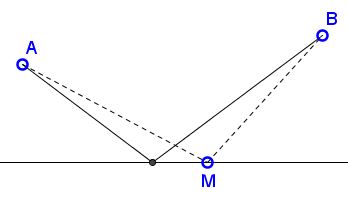

Think of l as a mirror. Heron posed that the shortest distance between A and B via l is exactly the path traversed by a ray of light emitted from A and observed at B. From here he deduced that when light is reflected in a mirror the angle of incidence fi is equal to the angle of reflection fr, where the angles at hand are formed by AM and MB with the perpendicular to l at M.
Why so?
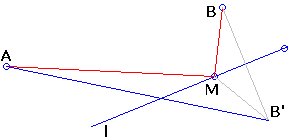
Let B' be the symmetric image of B in l, such that BB' is perpendicular to l and is divided by the latter in halves.
AM + MB' ≥ AB'.
with the equality reached only when M lies on AB', in which case clearly the two angles coincide.
Heron's problem has applications to curved surfaces, ellipse for one.
Note: the problem has been known in Japan. It appeared on a now lost sangaku tablet from 1830 written in the Yamagata prefecture [Fukagawa and Pedoe, problem 4.1.1]. The Japanese variant underscored the computational aspects of the solution:
P is a variable point in the given segment AB, and C is a fixed point on the perpendicular AC to the line AB, and D is fixed, on the same side of AB as C, and lies on the perpendicular BD to AB.
It is not difficult to surmise the solution from the diagram
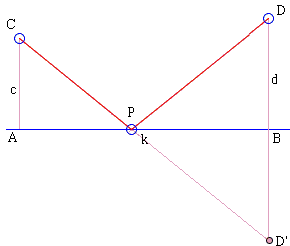
When P satisfies the minimality requirement, triangles APC and BPD' are similar from which
AP / AC = BP /BD = (AP + BP) / (AC + BD),
or,
p / c = k / (c + d),
so that
p = kc / (c + d).
References
H. Fukagawa, D. Pedoe, Japanese Temple Geometry Problems, The Charles Babbage Research Center, Winnipeg, 1989
Write to:
Charles Babbage Research Center
P.O. Box 272, St. Norbert Postal Station
Winnipeg, MB
Canada R3V 1L6- P. J. Nahin, When Least Is Best, Princeton University Press, 2007 (Fifth printing).
- V. M. Tikhomirov, Stories about Maximua and Minima, AMS & MAA, 1990
- D. Wells, The Penguin Book of Curious and Interesting Geometry, Penguin, 1991
- I. M. Yaglom, Geometric Transformations I, MAA, 1962
Sangaku
- Sangaku: Reflections on the Phenomenon
- Critique of My View and a Response
- 1 + 27 = 12 + 16 Sangaku
- 3-4-5 Triangle by a Kid
- 7 = 2 + 5 Sangaku
- A 49th Degree Challenge
- A Geometric Mean Sangaku
- A Hard but Important Sangaku
- A Restored Sangaku Problem
- A Sangaku: Two Unrelated Circles
- A Sangaku by a Teen
- A Sangaku Follow-Up on an Archimedes' Lemma
- A Sangaku with an Egyptian Attachment
- A Sangaku with Many Circles and Some
- A Sushi Morsel
- An Old Japanese Theorem
- Archimedes Twins in the Edo Period
- Arithmetic Mean Sangaku
- Bottema Shatters Japan's Seclusion
- Chain of Circles on a Chord
- Circles and Semicircles in Rectangle
- Circles in a Circular Segment
- Circles Lined on the Legs of a Right Triangle
- Equal Incircles Theorem
- Equilateral Triangle, Straight Line and Tangent Circles
- Equilateral Triangles and Incircles in a Square
- Five Incircles in a Square
- Four Hinged Squares
- Four Incircles in Equilateral Triangle
- Gion Shrine Problem
- Harmonic Mean Sangaku
- Heron's Problem
- In the Wasan Spirit
- Incenters in Cyclic Quadrilateral
- Japanese Art and Mathematics
- Malfatti's Problem
- Maximal Properties of the Pythagorean Relation
- Neuberg Sangaku
- Out of Pentagon Sangaku
- Peacock Tail Sangaku
- Pentagon Proportions Sangaku
- Proportions in Square
- Pythagoras and Vecten Break Japan's Isolation
- Radius of a Circle by Paper Folding
- Review of Sacred Mathematics
- Sangaku à la V. Thebault
- Sangaku and The Egyptian Triangle
- Sangaku in a Square
- Sangaku Iterations, Is it Wasan?
- Sangaku with 8 Circles
- Sangaku with Angle between a Tangent and a Chord
- Sangaku with Quadratic Optimization
- Sangaku with Three Mixtilinear Circles
- Sangaku with Versines
- Sangakus with a Mixtilinear Circle
- Sequences of Touching Circles
- Square and Circle in a Gothic Cupola
- Steiner's Sangaku
- Tangent Circles and an Isosceles Triangle
- The Squinting Eyes Theorem
- Three Incircles In a Right Triangle
- Three Squares and Two Ellipses
- Three Tangent Circles Sangaku
- Triangles, Squares and Areas from Temple Geometry
- Two Arbelos, Two Chains
- Two Circles in an Angle
- Two Sangaku with Equal Incircles
- Another Sangaku in Square
- Sangaku via Peru
- FJG Capitan's Sangaku
|Activities| |Contact| |Front page| |Contents| |Geometry| |Eye opener|
Copyright © 1996-2018 Alexander Bogomolny74313773