
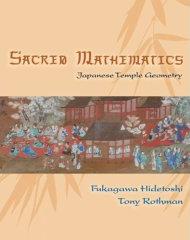
Sacred Mathematics
|
|

A result of an unusual collaboration of two authors who never met, this is a glamorous book which will be treasured by all mathematics fans and especially by lovers of geometry.
The period that began in the early seventeenth century and lasted a little past the mid-nineteenth holds fascination for any student of Japanese history. During this period of roughly 200 years the country was almost entirely closed to foreign influence; travel to and from the West was banned and considered a capital offence. Trade with the West was channeled through the man-made miniature island of Deshima in Nagasaki harbor. (However, trade with China and Korea was not so obstructed.) Deshima was surrounded by a wall and joined to the mainland by a guarded bridge.
This period of seclusion - sakoku in Japanese - is also known as the "Great Peace". In the absence of warfare, samurai sought administrative jobs and gentlemen were supposed to cultivate skills in "medicine, poetry, the tea ceremony, music, ... arithmetic and calculation, ... reading and writing ..." Travel - mostly on foot - became secure and popular; many poets and mathematicians traveled throughout the country sight seeing, visiting temples and friends, and sharing their art and knowledge.
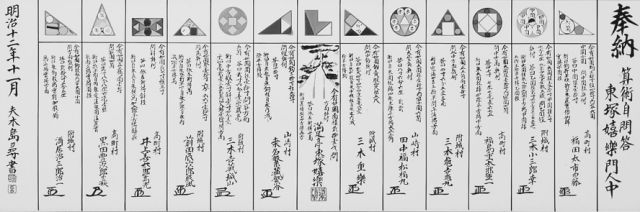
During that time, a strange custom arose of hanging wooden tablets with mathematical problems under the roofs of shrines and temples. These tablets are known in Japanese as sangaku, and we may only guess at their exact purpose. Some were probably a challenge to others, while some may have been offered to gods in gratitude for an inspiring problem. This explains both parts of the title Sacred Mathematics and Japanese Temple Geometry.
|
The book presents much more than a gorgeous narrative of sangaku problems. The authors paint an extensive historic background of Japanese Art and Mathematics, which begins with the influence of Chinese mathematics and the introduction of abacus to the islands. The narrative is enhanced with biographies of many contemporary mathematicians and an outline of their work, and includes a chapter of extracts from the travel diary of the 19th century mathematician Yamaguchi Kanzan. Solutions are provided for most of the problems in the book, both simple and complex, and an additional chapter carries a comparison with similar problems published in the West.
One other collection of sangaku is available in the English speaking world. This was published by Dan Pedoe and H. Fukagawa some 20 years ago and has long since become a bibliographic rarity. It may be found on the Web for close to $100. The present volume not only transcends the former in quality and breadth of material, but brings out a peculiar Japanese cultural phenomenon to a much broader audience at an affordable price of $35 ($23.45 with a discount.) The book will be of value to teachers of geometry and history of mathematics; fans of mathematics will find it especially enjoyable.
Sakoku was a remarkable period in the history of Japan, but no less remarkable was the manner in which it ended and the repercussions its end had on the development of Japanese society in general and on mathematics in Japan in particular. On July 8, 1853 an armada of four steamships commanded by Commodore Matthew Perry anchored at Edo (Tokyo) Bay. The impression left by the ships' great guns and novel Western technologies was of mystical proportions. Nearly one year later, in March 1854, when Perry returned at the head of seven steamships, a peace treaty was signed between the US and Japan that effectively opened Japan to Western trade and international cooperation. Similar treaties were soon signed with other Western countries, and Japan entered a period of modernization. The practice of hanging sangaku tapered out, as Western science and mathematics supplanted the Japanese tradition.
The effect was drastic. At the end of the ICME-9 that took place in Makuhari near Tokyo in the year 2000, the participants toured the temples and shrines in the Kyoto area, but the guides never found it necessary to draw our attention to any sangaku or traditional Japanese mathematics. In the Preface, Dr. Fukagawa Hidetoshi, a high school math teacher, describes his first encounter with sangaku in 1969 when a teacher of traditional Japanese literature asked him to decipher an 1815 book printed from wooden blocks. This suggests that in the 20th century wasan - the traditional Japanese mathematics, which flourished during the Edo period - was all but forgotten.
Fukagawa Hidetoshi, one of the authors of the book, is chiefly responsible for the revival of the interest in wasan. And this, in particular, explains the great enthusiasm with which the book was created. The outcome is a wonderful, lavishly illustrated, exquisite work of art and mathematics, a worthy tribute to the charming beauty and peculiar ingenuity of the mathematical tablets.
My one reservation about the book is a mental block of sorts. At one point, the authors' enthusiasm for the sangaku phenomenon carried them away towards an unjustified and implausible claim. Even allowing for a significant dose of literary license the authors' estimate of sangaku's popularity seems exaggerated. We read (p. 1):
| The creators of these sangaku - a word that literally means "mathematical tablet" - hung them by the thousands in Buddhist temples and Shinto shrines throughout Japan ... |
and later (pp. 9-10):
| ... the inscriptions on the tablets make clear that whole classes of students, children, and occasionally women dedicated sangaku. So the best answer to the question "Who created them?" seems to be "everybody." |
Realistically, this is impossible. The number of surviving tablets is about 900, and according to the 1721 census, the population of Japan was approximately 30 million, including 4 million samurai families and their attendants. The population of Edo (the future Tokyo) was approximately 1 million, and that of Kyoto 400,000. Now, this historic period lasted for roughly 200 years. Do the arithmetic. The authors themselves write in one place:
| So it is reasonable to guess that there were originally thousands more than the 900 tablets extant today. |
If by "thousands" the authors mean "a few thousands", this is an estimate I am willing to accept.
Sacred Mathematics - Japanese Temple Geometry, Fukagawa Hidetoshi, Tony Rothman, Princeton University Press, 2008
Sangaku
- Sangaku: Reflections on the Phenomenon
- Critique of My View and a Response
- 1 + 27 = 12 + 16 Sangaku
- 3-4-5 Triangle by a Kid
- 7 = 2 + 5 Sangaku
- A 49th Degree Challenge
- A Geometric Mean Sangaku
- A Hard but Important Sangaku
- A Restored Sangaku Problem
- A Sangaku: Two Unrelated Circles
- A Sangaku by a Teen
- A Sangaku Follow-Up on an Archimedes' Lemma
- A Sangaku with an Egyptian Attachment
- A Sangaku with Many Circles and Some
- A Sushi Morsel
- An Old Japanese Theorem
- Archimedes Twins in the Edo Period
- Arithmetic Mean Sangaku
- Bottema Shatters Japan's Seclusion
- Chain of Circles on a Chord
- Circles and Semicircles in Rectangle
- Circles in a Circular Segment
- Circles Lined on the Legs of a Right Triangle
- Equal Incircles Theorem
- Equilateral Triangle, Straight Line and Tangent Circles
- Equilateral Triangles and Incircles in a Square
- Five Incircles in a Square
- Four Hinged Squares
- Four Incircles in Equilateral Triangle
- Gion Shrine Problem
- Harmonic Mean Sangaku
- Heron's Problem
- In the Wasan Spirit
- Incenters in Cyclic Quadrilateral
- Japanese Art and Mathematics
- Malfatti's Problem
- Maximal Properties of the Pythagorean Relation
- Neuberg Sangaku
- Out of Pentagon Sangaku
- Peacock Tail Sangaku
- Pentagon Proportions Sangaku
- Proportions in Square
- Pythagoras and Vecten Break Japan's Isolation
- Radius of a Circle by Paper Folding
- Review of Sacred Mathematics
- Sangaku à la V. Thebault
- Sangaku and The Egyptian Triangle
- Sangaku in a Square
- Sangaku Iterations, Is it Wasan?
- Sangaku with 8 Circles
- Sangaku with Angle between a Tangent and a Chord
- Sangaku with Quadratic Optimization
- Sangaku with Three Mixtilinear Circles
- Sangaku with Versines
- Sangakus with a Mixtilinear Circle
- Sequences of Touching Circles
- Square and Circle in a Gothic Cupola
- Steiner's Sangaku
- Tangent Circles and an Isosceles Triangle
- The Squinting Eyes Theorem
- Three Incircles In a Right Triangle
- Three Squares and Two Ellipses
- Three Tangent Circles Sangaku
- Triangles, Squares and Areas from Temple Geometry
- Two Arbelos, Two Chains
- Two Circles in an Angle
- Two Sangaku with Equal Incircles
- Another Sangaku in Square
- Sangaku via Peru
- FJG Capitan's Sangaku
|Up| |Contact| |Front page| |Contents| |Store|
Copyright © 1996-2018 Alexander Bogomolny74430958