
Equal Incircles Theorem
What Is It About?
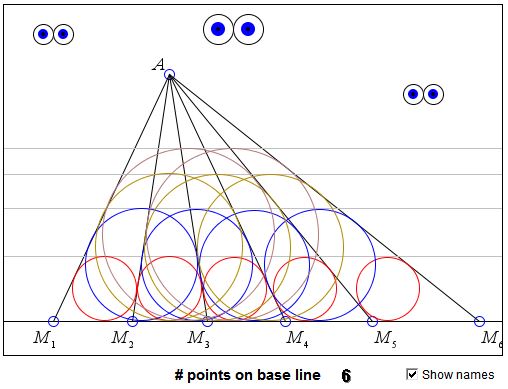
A Mathematical Droodle
| What if applet does not run? |
(The number of points on the base line which is originally 4 can be changed by clicking on it a little off its center line.)

|Activities| |Contact| |Front page| |Contents| |Geometry| |Eye opener|
Copyright © 1996-2018 Alexander Bogomolny
Equal Incircles Theorem
The applet suggests the following theorem [Wells, p. 67] from triangle geometry:
Let A be a point. Assume points Mi, i = 1, 2, ..., N (N > 3) lie on a line not through A. Assume further that the incircles of triangles M1AM2, M2AM3, ..., MN-1AMN all have equal radii. Then the same is true of triangles M1AM3, M2AM4, ..., MN-2AMN, and also of triangles M1AM4, M2AM5, ..., MN-3AMN, and so on.
I do not know of an elegant proof of that theorem. In [Wells, p. 67] it appears without a proof. There's no reference either.
The problem has been also discussed by R. Honsberger [Delights, section 17], where he mistakenly claims that the equality of the incircles only extends on the "triangles formed by sets of 2n consecutive triangles in the fan". The solution, nonetheless, works for a more general statement. Honsberger found this to be #2.2.5 in the Sangaku collection by H. Fukagawa and D. Pedoe. In fact problem #2.2.5 shows only two circles and the question is to find the length of the common tangent from the apex A in case the two circles are equal. In this form the problem appears on a surviving 1897 tablet from the Chiba prefecture. The answer to this problem can be found to be
AM2 = √s(s - a),
where a is the base and s is the semiperimeter of the triangle.
However, the theorem is a consequence (and also a generalization) of a theorem published in 1986 by H. Demir, which, as was shown by J. B. Tabov, admits if not a more elegant proof, then quite an elegant generalization:
Assume n > 4, and the inradii of the "first level" triangles are equal in pairs: the inradius of ΔMiAMi+1 is equal to that of ΔMi+2AMi+3, i = 1, 2, ..., n-3. Then the incircles of the "second level" triangles MiAMi+2 are all equal.
(There is another, simple proof of the general statement.)
References
- H. Fukagawa, D. Pedoe, Japanese Temple Geometry Problems, The Charles Babbage Research Center, Winnipeg, 1989
- R. Honsberger, Mathematical Delights, MAA, 2004
- D. Wells, Curious and Interesting Geometry, Penguin Books, 1991
Sangaku
- Sangaku: Reflections on the Phenomenon
- Critique of My View and a Response
- 1 + 27 = 12 + 16 Sangaku
- 3-4-5 Triangle by a Kid
- 7 = 2 + 5 Sangaku
- A 49th Degree Challenge
- A Geometric Mean Sangaku
- A Hard but Important Sangaku
- A Restored Sangaku Problem
- A Sangaku: Two Unrelated Circles
- A Sangaku by a Teen
- A Sangaku Follow-Up on an Archimedes' Lemma
- A Sangaku with an Egyptian Attachment
- A Sangaku with Many Circles and Some
- A Sushi Morsel
- An Old Japanese Theorem
- Archimedes Twins in the Edo Period
- Arithmetic Mean Sangaku
- Bottema Shatters Japan's Seclusion
- Chain of Circles on a Chord
- Circles and Semicircles in Rectangle
- Circles in a Circular Segment
- Circles Lined on the Legs of a Right Triangle
- Equal Incircles Theorem
- Equilateral Triangle, Straight Line and Tangent Circles
- Equilateral Triangles and Incircles in a Square
- Five Incircles in a Square
- Four Hinged Squares
- Four Incircles in Equilateral Triangle
- Gion Shrine Problem
- Harmonic Mean Sangaku
- Heron's Problem
- In the Wasan Spirit
- Incenters in Cyclic Quadrilateral
- Japanese Art and Mathematics
- Malfatti's Problem
- Maximal Properties of the Pythagorean Relation
- Neuberg Sangaku
- Out of Pentagon Sangaku
- Peacock Tail Sangaku
- Pentagon Proportions Sangaku
- Proportions in Square
- Pythagoras and Vecten Break Japan's Isolation
- Radius of a Circle by Paper Folding
- Review of Sacred Mathematics
- Sangaku à la V. Thebault
- Sangaku and The Egyptian Triangle
- Sangaku in a Square
- Sangaku Iterations, Is it Wasan?
- Sangaku with 8 Circles
- Sangaku with Angle between a Tangent and a Chord
- Sangaku with Quadratic Optimization
- Sangaku with Three Mixtilinear Circles
- Sangaku with Versines
- Sangakus with a Mixtilinear Circle
- Sequences of Touching Circles
- Square and Circle in a Gothic Cupola
- Steiner's Sangaku
- Tangent Circles and an Isosceles Triangle
- The Squinting Eyes Theorem
- Three Incircles In a Right Triangle
- Three Squares and Two Ellipses
- Three Tangent Circles Sangaku
- Triangles, Squares and Areas from Temple Geometry
- Two Arbelos, Two Chains
- Two Circles in an Angle
- Two Sangaku with Equal Incircles
- Another Sangaku in Square
- Sangaku via Peru
- FJG Capitan's Sangaku
|Activities| |Contact| |Front page| |Contents| |Geometry| |Eye opener|
Copyright © 1996-2018 Alexander Bogomolny
74432622