
Out of Pentagon Sangaku
Many sangaku problems include circle and ellipses, but quite a few do not. An elegant one [Fakagawa & Pedoe, p. 49] with a rather computational solution is presented below.
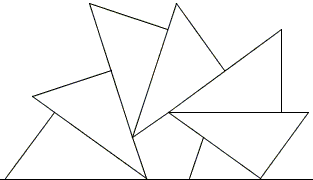
6 congruent right triangles fan out along the sides of a regular pentagon of side a. Find the length of the hypotenuse t of these triangles in terms of a.
This sangaku appears on a extant tablet in the Miyagai prefecture. Unless there is a misprint, [Fakagawa & Pedoe, p. 134] dates the tablet from 1912.
References
H. Fukagawa, D. Pedoe, Japanese Temple Geometry Problems, The Charles Babbage Research Center, Winnipeg, 1989
Write to:
Charles Babbage Research Center
P.O. Box 272, St. Norbert Postal Station
Winnipeg, MB
Canada R3V 1L6

|Contact| |Front page| |Contents| |Geometry|
Copyright © 1996-2018 Alexander Bogomolny
6 congruent right triangles fan out along the sides of a regular pentagon of side a. Find the length of the hypotenuse t of these triangles in terms of a.
Solution
We can imagine a couple of right triangles with sides computable from the Pythagorean theorem that combine into the altitude of one of the congruent triangles:
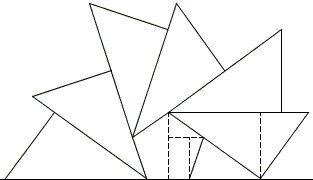
Given that the internal angle of a regular pentagon is 108°, one of the triangles has angles
The altitude in question equals
h = a·(sin(36°) + sin(72°)).
The fan forming triangles are also of the
t = h·(tan(36°) + tan(54°)).
Combining the two we get
t = a·(tan(36°) + tan(54°))·(sin(36°) + sin(72°)).
The solution t = a·(1 + √5) given by [Fakagawa & Pedoe] tells us that the expression for t, if correct, is amenable to a simplification effort.
Let's denote c = cos(36°) and s = sin(36°). By the Pythagorean theorem
| t | = a·(tan(36°) + tan(54°))·(sin(36°) + sin(72°)) |
| = a·(s/c + c/s)·(s + 2sc) | |
| = a·s/sc·(s2 + c2)·(1 + 2c) | |
| = a·(1 + 2c)/c |
This must be transformed further taking into account that
| t | = a·(1 + 2c)/c |
| = a·(1 + (1 + √5)/2) / (1 + √5)·4 | |
| = a·(3 + √5)) / (1 + √5)·2 | |
| = a·(3 + √5))·(-1 + √5) / 2 | |
| = a·(-3 + 5 - √5 + 3√5) / 2 | |
| = a·(2 + 2√5) / 2 | |
| = a·(1 + √5). |
Sangaku
- Sangaku: Reflections on the Phenomenon
- Critique of My View and a Response
- 1 + 27 = 12 + 16 Sangaku
- 3-4-5 Triangle by a Kid
- 7 = 2 + 5 Sangaku
- A 49th Degree Challenge
- A Geometric Mean Sangaku
- A Hard but Important Sangaku
- A Restored Sangaku Problem
- A Sangaku: Two Unrelated Circles
- A Sangaku by a Teen
- A Sangaku Follow-Up on an Archimedes' Lemma
- A Sangaku with an Egyptian Attachment
- A Sangaku with Many Circles and Some
- A Sushi Morsel
- An Old Japanese Theorem
- Archimedes Twins in the Edo Period
- Arithmetic Mean Sangaku
- Bottema Shatters Japan's Seclusion
- Chain of Circles on a Chord
- Circles and Semicircles in Rectangle
- Circles in a Circular Segment
- Circles Lined on the Legs of a Right Triangle
- Equal Incircles Theorem
- Equilateral Triangle, Straight Line and Tangent Circles
- Equilateral Triangles and Incircles in a Square
- Five Incircles in a Square
- Four Hinged Squares
- Four Incircles in Equilateral Triangle
- Gion Shrine Problem
- Harmonic Mean Sangaku
- Heron's Problem
- In the Wasan Spirit
- Incenters in Cyclic Quadrilateral
- Japanese Art and Mathematics
- Malfatti's Problem
- Maximal Properties of the Pythagorean Relation
- Neuberg Sangaku
- Out of Pentagon Sangaku
- Peacock Tail Sangaku
- Pentagon Proportions Sangaku
- Proportions in Square
- Pythagoras and Vecten Break Japan's Isolation
- Radius of a Circle by Paper Folding
- Review of Sacred Mathematics
- Sangaku à la V. Thebault
- Sangaku and The Egyptian Triangle
- Sangaku in a Square
- Sangaku Iterations, Is it Wasan?
- Sangaku with 8 Circles
- Sangaku with Angle between a Tangent and a Chord
- Sangaku with Quadratic Optimization
- Sangaku with Three Mixtilinear Circles
- Sangaku with Versines
- Sangakus with a Mixtilinear Circle
- Sequences of Touching Circles
- Square and Circle in a Gothic Cupola
- Steiner's Sangaku
- Tangent Circles and an Isosceles Triangle
- The Squinting Eyes Theorem
- Three Incircles In a Right Triangle
- Three Squares and Two Ellipses
- Three Tangent Circles Sangaku
- Triangles, Squares and Areas from Temple Geometry
- Two Arbelos, Two Chains
- Two Circles in an Angle
- Two Sangaku with Equal Incircles
- Another Sangaku in Square
- Sangaku via Peru
- FJG Capitan's Sangaku
|Contact| |Front page| |Contents| |Geometry|
Copyright © 1996-2018 Alexander Bogomolny
74313178