
Four Hinged Squares
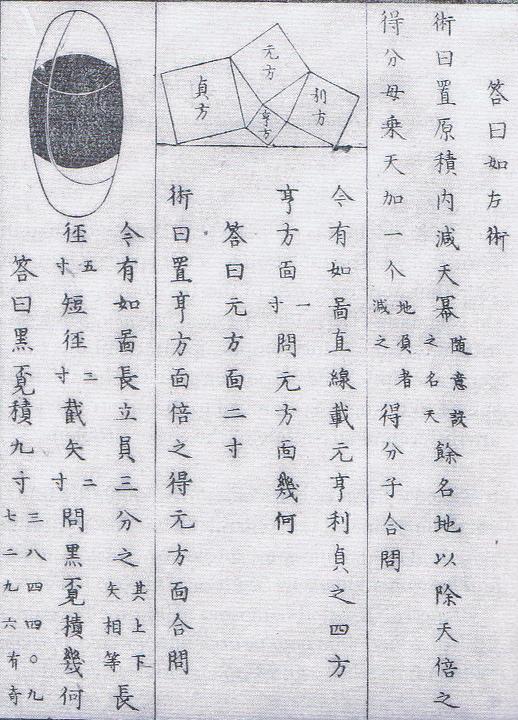
The purpose of the applet below is to illustrate an 1826 sangaku hung by Ikeda Sadakazu in an Azabu shrine, Tokyo. The tablet since disappeared but not before it was recorded in an 1827 book Shamei Sanpu (Sacred Mathematics) by Shiraishi Nagatada (1795-1862). The problem has also been included in an 1840 collection Sanpo Chokujutsu Seikai (Mathematics without Proof) by Heinouchi Masaomi.
Four squares are hinged as shown. When points A, B, C are collinear, what is the relationship between the sides of squares BEKH and KINS?
I first stumbled upon this simple problem in the Temple Geometry by Fukagawa and Pedoe, where it was listed without solution. My solution that employs Bottema's theorem appears on a separate page. Michel Cabart gave a solution that employed complex numbers. The newer book Sacred Geometry by Fukagawa and Rothman also lists the problem but now with the original solution from Sanpo Chokujutsu Seikai where it read:
Draw the three dashed squares; and contemplate the figure in detail; the result is trivial.
Fukagawa and Rothman give a solution nonetheless.
Shamei Sanpu in general contains by far more difficult problems. For example, the page where the four hinged squares is presented also includes a problem of determining the surface area of an ellipsoid:
References
H. Fukagawa, D. Pedoe, Japanese Temple Geometry Problems, The Charles Babbage Research Center, Winnipeg, 1989
Write to:
Charles Babbage Research Center
P.O. Box 272, St. Norbert Postal Station
Winnipeg, MB
Canada R3V 1L6- H. Fukagawa, A. Rothman, Sacred Geometry: Japanese Temple Geometry, Princeton University Press, 2008, p. 149

|Activities| |Contact| |Front page| |Contents| |Geometry| |Store|
Copyright © 1996-2018 Alexander Bogomolny

Square BEKH is inscribed in square UVTR so that
HV = KT
(and also EU = KR.) In the square circumscribing square CYIH,
HV = IQ
implying KT = IQ. Let M be the intersection of QT and IK. Then triangles KTM and IQM are congruent so that M is the midpoint of IK
We conclude that since KM = KL and angle LKM is right while angle RKT is straight, triangles LRK and KTM are congruent. In square UVTR, KR = HT. So it follows that triangles LRK and KTH are also congruent leading to
Δ KTH = Δ KTM
and KM = KH. Just what was needed.
Incidently, there is another sangaku with a similar configuration:
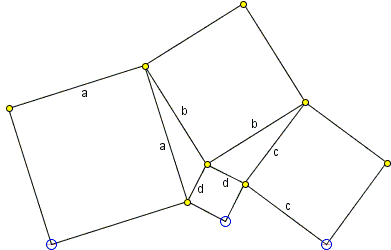
This has been written in 1832 also in the Tokyo prefecture and was recorded in Kokon Sankan by Uchida Gokan [Temple Geometry, p. 131]. The problem is to express d in terms of a, b, c. The solution is more conventional. Apply the Law of Cosines to triangles abd and bcd:
a² = b² + d² - 2bd·X
c² = b² + d² + 2bd·X,
where X is the cosine of the angle between b and d in triangle abd.
Adding the two gives:
2d² = a² + c² - 2b²,
from which d is found to be
d = √½(a² + c² - 2b²).
Sangaku
- Sangaku: Reflections on the Phenomenon
- Critique of My View and a Response
- 1 + 27 = 12 + 16 Sangaku
- 3-4-5 Triangle by a Kid
- 7 = 2 + 5 Sangaku
- A 49th Degree Challenge
- A Geometric Mean Sangaku
- A Hard but Important Sangaku
- A Restored Sangaku Problem
- A Sangaku: Two Unrelated Circles
- A Sangaku by a Teen
- A Sangaku Follow-Up on an Archimedes' Lemma
- A Sangaku with an Egyptian Attachment
- A Sangaku with Many Circles and Some
- A Sushi Morsel
- An Old Japanese Theorem
- Archimedes Twins in the Edo Period
- Arithmetic Mean Sangaku
- Bottema Shatters Japan's Seclusion
- Chain of Circles on a Chord
- Circles and Semicircles in Rectangle
- Circles in a Circular Segment
- Circles Lined on the Legs of a Right Triangle
- Equal Incircles Theorem
- Equilateral Triangle, Straight Line and Tangent Circles
- Equilateral Triangles and Incircles in a Square
- Five Incircles in a Square
- Four Hinged Squares
- Four Incircles in Equilateral Triangle
- Gion Shrine Problem
- Harmonic Mean Sangaku
- Heron's Problem
- In the Wasan Spirit
- Incenters in Cyclic Quadrilateral
- Japanese Art and Mathematics
- Malfatti's Problem
- Maximal Properties of the Pythagorean Relation
- Neuberg Sangaku
- Out of Pentagon Sangaku
- Peacock Tail Sangaku
- Pentagon Proportions Sangaku
- Proportions in Square
- Pythagoras and Vecten Break Japan's Isolation
- Radius of a Circle by Paper Folding
- Review of Sacred Mathematics
- Sangaku à la V. Thebault
- Sangaku and The Egyptian Triangle
- Sangaku in a Square
- Sangaku Iterations, Is it Wasan?
- Sangaku with 8 Circles
- Sangaku with Angle between a Tangent and a Chord
- Sangaku with Quadratic Optimization
- Sangaku with Three Mixtilinear Circles
- Sangaku with Versines
- Sangakus with a Mixtilinear Circle
- Sequences of Touching Circles
- Square and Circle in a Gothic Cupola
- Steiner's Sangaku
- Tangent Circles and an Isosceles Triangle
- The Squinting Eyes Theorem
- Three Incircles In a Right Triangle
- Three Squares and Two Ellipses
- Three Tangent Circles Sangaku
- Triangles, Squares and Areas from Temple Geometry
- Two Arbelos, Two Chains
- Two Circles in an Angle
- Two Sangaku with Equal Incircles
- Another Sangaku in Square
- Sangaku via Peru
- FJG Capitan's Sangaku
|Activities| |Contact| |Front page| |Contents| |Geometry| |Store|
Copyright © 1996-2018 Alexander Bogomolny
74343066