
The Law of Cosines (Cosine Rule)
The Law of Cosines (interchangeably known as the Cosine Rule or Cosine Law) is a generalization of the Pythagorean Theorem in that a formulation of the latter can be obtained from a formulation of the Law of Cosines as a particular case. However, all proofs of the former seem to implicitly depend on or explicitly consider the Pythagorean
Theorem. For example, to be comprehensive, i.e. to cover the case
Note
Julian Gilbey took an issue with the last sentence: On the Law of Cosines page, you say "I'll be extremely curious to learn of any proof of the Cosine Rule completely independent of the Pythagorean Theorem." The answer is that there cannot be such a thing: the Law of Cosines is only true in Euclidean Geometry, not in spherical or hyperbolic geometry, so must depend upon the metric of the plane. And the metric of the Euclidean plane is precisely
However, John Molokach came up with a proof that does not appear to use the Pythagorean theorem. How can one explain the paradox?
The Law of Cosines
For a triangle with sides a,b, and c and the angle µ opposite the side c, one has
c2 = a2 + b2 - 2ab·cos(µ)
Following is a proof of the Cosine Rule sent to me by Dr. Scott Brodie from the Mount Sinai School of Medicine, NY. In the beginning, when mentioning right triangles, Dr. Broddie refers to his proof of the Pythagorean Theorem.
Proof
If the original triangle is not right, one may still inquire as to the relationship between the lengths of the sides. To be specific, take as given a and b, the lengths of sides BC and AC, respectively, and consider the length, c, of side AB, as a function of µ, the magnitude of the angle at C. We will need the two additional forms of the "power of the point" theorem: If two such secant lines cut the same circle, the product of the distances along each to the near and far intersection points is the same for each secant; If two chords of a circle intersect in the interior of the circle, then the product of the distances from the intersection point to the circle in each direction along one chord is the same as the analogous product of the distances to the circle along the other chord.
There are three cases:

If the triangle is acute, construct the three altitudes, and, as before, the circles with diameters BC and AC. As before, the foot of the altitude from C to AB and the two circles coincide at a point, say P, which cuts AB into segments BP and PA of lengths x and y, respectively. If Q denotes the foot of the altitude from A, angle AQC is right, and Q lies on the circle with diameter AC. Inspection confirms that QC is of length bcos(µ). Similarly, let R denote the foot of the altitude from B; then R lies on circle BC, and RC is of length acos(µ). Then the Power Theorem for the case of two secants states, for the power of the point B with respect to circle AC, that a(a - bcos(µ)) = xc; for the power of the point A with respect to circle BC, we have b(b - acos(µ)) = yc. Adding the two equations yields immediately a2 + b2 - 2abcos(µ) = (x + y)c = c2, which is the Law of Cosines.
If the original triangle is obtuse, we have two further cases:
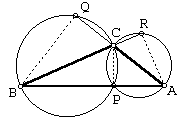
If angle C is obtuse, then the altitude from C cuts side AB say, at P, but the altitudes from A and B lie outside the triangle. The feet of these altitudes are found at the intersection of sides BC and AC, produced, with the circles with diameters AC and BC, respectively; call them Q and R. As before, let x and y denote the lengths of BP and PA. Since angle C is obtuse, cos(µ) is less than zero, and the lengths of RC and QC are and -acos(µ) and -bcos(µ), respectively. Then we have for the power of B with respect to circle AC a(a - bcos(µ)) = xc, and for the power of A with respect to circle BC b(b - acos(µ)) = yc. As before, adding the two equations yields the Law of Cosines.
Finally, if angle C is acute, but, say, angle B is obtuse, then the altitude from B cuts side AC, say at R, but the altitudes from A and C lie outside the triangle, and meet the sides CB and AB, produced, respectively, at, say Q and P. As before, Q and P lie on the circles with diameters AC and BC, respectively. Denote the distance BP by z. Since the length of RC is acos(µ), while the length of QC is bcos(µ), we have for the power of A with respect to circle BC b(b - acos(µ)) = (c + z)c, while, using the Power Theorem for an interior point, we have for the power of B with respect to circle AC a(bcos(µ) - a) = zc. In this case, subtracting the second equation from the first yields the Law of Cosines. QED.
Dr. Broddie also supplied a nice "dynamic" figure as a Geometer's Sketchpad file where moving vertex "C" nicely switches automatically between the various cases of the proof.
Other proofs can be found elsewhere. One proof without words is a direct generalization of Thâbit ibn Qurra's proof of the Pythagorean proposition. There is, as well, an "unfolded variant." Also, the Cosines Law admits a slightly different form discovered by Larry Hoehn that generalizes the Pythagorean theorem in a somewhat different way.

Trigonometry
- What Is Trigonometry?
- Addition and Subtraction Formulas for Sine and Cosine
- The Law of Cosines (Cosine Rule)
- Cosine of 36 degrees
- Tangent of 22.5o - Proof Wthout Words
- Sine and Cosine of 15 Degrees Angle
- Sine, Cosine, and Ptolemy's Theorem
- arctan(1) + arctan(2) + arctan(3) = π
- Trigonometry by Watching
- arctan(1/2) + arctan(1/3) = arctan(1)
- Morley's Miracle
- Napoleon's Theorem
- A Trigonometric Solution to a Difficult Sangaku Problem
- Trigonometric Form of Complex Numbers
- Derivatives of Sine and Cosine
- ΔABC is right iff sin²A + sin²B + sin²C = 2
- Advanced Identities
- Hunting Right Angles
- Point on Bisector in Right Angle
- Trigonometric Identities with Arctangents
- The Concurrency of the Altitudes in a Triangle - Trigonometric Proof
- Butterfly Trigonometry
- Binet's Formula with Cosines
- Another Face and Proof of a Trigonometric Identity
- cos/sin inequality
- On the Intersection of kx and |sin(x)|
- Cevians And Semicircles
- Double and Half Angle Formulas
- A Nice Trig Formula
- Another Golden Ratio in Semicircle
- Leo Giugiuc's Trigonometric Lemma
- Another Property of Points on Incircle
- Much from Little
- The Law of Cosines and the Law of Sines Are Equivalent
- Wonderful Trigonometry In Equilateral Triangle
- A Trigonometric Observation in Right Triangle
- A Quick Proof of cos(pi/7)cos(2.pi/7)cos(3.pi/7)=1/8
- The Law of Cosines (Cosine Rule)
- The Illustrated Law of Cosines
- The Law of Sines and Cosines
- The Law of Cosines: Plane Tessellation
- The Law of Cosines: after Thâbit ibn Qurra
- The Law of Cosines: Unfolded Version
- The Law of Cosines (Independent of the Pythagorean Theorem)
- The Cosine Law by Similarity
- The Law of Cosines by Larry Hoehn
- The Law of Cosines - Another PWW
- The Law of Cosines - Yet Another PWW
- Law of Cosines by Ancient Sliding
- The Cosine Law: PWW by S. Kung
|Contact| |Front page| |Contents| |Geometry| |Up|
Copyright © 1996-2018 Alexander Bogomolny74451311