
Golden Ratio in an Isosceles Trapezoid with a 60° Angle
Source
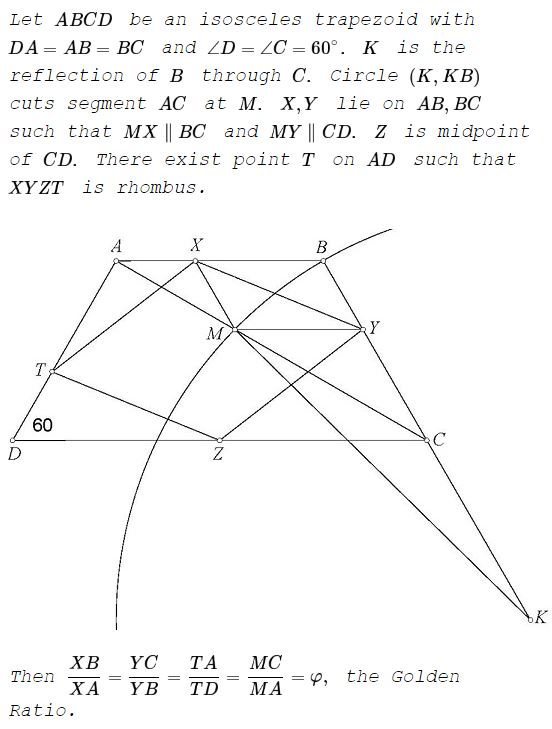
Proof 1
WLOG, assume $A=-1+i\sqrt{3},\;$ $B=1+i\sqrt{3},\;$ $C=-2,\;$ $D=4.\;$ THis gives $K=3-i\sqrt{3}.\;$ The circle $(K, BK\;$ is given by $(x-3)^2+(y+\sqrt{3})^2=16.\;$ But $AC\;$ is described by $x=2-y\sqrt{3}.\;$ Let's find their intersections. On $AC,\;$ the circle's equation reduces to $(1+y\sqrt{3})^2+(y+\sqrt{3})^2=16,\;$ leading to a quadratic equation: $y^2+y\sqrt{3}-3,\;$ with the only positive root $\displaystyle y_M=\sqrt{3}\frac{-1+\sqrt{5}}{2}=\frac{\sqrt{3}}{\varphi}.\;$
For now, we are not interested in $x\;$ values. Clearly, $\displaystyle y_Y=y_M=\frac{\sqrt{3}}{\varphi}.\;$ By Thales' theorem, $\displaystyle\frac{MC}{MA}=\frac{YC}{YA}=\varphi.\;$ Now, $\displaystyle X_M=2-\frac{3}{\varphi}=5-3\varphi.\;$ Since $BC\;$ is described by $x\sqrt{3}+y=2\sqrt{3},\;$ we find $x_Y=3-\varphi.$
Finally, as $XBYM\;$ is a parallelogram, $x_X=3-2\varphi.\;$ From here, $\displaystyle\frac{XB}{XA}=\varphi.\;$ But $Z=0,\;$ implying $\displaystyle y_T=\sqrt{3}\left(1-\frac{1}{\varphi}\right)=\frac{\sqrt{3}}{\varphi^2}.\;$ Thus $\displaystyle\frac{TA}{TB}=\varphi.$
Reformulation
As the matter of existence of point $T\;$ and the rhombus has been dealt with elsewhere, it is obvious that the only ratio that has to be verified is $\displaystyle\frac{MC}{MA}.\;$
The diagram and the statement could be simplified:
In $\Delta ABK,\;$ $AB=1,\;$ $BK=2,\;$ $\angle ABK=120^{\circ}.\;$ Let $C\;$ be the midpoint of $BK.\;$ $M\;$ a point on $AC\;$ such that $KM=2.$
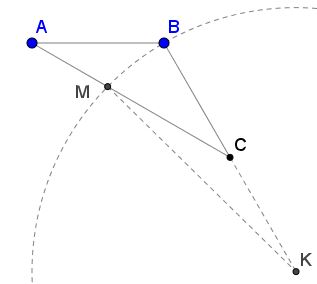
Then $\displaystyle\frac{CM}{AM}=\varphi,\;$ the Golden Ratio.
Proof 2
Indeed, $\angle KCM=150^{\circ}.\;$ Set $CM=x.\;$ In $\Delta CKM,\;$ according to the Law of Cosines,
$2^2=1^2+x^2-2x\cos 150^{\circ}=x^2+x\sqrt{3}+1.$
This gives a quadratic equation $x^2+x\sqrt{3}-3=0,\;$ with the only positive root $x=\displaystyle\frac{\sqrt{15}-\sqrt{3}}{2}=\sqrt{3}\frac{1}{\varphi}.$
But, applying the Law of Cosines in $\Delta ABC,\;$ we obtain $AC=\sqrt{3}.\;$ Such that, finally, $\displaystyle\frac{AC}{CM}=\frac{CM}{AM}=\varphi.$
Acknowledgment
The problem above has been kindly posted by Tran Quang Hung at the CutTheKnotMath facebook page, followed by a proof (Proof 1) by Leo Giugiuc.

Golden Ratio
- Golden Ratio in Geometry
- Golden Ratio in Regular Pentagon
- Golden Ratio in an Irregular Pentagon
- Golden Ratio in a Irregular Pentagon II
- Inflection Points of Fourth Degree Polynomials
- Wythoff's Nim
- Inscribing a regular pentagon in a circle - and proving it
- Cosine of 36 degrees
- Continued Fractions
- Golden Window
- Golden Ratio and the Egyptian Triangle
- Golden Ratio by Compass Only
- Golden Ratio with a Rusty Compass
- From Equilateral Triangle and Square to Golden Ratio
- Golden Ratio and Midpoints
- Golden Section in Two Equilateral Triangles
- Golden Section in Two Equilateral Triangles, II
- Golden Ratio is Irrational
- Triangles with Sides in Geometric Progression
- Golden Ratio in Hexagon
- Golden Ratio in Equilateral Triangles
- Golden Ratio in Square
- Golden Ratio via van Obel's Theorem
- Golden Ratio in Circle - in Droves
- From 3 to Golden Ratio in Semicircle
- Another Golden Ratio in Semicircle
- Golden Ratio in Two Squares
- Golden Ratio in Two Equilateral Triangles
- Golden Ratio As a Mathematical Morsel
- Golden Ratio in Inscribed Equilateral Triangles
- Golden Ratio in a Rhombus
- Golden Ratio in Five Steps
- Between a Cross and a Square
- Four Golden Circles
- Golden Ratio in Mixtilinear Circles
- Golden Ratio With Two Equal Circles And a Line
- Golden Ratio in a Chain of Polygons, So to Speak
- Golden Ratio With Two Unequal Circles And a Line
- Golden Ratio In a 3x3 Square
- Golden Ratio In a 3x3 Square II
- Golden Ratio In Three Tangent Circles
- Golden Ratio In Right Isosceles Triangle
- Golden Ratio Poster
- Golden Ratio Next to the Poster
- Golden Ratio In Rectangles
- Golden Ratio In a 2x2 Square: Without And Within
- Golden Ratio With Two Unequal Circles And a Line II
- Golden Ratio in Equilateral and Right Isosceles Triangles
- Golden Ratio in a Butterfly Astride an Equilateral Triangle
- The Golden Pentacross
- 5-Step Construction of the Golden Ratio, One of Many
- Golden Ratio in 5-gon and 6-gon
- Golden Ratio in an Isosceles Trapezoid with a 60 degrees Angle
- Golden Ratio in Pentagon And Two Squares
- Golden Ratio in Pentagon And Three Triangles
- Golden Ratio in a Mutually Beneficial Relationship
- Star, Six Pentagons and Golden Ratio
- Rotating Square in Search of the Golden Ratio
- Cultivating Regular Pentagons
- Golden Ratio in an Isosceles Trapezoid with a 60 degrees Angle II
- More of Gloden Ratio in Equilateral Triangles
- Golden Ratio in Three Regular Pentagons
- Golden Ratio in Three Regular Pentagons II
- Golden Ratio in Wu Xing
- Golden Ratio In Three Circles And Common Secant
- Flat Probabilities on a Sphere
- Golden Ratio in Square And Circles
- Golden Ratio in Square
- Golden Ratio in Two Squares, Or, Perhaps in Three
- Golden Ratio in Isosceles Triangle
- Golden Ratio in Circles
- Golden Ratio in Isosceles Triangle II
- Golden Ratio in Yin-Yang
|Contact| |Front page| |Contents| |Geometry|
Copyright © 1996-2018 Alexander Bogomolny74709674