
Golden Ratio in Five Steps
Bùi Quang Tuån has devised a 5-step construction of the Golden Ratio (earlier 5-step constructions are due to K. Hofstetter.)
Here are Bùi Quang Tuån's five steps:
Draw line $L$ and choose point $O$ on that line.
Draw circle $(O)$ of a random radius and mark the points of intersection of $(O)$ with $L,$ say $A$ and $B.$
Draw circle $B(A)$ centered at $B$ and passing through $A.$ Let $C$ be the second intersection of $B(A)$ with $L.$
Draw circle $C(O)$ centered at $C$ and passing through $O.$ Let it intersect $B(A)$ at $N$ below $L$ and $(O)$ at $M$ above $L.$
Join $MN$ and let $P$ be the intersection of $MN$ and $(O).$
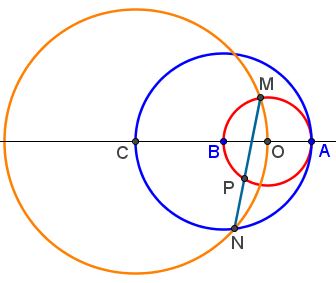
$P$ divides $MN$ in the golden ratio.
Proof
The proof is much less elegant than the construction itself. First of all, let's choose the Cartesian coordinates with $O$ as the origin and $OA$ as $x$-axis.
$M$ is one of the intersections of two circles $x^{2}+y^{2}=1$ and $(x+3)^{2}+y^{2}=3^{2}.$ From these, $\displaystyle x=\frac{1}{6}$ and $\displaystyle y=\frac{\sqrt{35}}{6}.$ We can identify $M$ with $\displaystyle \bigg(-\frac{1}{6},\frac{\sqrt{35}}{6}\bigg).$
For $N,$ we similarly have two equations: $(x+1)^{2}+y^{2}=2^{2}$ and $(x+3)^{2}+y^{2}=3^{2}.$ Solving these gives $\displaystyle N=\bigg(-\frac{3}{4},-\frac{3}{4}\sqrt{7}\bigg).$
We can now find that $\displaystyle MN^{2}=\frac{7}{4}(3+\sqrt{5}).$ To establish the validity of the construction we also need to compute $MP.$ Bùi Quang Tuån suggested that it is easier to compute $DN$ where $D$ is the second intersection of $C(O)$ with $L:$
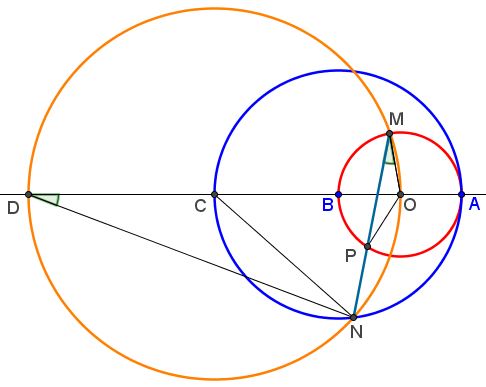
This is because in isosceles triangles $MOP$ and $DCN,$
$\angle CDN=\angle ODN=\angle OMN=\angle OMP.$
And, since the radii of the two circles are in the $1:3$ ratio, $DN=3\cdot MP.$ With our choice of the coordinates, $D=(-6,0)$ so that $\displaystyle DN^{2}=\frac{63}{2},$ making $MP^{2}=\displaystyle\frac{7}{2}.$
Finally, $\displaystyle\frac{MN^{2}}{MP^{2}}=\frac{3+\sqrt{5}}{2}=1+\phi$ which shows that $\displaystyle\frac{MN}{MP}=\phi,$ as required.

Golden Ratio
- Golden Ratio in Geometry
- Golden Ratio in Regular Pentagon
- Golden Ratio in an Irregular Pentagon
- Golden Ratio in a Irregular Pentagon II
- Inflection Points of Fourth Degree Polynomials
- Wythoff's Nim
- Inscribing a regular pentagon in a circle - and proving it
- Cosine of 36 degrees
- Continued Fractions
- Golden Window
- Golden Ratio and the Egyptian Triangle
- Golden Ratio by Compass Only
- Golden Ratio with a Rusty Compass
- From Equilateral Triangle and Square to Golden Ratio
- Golden Ratio and Midpoints
- Golden Section in Two Equilateral Triangles
- Golden Section in Two Equilateral Triangles, II
- Golden Ratio is Irrational
- Triangles with Sides in Geometric Progression
- Golden Ratio in Hexagon
- Golden Ratio in Equilateral Triangles
- Golden Ratio in Square
- Golden Ratio via van Obel's Theorem
- Golden Ratio in Circle - in Droves
- From 3 to Golden Ratio in Semicircle
- Another Golden Ratio in Semicircle
- Golden Ratio in Two Squares
- Golden Ratio in Two Equilateral Triangles
- Golden Ratio As a Mathematical Morsel
- Golden Ratio in Inscribed Equilateral Triangles
- Golden Ratio in a Rhombus
- Golden Ratio in Five Steps
- Between a Cross and a Square
- Four Golden Circles
- Golden Ratio in Mixtilinear Circles
- Golden Ratio With Two Equal Circles And a Line
- Golden Ratio in a Chain of Polygons, So to Speak
- Golden Ratio With Two Unequal Circles And a Line
- Golden Ratio In a 3x3 Square
- Golden Ratio In a 3x3 Square II
- Golden Ratio In Three Tangent Circles
- Golden Ratio In Right Isosceles Triangle
- Golden Ratio Poster
- Golden Ratio Next to the Poster
- Golden Ratio In Rectangles
- Golden Ratio In a 2x2 Square: Without And Within
- Golden Ratio With Two Unequal Circles And a Line II
- Golden Ratio in Equilateral and Right Isosceles Triangles
- Golden Ratio in a Butterfly Astride an Equilateral Triangle
- The Golden Pentacross
- 5-Step Construction of the Golden Ratio, One of Many
- Golden Ratio in 5-gon and 6-gon
- Golden Ratio in an Isosceles Trapezoid with a 60 degrees Angle
- Golden Ratio in Pentagon And Two Squares
- Golden Ratio in Pentagon And Three Triangles
- Golden Ratio in a Mutually Beneficial Relationship
- Star, Six Pentagons and Golden Ratio
- Rotating Square in Search of the Golden Ratio
- Cultivating Regular Pentagons
- Golden Ratio in an Isosceles Trapezoid with a 60 degrees Angle II
- More of Gloden Ratio in Equilateral Triangles
- Golden Ratio in Three Regular Pentagons
- Golden Ratio in Three Regular Pentagons II
- Golden Ratio in Wu Xing
- Golden Ratio In Three Circles And Common Secant
- Flat Probabilities on a Sphere
- Golden Ratio in Square And Circles
- Golden Ratio in Square
- Golden Ratio in Two Squares, Or, Perhaps in Three
- Golden Ratio in Isosceles Triangle
- Golden Ratio in Circles
- Golden Ratio in Isosceles Triangle II
- Golden Ratio in Yin-Yang
|Contact| |Front page| |Contents| |Geometry| |Up|
Copyright © 1996-2018 Alexander Bogomolny74724523