
Four Golden Circles
Bùi Quang Tuån has posted on the CutTheKnotMath facebook page a configuration of four circles and a parallelogram rich in interrelations between the parts among which are several sightings of the Golden Ratio.
Main statement
Each of the four congruent circles $(A),$ $(B),$ $(C),$ $(D)$ touches other two and passes through the center of the remaining third, as shown:
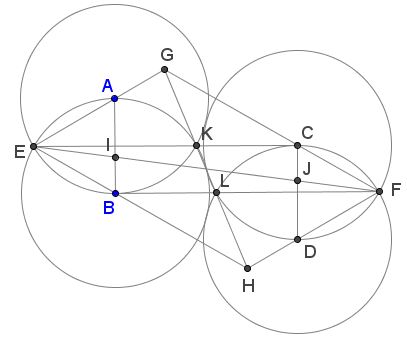
In the parallelogram $EHFG,$
The sides are in Golden Ratio: $FG/EG=\phi,$
The diagonals are in Golden Ratio: $EF/GH=\phi,$
Circle centers divide the sides in Golden Ratio, e.g., $AE/AG=BE/BH=\phi,$
The two center lines $AB$ and $CD$ are divided in Golden Ratio by the diagonal $EF,$ e.g. $AI/BI=\phi,$
Two lines $BF$ and $CE$ are divided in Golden Ratio by the diagonal $GH,$ e.g. $EK/CK=\phi,$
In turn, lines $BF$ and $CE$ divide the diagonal $GH$ in Golden Ratio, e.g., $GL/HL=\phi.$
Note: The configuration has several additional properties worth of consideration. These are listed at the bottom of the page.
Proof
Without loss of generality, assume that the common radius of the four circles is $1.$ Let $N$ be the second intersection of $(A)$ and $(B);$ $M$ the midpoint of $AB.$
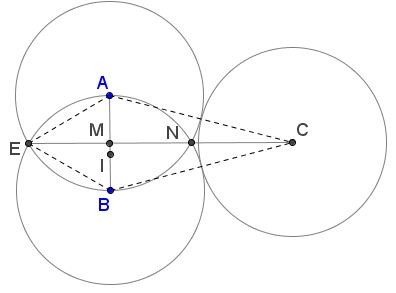
Due to the symmetry of the configuration, $M$ is the intersection of $AB$ and $CE,$ $\Delta ABC$ is isosceles, with $AB=1,$ $AC=BC=2.$ By the Pythagorean theorem, $CM=\sqrt{15}/2.$ In equilateral $\Delta ABE,$ sides are equal to $1$ so that $EM = \sqrt{3}/2.$ By symmetry, also $MN=\sqrt{3}/2.$ Thus
$\displaystyle CE=\frac{\sqrt{15}}{2}+\frac{\sqrt{3}}{2}=\frac{\sqrt{3}}{2}(\sqrt{5}+1)$
and $\displaystyle\frac{CE}{EN}=\frac{\sqrt{5}+1}{2}=\phi.$
Let now $I$ and $J$ be the intersections of $EF$ with $AB$ and $CD,$ respectively. By symmetry, $AI=DJ,$ $BI=CJ.$
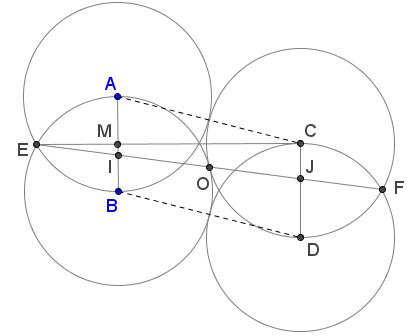
Triangles $CEJ$ and $MEI$ are similar so that $CE/EM=CJ/MI.$ From the foregoing discussion, $CE/EM=\sqrt{5}+1.$ Let $CJ=BI=x.$ Then $\displaystyle MI=\frac{1}{2}-x,$ giving an equation:
$\displaystyle\frac{x}{\frac{1}{2}-x}=\sqrt{5}+1,$
solving which we get $\displaystyle BI=x=\frac{3-\sqrt{5}}{2}.$ Now, $\displaystyle AI=1-x=\frac{\sqrt{5}-1}{2}$ and, as can be easily verified, $\displaystyle\frac{AI}{BI}=\phi.$ This proves #4.
Further, $\angle BEA=60^{\circ}$ so $\angle EGC=\angle EGF=120^{\circ}.$
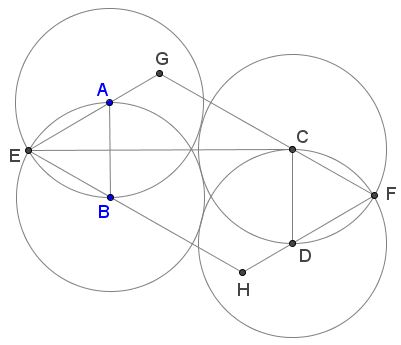
$\Delta EGC$ is isosceles, with $\angle CEG=30^{\circ},$ implying
$\begin{align}\displaystyle EG &=\frac{\frac{1}{2}CE}{\cos 30^{\circ}}\\ &=\frac{1}{2}\cdot \frac{\sqrt{3}}{2}(\sqrt{5}+1)\cdot\frac{2}{\sqrt{3}}\\ &=\frac{\sqrt{5}+1}{2}=\phi. \end{align}$
$FG=GC+CF=\phi +1=\phi^{2}$ such that $FG/EG=FG/CG=\phi,$ proving #1. We now possess all segment lengths to verify #3 directly.
The validity of #4 is the subject of the following
Lemma
In a parallelogram $EHFG$ with angles of $60^{\circ}$ and $120^{\circ},$ if the sides relate in the Golden Ratio, so do the diagonals.
Proof
Using coordinates makes a 1-step proof.
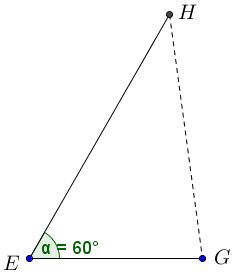
Let $E$ be the origin, $G=(1,0),$ $EH=\phi,$ and $\angle GEH=60^{\circ}.$ Then $\displaystyle H=\bigg(\frac{\phi}{2},\frac{\phi\sqrt{3}}{2}\bigg),$ implying
$\begin{align}\displaystyle GH^{2}&=\bigg(1-\frac{\phi}{2}\bigg)^{2}+\bigg(\frac{\phi\sqrt{3}}{2}\bigg)^{2}\\ &=1-\phi+\frac{\phi^{2}}{4}+\frac{3\phi^{2}}{4}\\ &=1-\phi+\phi^{2}\\ &=(1-\phi)+(1+\phi)=2. \end{align}$
Similarly, $EF^{2}=(1+\phi)+(1+\phi)=2(1+\phi)=2\phi^{2},$ so that $EF/GH=\phi.$
Note: In addition to #5 and #6, the diagram has several attractive properties (similar triangles, point collinearity, line concurrency, one angle being twice another, the angles between the diagonals being $60^{\circ}/120^{\circ},$ etc.) discovering which, along with proving #5 and $6 is left to the reader.

Golden Ratio
- Golden Ratio in Geometry
- Golden Ratio in Regular Pentagon
- Golden Ratio in an Irregular Pentagon
- Golden Ratio in a Irregular Pentagon II
- Inflection Points of Fourth Degree Polynomials
- Wythoff's Nim
- Inscribing a regular pentagon in a circle - and proving it
- Cosine of 36 degrees
- Continued Fractions
- Golden Window
- Golden Ratio and the Egyptian Triangle
- Golden Ratio by Compass Only
- Golden Ratio with a Rusty Compass
- From Equilateral Triangle and Square to Golden Ratio
- Golden Ratio and Midpoints
- Golden Section in Two Equilateral Triangles
- Golden Section in Two Equilateral Triangles, II
- Golden Ratio is Irrational
- Triangles with Sides in Geometric Progression
- Golden Ratio in Hexagon
- Golden Ratio in Equilateral Triangles
- Golden Ratio in Square
- Golden Ratio via van Obel's Theorem
- Golden Ratio in Circle - in Droves
- From 3 to Golden Ratio in Semicircle
- Another Golden Ratio in Semicircle
- Golden Ratio in Two Squares
- Golden Ratio in Two Equilateral Triangles
- Golden Ratio As a Mathematical Morsel
- Golden Ratio in Inscribed Equilateral Triangles
- Golden Ratio in a Rhombus
- Golden Ratio in Five Steps
- Between a Cross and a Square
- Four Golden Circles
- Golden Ratio in Mixtilinear Circles
- Golden Ratio With Two Equal Circles And a Line
- Golden Ratio in a Chain of Polygons, So to Speak
- Golden Ratio With Two Unequal Circles And a Line
- Golden Ratio In a 3x3 Square
- Golden Ratio In a 3x3 Square II
- Golden Ratio In Three Tangent Circles
- Golden Ratio In Right Isosceles Triangle
- Golden Ratio Poster
- Golden Ratio Next to the Poster
- Golden Ratio In Rectangles
- Golden Ratio In a 2x2 Square: Without And Within
- Golden Ratio With Two Unequal Circles And a Line II
- Golden Ratio in Equilateral and Right Isosceles Triangles
- Golden Ratio in a Butterfly Astride an Equilateral Triangle
- The Golden Pentacross
- 5-Step Construction of the Golden Ratio, One of Many
- Golden Ratio in 5-gon and 6-gon
- Golden Ratio in an Isosceles Trapezoid with a 60 degrees Angle
- Golden Ratio in Pentagon And Two Squares
- Golden Ratio in Pentagon And Three Triangles
- Golden Ratio in a Mutually Beneficial Relationship
- Star, Six Pentagons and Golden Ratio
- Rotating Square in Search of the Golden Ratio
- Cultivating Regular Pentagons
- Golden Ratio in an Isosceles Trapezoid with a 60 degrees Angle II
- More of Gloden Ratio in Equilateral Triangles
- Golden Ratio in Three Regular Pentagons
- Golden Ratio in Three Regular Pentagons II
- Golden Ratio in Wu Xing
- Golden Ratio In Three Circles And Common Secant
- Flat Probabilities on a Sphere
- Golden Ratio in Square And Circles
- Golden Ratio in Square
- Golden Ratio in Two Squares, Or, Perhaps in Three
- Golden Ratio in Isosceles Triangle
- Golden Ratio in Circles
- Golden Ratio in Isosceles Triangle II
- Golden Ratio in Yin-Yang
|Contact| |Front page| |Contents| |Geometry| |Up|
Copyright © 1996-2018 Alexander Bogomolny74301917