
Addition and Subtraction Formulas for Sine and Cosine
In a right triangle with legs a and b and hypotenuse c, and angle α opposite side a, the trigonometric functions sine and cosine are defined as
sinα = a/c, cosα = b/c.
This definition only covers the case of acute positive angles α:
sin(90° - α) = cosα and cos(90° - α) = sinα,
for 0 < α < 90° because these limitations of α also imply the same limitations on
We are concerned here with illustrating two pairs of formulas known as the Sine and Cosine Addition and Subtraction formulas, i.e., the formulas for sin(α±β) and cos(α±β), where all the angles involved satisfy the basic limitations:
| 0 < α, β, α + β, < 90°, for addition, and | |
| 0 < α, β, α - β < 90°, for subtraction. |
Naturally, after the common extension of the definitions, the formulas remain true for all values of the two angles.
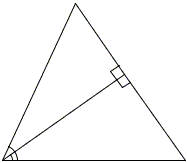
So, given two right triangles, one with angle α and the other with angle β. For the sake of a geometric illustration, we need to put those triangles somehow together to make a combination of angles α and β to stand out. As is suggested in [Gelfand & Saul, p. 126], there are just three ways of doing that:
 |
 |
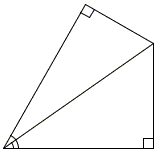 |
The third one is the basis for the derivation of the formulas for
Formulas for sin(α + β) and cos(α + β)
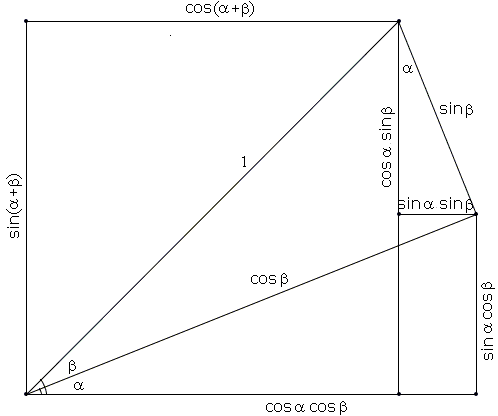
| sin(α + β) = sinα cos β + cos α sin β. | |
| cos(α + β) = cosα cos β - sin α sin β. |
Formulas for sin(α - β) and cos(α - β)
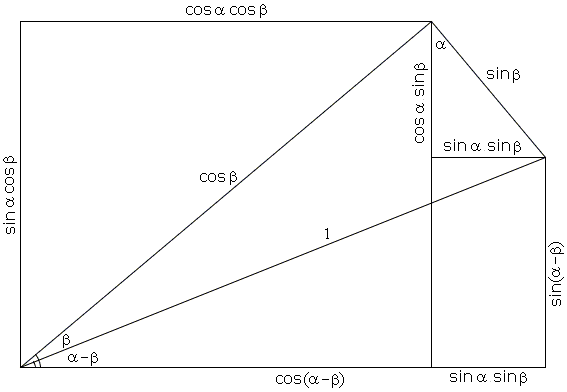
| sin(α - β) = sinα cos β - cos α sin β. | |
| cos(α - β) = cosα cos β + sin α sin β. |
Another Proof of sin(α + β) = sinα cos β + cos α sin β
The next proof relies on the diagram:
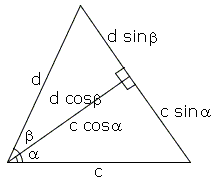
From the definition of sine and the fact that the area of a triangle is half the product of the altitude and the base, it follows that the are of a triangle is half the product of any of the two side times sin of the included angle. For the three triangles in the diagram we have
| 2Ac | = c (d cosβ) sinα, | |
| 2Ad | = d (c cosα) sinβ, | |
| 2A | = cd sin(α + β). |
Which after cancelling cd gives the addition formula for sine.
Observe that in this proof α + β need not be acute. (This proof alongside a similar one for
References
- I. M. Gelfand, M. Saul, Trigonometry, Birkhäuser, 2001
- R. B. Nelsen, Proofs Without Words, MAA, 1993
- R. B. Nelsen, Proofs Without Words II, MAA, 2000
- J. Zimba, On the Possibility of Trigonometric Proofs of the Pythagorean Theorem, Forum Geometricorum, Volume 9 (2009) 275-278

Trigonometry
- What Is Trigonometry?
- Addition and Subtraction Formulas for Sine and Cosine
- The Law of Cosines (Cosine Rule)
- Cosine of 36 degrees
- Tangent of 22.5o - Proof Wthout Words
- Sine and Cosine of 15 Degrees Angle
- Sine, Cosine, and Ptolemy's Theorem
- arctan(1) + arctan(2) + arctan(3) = π
- Trigonometry by Watching
- arctan(1/2) + arctan(1/3) = arctan(1)
- Morley's Miracle
- Napoleon's Theorem
- A Trigonometric Solution to a Difficult Sangaku Problem
- Trigonometric Form of Complex Numbers
- Derivatives of Sine and Cosine
- ΔABC is right iff sin²A + sin²B + sin²C = 2
- Advanced Identities
- Hunting Right Angles
- Point on Bisector in Right Angle
- Trigonometric Identities with Arctangents
- The Concurrency of the Altitudes in a Triangle - Trigonometric Proof
- Butterfly Trigonometry
- Binet's Formula with Cosines
- Another Face and Proof of a Trigonometric Identity
- cos/sin inequality
- On the Intersection of kx and |sin(x)|
- Cevians And Semicircles
- Double and Half Angle Formulas
- A Nice Trig Formula
- Another Golden Ratio in Semicircle
- Leo Giugiuc's Trigonometric Lemma
- Another Property of Points on Incircle
- Much from Little
- The Law of Cosines and the Law of Sines Are Equivalent
- Wonderful Trigonometry In Equilateral Triangle
- A Trigonometric Observation in Right Triangle
- A Quick Proof of cos(pi/7)cos(2.pi/7)cos(3.pi/7)=1/8
|Contact| |Front page| |Contents| |Geometry|
Copyright © 1996-2018 Alexander Bogomolny74192331