
Morley's Theorem
M. T. Naraniengar's proof
This proof is one of the earliest. It has been appreciatively popularized by Coxeter and Greitzer. Morley's theorem was presented as a problem in Mathematical Questions and Their Solutions sections in the Educational Times (New Series), v 15 (1909), p. 47. One of the solutions sent in was by M. T. Naraniengar and is discussed below.
Naraniengar's proof depends on the following
Lemma
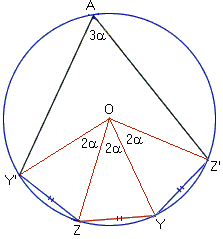
If four points Y', Z, Y, Z' satisfy the conditions
- Y'Z = ZY = YZ' and
- ∠YZY' = ∠Z'YZ = 180° - 2a > 60°
then they lie on a circle. Moreover, if a point A, on the side of the line Y'Z' away from point Y, is so situated that ∠Y'AZ' = 3a, then this fifth point A also lies on the same circle.
|
Following Coxeter and Greitzer, let the bisectors of angles YZY' and Z'YZ meet at O. Then triangles OY'Z, OZY, OYZ' are congruent and isosceles having base angles
|
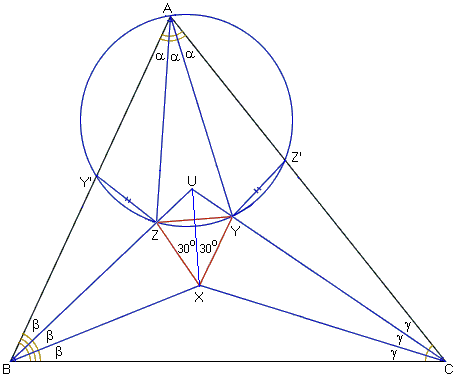
Now for the proof of Morley's theorem. Morley's trisectors of angles
| ∠ZXU = ∠YXU = 30°. |
Then triangles ZXU and YXU are equal by ASA. Therefore,
In addition, ΔUZY is isosceles with base angles at Y and Z equal to
|
∠YZU = 60° - a and ∠XZU = 120° - a. |
Next, mark Y' on AB and Z' on AC so that
| BY' = BX and CZ' = CX. |
This makes triangles BZX and BZY' congruent by SAS; and the same holds for triangles CYX and CYZ'. Thus we make a step towards the premises of Lemma:
| Y'Z = ZX = ZY = YX = YZ'. |
We have to check the second condition:
|
Similarly, ∠Z'YZ = 180° - 2a; and of course
References
- H. S. M. Coxeter, S. L. Greitzer, Geometry Revisited, MAA, 1967

Morley's Miracle
On Morley and his theorem
- Doodling and Miracles
- Morley's Pursuit of Incidence
- Lines, Circles and Beyond
- On Motivation and Understanding
- Of Looking and Seeing
Backward proofs
- J.Conway's proof
- D. J. Newman's proof
- B. Bollobás' proof
- G. Zsolt Kiss' proof
- Backward Proof by B. Stonebridge
- Morley's Equilaterals, Spiridon A. Kuruklis' proof
- J. Arioni's Proof of Morley's Theorem
Trigonometric proofs
- Bankoff's proof
- B. Bollobás' trigonometric proof
- Proof by R. J. Webster
- A Vector-based Proof of Morley's Trisector Theorem
- L. Giugiuc's Proof of Morley's Theorem
- Dijkstra's Proof of Morley's Theorem
Synthetic proofs
- Another proof
- Nikos Dergiades' proof
- M. T. Naraniengar's proof
- An Unexpected Variant
- Proof by B. Stonebridge and B. Millar
- Proof by B. Stonebridge
- Proof by Roger Smyth
- Proof by H. D. Grossman
- Proof by H. Shutrick
- Original Taylor and Marr's Proof of Morley's Theorem
- Taylor and Marr's Proof - R. A. Johnson's Version
- Morley's Theorem: Second Proof by Roger Smyth
- Proof by A. Robson
Algebraic proofs
Invalid proofs
|Contact| |Front page| |Contents| |Geometry|
Copyright © 1996-2018 Alexander Bogomolny
74281317