
An Inequality with Cyclic Sums And Products
Problem
Solution
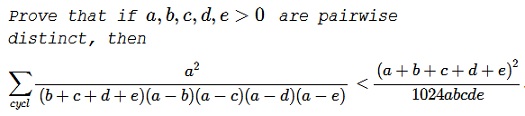
Let's split the left-hand side into partial fractions:
$\displaystyle \frac{x^2}{\displaystyle\prod_{cycl}(x-a)}= \frac{A}{x-a}+\frac{B}{x-b}+\frac{C}{x-c}+\frac{D}{x-d}+\frac{E}{x-e}.$
Then
$\displaystyle \frac{x^2}{\displaystyle\prod_{k\ne a}(x-k)}= A+\frac{B(x-a)}{x-b}+\frac{C(x-a)}{x-c}+\frac{D(x-a)}{x-d}+\frac{E(x-a)}{x-e}.$
This shows that $\displaystyle A=\frac{a^2}{(a-b)(a-c)(a-d)(a-e)}.\,$ Similar expressions can be found for $B,\,$ $C,\,$ $D,\,$ and $E.\,$ It follows that
$\displaystyle \begin{align} \sum_{cycl}\frac{A}{x-a} &= \sum_{cycl}\frac{a^2}{(x-a)(a-b)(a-c)(a-d)(a-e)}\\ &= \frac{x^2}{(x-a)(x-b)(x-c)(x-d)(x-e)}. \end{align}$
Replacing $x\,$ with $a+b+c+d+e\,$ and using the AM-GM inequality, we get
$\displaystyle\begin{align} \sum_{cycl}\frac{a^2}{\displaystyle (b+c+d+e)\prod_{k\ne a}(a-k)} &= \frac{(a+b+c+d+e)}{\displaystyle \prod_{cycl}\left[\sum_{k\ne a}k\right]}\\ &\lt\frac{(a+b+c+d+e)^2}{\displaystyle \prod_{cycl}\left[4\sqrt[4]{\prod_{k\ne a}k}\right]}\\ &=\frac{(a+b+c+d+e)^2}{4^4abcde}. \end{align}$
Acknowledgment
The problem has been kindly posted by Dan Sitaru at the CutTheKnotMath facebook page; his solution in a latex file came via email.
Resource Limit Is Reached
The website is temporarily unable to service your request as it exceeded resource limit. Please try again later.
|Contact| |Up| |Front page| |Contents| |Algebra|
Copyright © 1996-2018 Alexander Bogomolny