
Construction of n-gon from the midpoints of its sides
Construct an n-gon (polygon with n sides) for which n given points serve as midpoints of its sides.
Below there is a Java applet that may help you gain insight into the problem. The applet can be in two modes: "Place points" and "Drag mouse", depending on which of the two boxes at the bottom of the applet is checked.
- In the "Place points" mode you should define n points - midpoints of the sides of a polygon. Just click the mouse anywhere inside the applet's rectangle.
- Next you can experiment with the points you thus defined. Change the mode and start dragging the mouse.
If, for whatever reason, you decide to work with a different set of points - press the Reset button and start again.
A word of advice. First of all, start with a simple case. Try just a few points, say, 3, 4, 5. Secondly, attempt to visualize a polygon and then place the points approximately at the middle of its sides. Thirdly, pay attention to the red "target" circle.
| What if applet does not run? |
By now you ought to have arrived at the following conclusions:
- If n is odd it's probably possible to solve the problem.
- If n is even something goes wrong.
For odd n, the red circle indicates one of the polygon's vertices. Once you move the cursor into the red circle the problem seems to have been solved. Now, actually the applet provides an experimental device. It may help you to fathom a proof but it can't substitute for a rigorous demonstration.
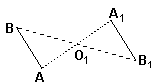
Useful for the proof could be the following observation: Let there be given a segment AB and a point O1. Consider a reflection A1B1 of AB in the point O1. In other words, in order to obtain A1B1 rotate AB around O1 180o. Now AB || A1B1 but they have a different orientation. If you continue reflecting A1B1 in another point O2 to get A2B2 then the segments remain parallel and equal but orientation changes again. After an odd number (1 in particular) of reflections the last segment will be parallel to AB but having a different orientation. After an even number of reflections the first and the last segment will be directly parallel (and, of course, equal). See if you can now complete the proof.
Remark 1
When n is even the segment joining the first and the last point is always the same for a given configuration of vertices. For
Remark 2
The problem could be described algebraically. Assume mi, i = 1, 2, ..., n, stand for the vectors from the origin to the given midpoints. (We may also treat them as the points in an affine space.) Let ai, i = 1, 2, ..., n, denoted the unknown vertices. Then ai's satisfy the following system of equations:
| (1) |
a1 + a2 = 2m1 a2 + a3 = 2m2 ... an + a1 = 2mn. |
Surprisingly this same system of equations describes an apparently unrelated problem.

|Contact| |Front page| |Contents| |Eye opener| |Geometry|
Copyright © 1996-2018 Alexander BogomolnyLet's consider the simplest case of three midpoints (n = 3). After toying with the applet for a while, it's hard not to notice that the center of the red circles does not depend on the position of the cursor but only on the three selected midpoints. Let A be an arbitrary point. Successive reflections in O1, O2, and O3 produce points A1, A2, and A3. It seems very plausible that the center of the red circles, say M, lies in the middle of the segment AA3. Put differently, the point A3 is obtained from A by reflection in the point M. This is something we may try to prove.
But before we do, let's create an accurate picture of what happened. Three successive reflections resulted in another reflection. And the same is probably true of any odd number of reflections. Reflections are just functions: they map points of a plane into points of the same plane. Successive application of two reflections is none other than the composition of the corresponding functions. Thus we want to show that composition of an odd number of reflections is again a reflection.
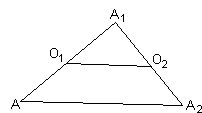
What about an even number of reflections? What about just two reflections? Composition of two reflections is a translation to the vector parallel to the line connecting the two centers of reflection and twice as long as the distance between the centers. Indeed, in ΔAA1A2,
Translation is a transformation of a plane that moves the plane as a whole in a certain direction to a certain distance. Each point is shifted by a certain vector. Composition of two translations with vectors v1 and v2, respectively, is again a translation corresponding to the vector sum v1 + v2. The latter remark easily leads to a solution of our problem for an even number of points. If n is even, we can combine successive reflections in pairs to get n/2 successive translations. Obviously (e.g., by induction) the sum of any number of translations is a translation. This is true as long as we may refer to the triangular diagram above. But sometimes the sum of vectors is 0 (one side of a triangle shrinks to a point, and the triangle does not appear triangular in the least.) To make the italicized statement universally true we have to accept as a translation the identical transformation under which every point is mapped onto itself. The identical transformation has all points fixed. Since any translation moves all points by the same vector, the only translation that has a fixed point is identical.
Returning to our problem for n even. Let vectors vi, i = 1,...,n/2 map, respectively, O1 to O2
- v1 + v2 + ... + vn/2 = 0, and
- v1 + v2 + ... + vn/2 ≠ 0.
In case 1, pick any point A and obtain points Ai by successive reflections in points Oi. Then A2n will coincide with A thus solving the problem. Since A is arbitrary, the problem has an infinite number of solutions.
In case 2, no solution exists.
For n odd, the problem always has a unique solution. As we already noticed, we have to show that the composition of an odd number of reflections is again a reflection. Taking the center of the latter as a starting point A which is successively reflected in points Oi we'll find that the point An coincides with A. To prove the statement, note that (by induction) composition of an odd number of reflections is the composition of a reflection and a translation (or of a translation and a reflection depending on how one groups our reflections.)
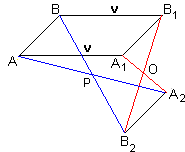
Choose two points A and B, shift them into A1 and B1 by vector v, and then reflect these two in a point O to obtain A2 and B2. As we already know, the quadrilateral ABA2B2 is a parallelogram. Let P denote the point of intersection of its diagonals. This is the midpoint of the segment AA2. Now let B vary. Regardless of its position, the midpoint of the segment BB2 will always coincide with the midpoint of AA2, that is P. Therefore, B2 is always obtained from B by reflection in P.
From the above discussion it follows that all planar translations form a group, and another group is formed by all translations and reflections. The group of translations is commutative (Abelian); for the sum of vectors is commutative. The combined group of translations and reflections is not commutative. It can be shown (try it) that, in general, the composition TR of a translation T and a rotation R is not the same as RT.
|Contact| |Front page| |Contents| |Eye opener| |Geometry|
Copyright © 1996-2018 Alexander Bogomolny74283474