Two Circles and a Limit: What Is This About?
A Mathematical Droodle


This applet requires Sun's Java VM 2 which your browser may perceive as a popup. Which it is not. If you want to see the applet work, visit Sun's website at http://www.java.com/en/download/index.jsp, download and install Java VM and enjoy the applet.


Buy this applet
What if applet does not run?

Discussion

|Contact| |Front page| |Contents| |Algebra| |Store|

Copyright © 1996-2012 Alexander Bogomolny

A problem has been posted at the CTK Exchange and I also found it in a problem collection by E. J. Barbeau, M. S. Klamkin and W. O. J. Moser, and in another by J. Konhauser, D. Velleman, S. Wagon. It goes like this:

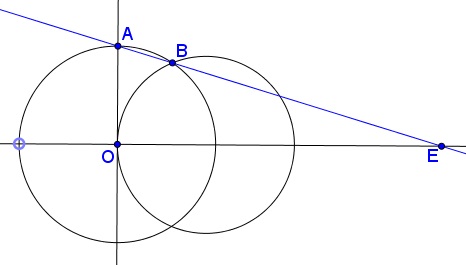
A stationary circle of radius 3 is centered at (3, 0). Another circle of variable radius r is centered at the origin and meets the positive y-axis in point A. Let B be the common point of the two circles in the upper half-plane. Let E be the intersection of AB extended with the x-axis. What happens to E as r grows smaller and smaller?


This applet requires Sun's Java VM 2 which your browser may perceive as a popup. Which it is not. If you want to see the applet work, visit Sun's website at http://www.java.com/en/download/index.jsp, download and install Java VM and enjoy the applet.


Buy this applet
What if applet does not run?

The curious fact about this problem is that, perhaps counterintuitively, E does not recede to infinity as r approaches 0. Instead, E has a limit at point (12, 0), or more generally, four times farther from the origin than the center of the stationary circle. Both at the CTK Exchange and in the both books the problem has been solved analytically and (in the first) also synthetically meaning that the value of the limit in question and its existence have been arrived at geometrically, rather than by deriving and investigating an algebraic formula. All geometric proofs shed light on the nature of the problem. Indeed, the last two proofs shine so brightly as to make the result altogether obvious.

References

  1. E. J. Barbeau, M. S. Klamkin, W. O. J. Moser, Five Hundred Mathematical Challenges, MAA, 1995, #396
  2. J. Konhauser, D. Velleman, S. Wagon, Which Way Did the Bicycle Go?, MAA, 1996, #5

Limits in Geometry


Related material
Read more...

  • Cavalieri's Principle
  • Derivative of Sine and Cosine
  • Distance From a Point to a Straight Line
  • Estimating Circumference of a Circle
  • Maximum Volume of a Cut Off Box
  • Mistrust Intuition of the Infinite
  • Naturally Discontinuous Functions
  • Rolle's and The Mean Value Theorems
  • Function, Derivative and Integral
  • Area of a Circle by Rabbi Abraham bar Hiyya Hanasi
  • Schwarz Lantern

  • |Contact| |Front page| |Contents| |Algebra| |Store|

    Copyright © 1996-2012 Alexander Bogomolny

     41143672

    A math books store at a unique math study site. Shopping at the store helps maintain the site. Thank you.
    Sites for teachers
    Sites for parents
    Terms of use
    Awards
    Interactive Activities

    CTK Exchange
    CTK Wiki Math
    CTK Insights - a blog
    Math Help
    Games & Puzzles
    What Is What
    Arithmetic
    Algebra
    Geometry
    Probability
    Outline Mathematics
    Make an Identity
    Book Reviews
    Stories for Young
    Eye Opener
    Analog Gadgets
    Inventor's Paradox
    Did you know?...
    Proofs
    Math as Language
    Things Impossible
    Visual Illusions
    My Logo
    Math Poll
    Cut The Knot!
    MSET99 Talk
    Old and nice bookstore
    Other Math sites
    Front Page
    Movie shortcuts
    Personal info
    Privacy Policy

    Guest book
    News sites

    Recommend this site

    Sites for parents

    Education & Parenting

    Search:
    Keywords:

    Google
    Web CTK
    Supported by
    3wVentures