
Between Major and Minor Circles
In a polar system of coordinates based at the center of ellipse, an ellipse is presented as a curve
P(t) = (a cos(t), b sin(t)),
where a and b are the lengths of its half-axes. Consider two circles (one major, the other minor) associated with the ellipse:
A(t) = (a cos(t), a sin(t)),
B(t) = (b cos(t), b sin(t)).
Both touch the ellipse at its vertices. If components of a generic point
P(t) = (A(t)x, B(t)y).
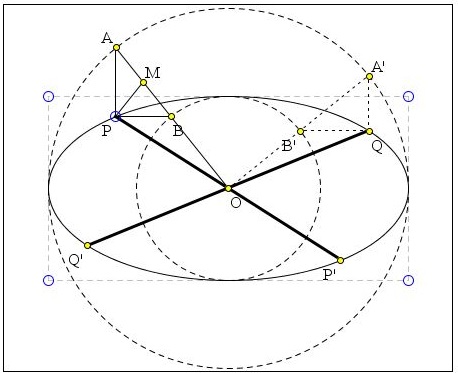
This explains the configuration illustrated by the applet below.
Since ΔABP is right, the midpoint M of its hypotenuse AB is also the circumcenter:
OM = (a + b) / 2.
MP = |a - b| / 2.
Let zX be the complex number associated with a point X. Then arg(zM) is the angle formed by the radius-vector OM with the (positive) x-axis. For a > b, the angle formed by MP with the (positive) x-axis is -arg(zM).
If
zP = (a + b)/2·eit + (a - b)/2·e-it.
(Euler's formula shows that this is exactly the same as
In an ellipse, conjugate diameters correspond to complementary values of parameter t. The applet illustrates this point too: OA is perpendicular to OA', although PP' and QQ' are not perpendicular, except when they coincide with the axes of the ellipse.

Conic Sections > Ellipse
- What Is Ellipse?
- Analog device simulation for drawing ellipses
- Angle Bisectors in Ellipse
- Angle Bisectors in Ellipse II
- Between Major and Minor Circles
- Brianchon in Ellipse
- Butterflies in Ellipse
- Concyclic Points of Two Ellipses with Orthogonal Axes
- Conic in Hexagon
- Conjugate Diameters in Ellipse
- Dynamic construction of ellipse and other curves
- Ellipse Between Two Circles
- Ellipse in Arbelos
- Ellipse Touching Sides of Triangle at Midpoints
- Euclidean Construction of Center of Ellipse
- Euclidean Construction of Tangent to Ellipse
- Focal Definition of Ellipse
- Focus and Directrix of Ellipse
- From Foci to a Tangent in Ellipse
- Gergonne in Ellipse
- Pascal in Ellipse
- La Hire's Theorem in Ellipse
- Maximum Perimeter Property of the Incircle
- Optical Property of Ellipse
- Parallel Chords in Ellipse
- Poncelet Porism in Ellipses
- Reflections in Ellipse
- Three Squares and Two Ellipses
- Three Tangents, Three Chords in Ellipse
- Van Schooten's Locus Problem
- Two Circles, Ellipse, and Parallel Lines
|Activities| |Contact| |Front page| |Contents| |Geometry|
Copyright © 1996-2018 Alexander Bogomolny
74289192