
Tiling Square with Tetrominoes Fault-Free
There are five types of tetromino (a polyomino that consist of four squares):
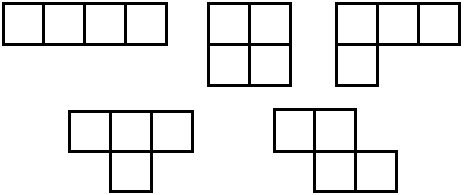
These are called "straight", "square", "L-tetromino", "T-tetromino", and "skew" or "Z-tetromino".
Four types of tetromino (all, except the skew) tile an 8×8 chessboard. In fact, each of these already tiles a 4×4 square:
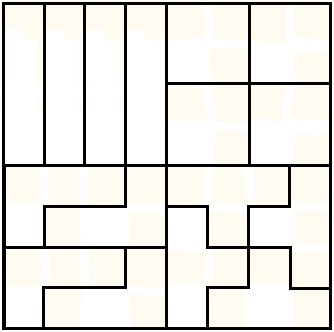
The covering of an 8×8 chessboard in this manner with a unique type of tetromino would introduce fault lines - the straight lines between squares that run from edge to edge.
- Every tiling of an 8×8 chessboard with straight tetrominoes contains a fault line.
- Every tiling of an 8×8 chessboard with square tetrominoes contains a fault line.
- An 8×8 chessboard can be tiled with no fault lines by T-tetromino.
- An 8×8 chessboard can be tiled with no fault lines by L-tetromino.
The first two claims are almost obvious or become so after short experimentation. The simplest way is to start from a corner tile and see how a tiling may evolve from there. (This is also a good approach to proving that the skew tromino does not tile a rectangle, let alone a square.)
There is a very general result (1981) by Ron Graham for the existence tiling rectangular boards with rectangular pieces:
A fault-free tiling of a p×q rectangle with a×b tiles exists (where we assume
- Each of a and b divides p or q;
- Each of p and q can be expressed as xa + yb,
x > 0, y > 0, in at least two ways; - For {a, b} = {1, 2}, {p, q} ≠ {6, 6}.
A solution to the third one is shown below.
George Jelliss found 12 solutions to the fourth problem.
References
- R. L. Graham, Fault-Free Tilings of Rectangles, In The Mathematical Gardner: A Collection in Honor of Martin Gardner (Ed. D. A. Klarner), Van Nostrand Reinhold (March 1982)

|Contact| |Front page| |Contents| |Geometry|
Copyright © 1996-2018 Alexander BogomolnySolutions
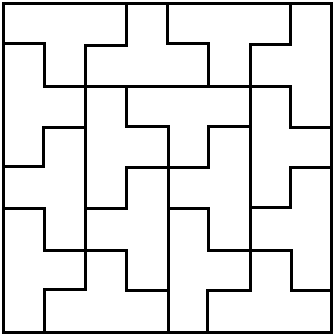
An 8×8 chessboard can be tiled with no fault lines by T-tetromino.
One solution is found at [Martin, p. 48]:
An 8×8 chessboard can be tiled with no fault lines by L-tetromino.
George Jelliss found 12 solutions. George has observed that the first three are symmetric; the second and third differ only by rotation of the central pair; I find the latter especially remarkable.

References
- G. E. Martin, POLYOMINOES: A Guide to Puzzles and Problems in Tiling, MAA, 1996
|Contact| |Front page| |Contents| |Geometry|
Copyright © 1996-2018 Alexander Bogomolny74724615