
Viviani's Theorem: What is it?
A Mathematical Droodle

|Activities| |Contact| |Front page| |Contents| |Geometry|
Copyright © 1996-2018 Alexander BogomolnyViviani's Theorem
The applet attempts to illustrate the following theorem:
The sum of distances of a point inside an equilateral triangle or on one of its sides equals the length of its altitude.
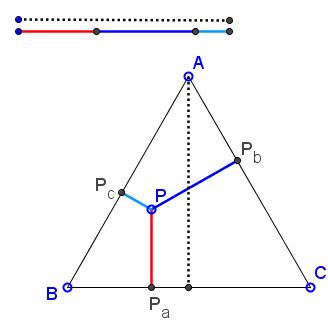
The theorem is named after Vincenzo Viviani (1622-1703).
Let $P_{a},$ $P_{b},$ and $P_{c}$ be the pedal points (projections) of a point $P$ on the side lines $BC,$ $AC,$ and $AB$ of $\Delta ABC.$ Then the theorem claims that
(1)
$h = PP_{a} + PP_{b} + PP_{c},$
where $h$ is the length of the altitudes of $\Delta ABC.$
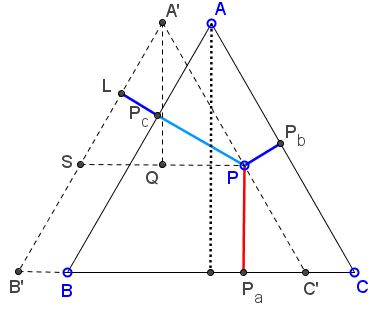
Consider a shifted copy $A'B'C'$ of $\Delta ABC$ such that $P$ lies on $A'C'.$ Let $PS$ be parallel to $BC,$ $Q$ be the foot of the perpendicular from $A'$ onto $PS,$ and $L$ the foot of the perpendicular from $P$ to $A'B',$ as in the applet. Then
$\begin{align} h&= A'Q + PP_{a}\\ &= PL + PP_{a}\\ &= P_{c}L + PP_{c} + PP_{a}\\ &= PP_{b} + PP_{c} + PP_{a}. \end{align}$
A slightly incorrect version of the above appears as a proof without words in [Nelsen, p. 15].
A direct proof is also pretty simple. Let's $[X]$ dennote the area of shape $X.$ As long as point $P$ is not outside $\Delta ABC,$ we have
(2)
$[ABC] = [ABP] + [BCP] + [CAP].$
Let $m$ be the length of a side of $\Delta ABC.$ Then from (2)
$m\cdot h/2 = PP_{c}\cdot m/2 + PP_{a}\cdot m/2 + PP_{b}\cdot m/2,$
wherefrom (1) follows immediately.
Note
There is available another proof without words of Viviani's theorem. For you to compare. Also, the theorem extends to equilateral as well as equiangular polygons.
There is also a very simple proof by inversion which reduces Viviani's theorem to the identity $AB + BC = AC,$ where $A,$ $B,$ $C,$ are three collinear points with $B$ between $A$ and $C.$
Finally, Viviani's theorem follows from a property of isosceles triangles.
References
- R. Nelsen, Proofs Without Words, MAA, 1993
|Activities| |Contact| |Front page| |Contents| |Geometry|
Copyright © 1996-2018 Alexander Bogomolny74309485