
Symmedian and the Tangents
What is this about?
A Mathematical Droodle

|Activities| |Contact| |Front page| |Contents| |Geometry|
Copyright © 1996-2018 Alexander BogomolnyA symmedian through one of the vertices of a triangle passes through the point of intersection of the tangents to the circumcircle at the other two vertices.
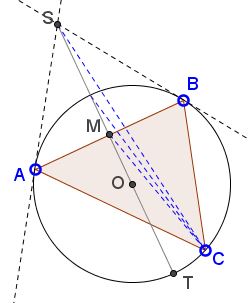
The proof is based on a known fact: the locus of the midpoints of the antiparallels to a side of a triangle is the summedian through the opposite vertex. Draw an antiparallel through S - the point of intersection of the two tangents to the circumcircle of the triangle ABC at A and B. Let it meet the extended sides AC and BC at U and V, respectively.
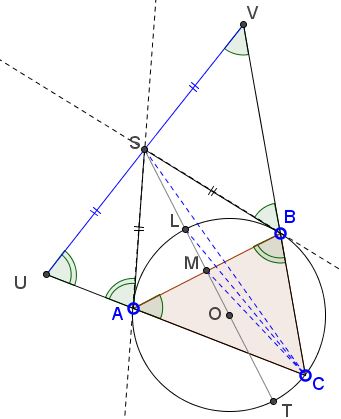
Then the triangles USA and VSB are isosceles, so that
SU = SA and
SV = SB.
In addition,
SA = SB,
as two tangents from a point to a circle. We conclude that S is the midpoint of UV. Therefore, S belongs to the locus of all such midpoints. Since the locus is the symmedian - a straight line - through the vertex C, CS is bound to be that symmedian.
References
- R. Honsberger, Episodes in Nineteenth and Twentieth Century Euclidean Geometry, MAA, 1995.
Symmedian
- All about Symmedians
- Symmedian and Antiparallel
- Symmedian and 2 Antiparallels
- Symmedian in a Right Triangle
- Nobbs' Points and Gergonne Line
- Three Tangents Theorem
- A Tangent in Concurrency
- Symmedian and the Tangents
- Ceva's Theorem
- Bride's Chair
- Star of David
- Concyclic Circumcenters: A Dynamic View
- Concyclic Circumcenters: A Sequel
- Steiner's Ratio Theorem
- Symmedian via Squares and a Circle
- Symmedian via Parallel Transversal and Two Circles
- Symmedian and the Simson
- Characterization of the Symmedian Point with Medians and Orthic Triangle
- A Special Triangle with a Line Through the Lemoine Point
|Activities| |Contact| |Front page| |Contents| |Geometry|
Copyright © 1996-2018 Alexander Bogomolny74315248