
Angle Bisector Theorem
Angle bisectors in a triangle have a characteristic property of dividing the opposite side in the ratio of the adjacent sides. More accurately,
Let AD - with D on BC - be the bisector of ∠A in ΔABC. If b = AC, c = AB, m = CD, and n = BD, then
b/c = m/n.
Jelena Nikolin from Serbia has graceously supplied several proofs. Below, (Δ) denotes the area of triangle Δ.
Proof 1
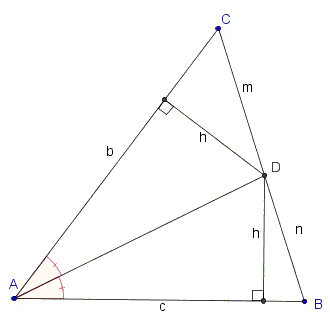
Here is a proof that does not appeal to the similarity of triangles. Instead, we'll argue that
(ACD) : (ABD) = m : n,
because the two triangles share the altitude from A.
On the other hand, point D is equidistant from the sides b and c (it belongs to the angle bisector), so altitudes of the smaller triangles from D are equals. These are denoted h:
(ACD) : (ABD) = bh/2 : ch/2 = b : c,
implying m : n = b : c.
Proof 2
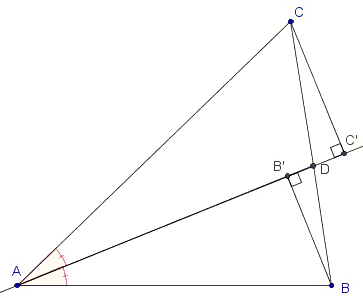
Let B' and C' are foots of the perpendicular from B and C to the angle bisector. Triangles ABB' and ACC' are similar - the two are right and have equal acute angles at A. So
AB : AC = BB' : CC'. (*)
Further, triangles BB'D and CC'D are similar too so
BB' : CC' = BD : CD. (**)
From (*) and (**) we have AB : AC = BD : CD.
Remark: These two proofs are not original, but do have educational value.
Proof 3
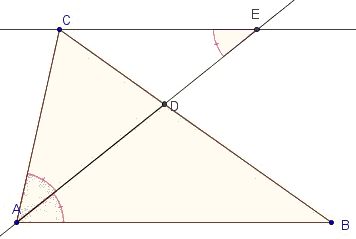
Let E be the intersection of AD and the line parallel to AB through C. ∠AEC = ∠BAE (Transversal theorem: the line that cuts two parallels, cuts it under equal angles), meaning that ΔACE is isosceles and thus
AB : CE = BD : CD.
Together with CE = AC, we obtain the required AB : AC = BD : CD.
Proof 4
This proof is based on the following lemma that is of interest in its own right:
Let B' is the point on the segment AC where B'D||AB. Let C' is point on the segment AB such that C'D||AC. Then AB'DC' is a rhombus.
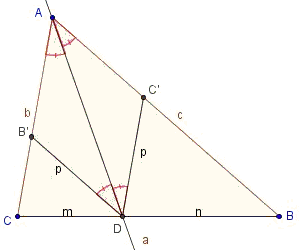
Proof of Lemma
∠DAC = ∠ADC' = ∠DAB = ∠ADB' = α/2 (transversal). Now, triangles ADB' and ADC' are congruent by ASA, so
Using Thales' theorem, we have: B'D : AB = CD : BC or
p : c = m : a (*)
and C'D : AC = BD : BC, or
p : b = n : a (**).
Combining (*) and (**), we end up with m : n = b : c.

|Contact| |Front page| |Contents| |Geometry|
Copyright © 1996-2018 Alexander Bogomolny
74392388