
Sum of Squares in Equilateral Triangle
Problem
Here's problem #86 from a charming collection by C. W. Trigg, the long term editor of the Problems sections at the Mathematics Magazine.
Let $ABC\;$ be an equilateral triangle, and $P\;$ a point on its incircle.
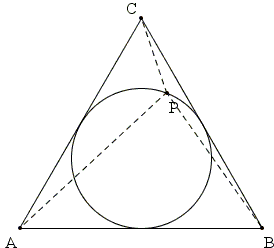
Prove that
$AP^{2} + BP^{2} + CP^{2}\;$ is constant.
Reference
- C. W. Trigg, Mathematical Quickies, Dover, 1985
Solution
Trigg credits Leo Moser with the following solution.
Think of the whole diagram as being drawn in three dimensions, so that $A = (1, 0, 0),\;$ $B = (0, 1, 0),\;$ $C = (0, 0, 1),\;$ making the three points lie in the plane $x + y + z = \alpha\;$ (in fact, $\alpha = 1,\;$ in this case but this is convenient to think of it as a generic constant for the sake of a lurking generalization.) The incircle of $\Delta ABC\;$ is the intersection of that plane with the sphere $x^{2} + y^{2} + z^{2} = \beta ,\;$ another constant.
For $P\;$ on the incircle,
$\begin{align} AP^{2} + BP^{2} + CP^{2} &= (1 - x)^{2} + y^{2} + z^{2}\\ &\;\;+x^{2} + (1 - y)^{2} + z\\&\;\;+x^{2} + y^{2} + (1 - z)^{2}\\ &= 3(x^{2} + y^{2} + z^{2}) - 2(x + y + z) + 3\\ &= 3\beta - 2\alpha + 3\\ &= constant. \end{align}$
Observe that the proof goes through for any circle concentric to the incircle. A more general result claims that the sum of squares of the distances from a point to the vertices of a triangle - not necessarily equilateral - is constant for every circle with center at the centroid of the triangle.
Generalization
Emmanuel José García has observed that a similar result holds for regular polygons, other than triangles, viz.,
Consider a regular $n\text{-gon}\;$ and a point $P\;$ on its circumcircle (or on any other circle with center at the centroid of the polygon). Denote the vertices of the $n\text{-gon}\;$ as $A_i.\;$ Then,
$\displaystyle \sum_{i=0}^{n-1}A_iP^2\;$ is constant.
Leo Moser's insightful embedding of the problem into 3D naturally extends to polygons with the number of sides beyond $3\;$ and embedding into $\mathbb{R}^n\;$ wherein the polygon vertices are obtained as the intersections of the hyperplane $\displaystyle\sum_{i=0}^{n-1}x_i=\alpha\;$ with the axes. However, the memory of the embedding in 3D suggests a further generalization of Emmanuel José García's statement:
Consider a regular $n\text{-gon}\;$ and a point $P\;$ on a sphere whose center coincides with that of the polygon. Denote the vertices of the $n\text{-gon}\;$ as $A_i.\;$ Then,
$\displaystyle \sum_{i=0}^{n-1}A_iP^2\;$ is constant.
Proof of the Generalization
WLOG, assume that the polygon is inscribed into the unit circle and that the vertices are defined as $\displaystyle A_i=\left(\cos\frac{2\pi}{n}i,\sin\frac{2\pi}{n}i\right),\;$ $i=0,\ldots,n-1.\;$ Let point $P\;$ lie on the sphere $x^2+y^2+z^2=\beta.$ Then
$\displaystyle\begin{align} \sum_{i=0}^{n-1}A_iP^{2} &= \sum_{i=0}^{n-1}\left[\left(x-\cos\frac{2\pi}{n}i\right)^2+\left(y-\sin\frac{2\pi}{n}i\right)^2+z^2\right]\\ &=\sum_{i=0}^{n-1}(x^2+y^2+z^2)+\sum_{i=0}^{n-1}\left(\cos^2\frac{2\pi}{n}i+\cos^2\frac{2\pi}{n}i\right)\\ &\;\;\;\;\;-2x\sum_{i=0}^{n-1}\cos\frac{2\pi}{n}i-2y\sum_{i=0}^{n-1}\sin\frac{2\pi}{n}i\\ &=n\beta+n\\ &= constant, \end{align}$
since $\displaystyle\sum_{i=0}^{n-1}\cos\frac{2\pi}{n}i=\sum_{i=0}^{n-1}\sin\frac{2\pi}{n}i=0.$

2D Problems That Benefit from a 3D Outlook
- Four Travellers, Solution
- Desargues' Theorem
- Soddy Circles and Eppstein's Points
- Symmetries in a Triangle
- Three Circles and Common Chords
- Three Circles and Common Tangents
- Three Equal Circles
- Menelaus from 3D
- Stereographic Projection and Inversion
- Stereographic Projection and Radical Axes
- Sum of Squares in Equilateral Triangle
|Contact| |Front page| |Contents| |Geometry|
Copyright © 1996-2018 Alexander Bogomolny74291406