Cut the knot: learn to enjoy mathematics
A math books store at a unique math study site. Learn to enjoy mathematics.
Google
Web CTK
Best sites for teachers
Sites for teachers
Sites for parents
Terms of use
Awards

Interactive Activities
CTK Exchange
CTK Insights - a blog

Games & Puzzles
What Is What
Arithmetic/Algebra
Geometry
Probability
Outline Mathematics
Make an Identity
Book Reviews
Eye Opener
Analog Gadgets
Inventor's Paradox
Did you know?...
Proofs
Math as Language
Things Impossible
Visual Illusions
My Logo
Math Poll
Cut The Knot!
MSET99 Talk
Other Math sites
Front Page
Movie shortcuts
Personal info
Reciprocal links
Privacy Policy

Guest book
News sites

Recommend this site

Best sites for teachers
Sites for teachers
Sites for parents

Education & Parenting

Manifesto: what CTK is about Search CTK Buying a book is a commitment to learning Table of content Things you can find on CTK Chronology of updates Email to Cut The Knot Recommend this page

Six Incircles in an Equilateral Triangle: What is it about?
A Mathematical Droodle


This applet requires Sun's Java VM 2 which your browser may perceive as a popup. Which it is not. If you want to see the applet work, visit Sun's website at http://www.java.com/en/download/index.jsp, download and install Java VM and enjoy the applet.


Buy this applet
What if applet does not run?

Explanation

Copyright © 1996-2008 Alexander Bogomolny


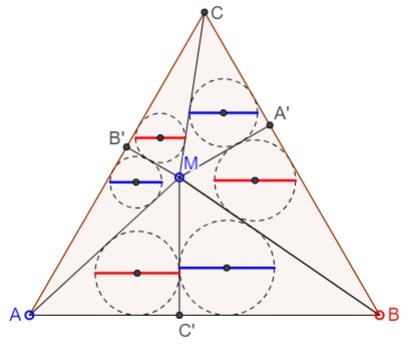
The applet purports to illustrate one of the many properties of an equilateral triangle.

Let M be a point inside an equilateral triangle ABC, with pedal points A', B', and C', as shown. The lines joining M to the six points split the triangle into six smaller ones. Circles are inscribed into each of the latter.

This applet requires Sun's Java VM 2 which your browser may perceive as a popup. Which it is not. If you want to see the applet work, visit Sun's website at http://www.java.com/en/download/index.jsp, download and install Java VM and enjoy the applet.


Buy this applet
What if applet does not run?

If the diameter of the incircle of triangle UVW is denoted D(UVW), the applet suggests that

(1) D(AMB') + D(BMC') + D(CMA') = D(A'MB) + D(B'MC) + D(C'MA).

For a proof, note that all six triangles are right, with the right angles at the pedal points A', B', C'. For a right triangle with legs a and b and the hypotenuse c, the inradius r is determined by

(2) 2r = a + b - c,

see the diagram in the Proof #33 of the Pythagorean proposition. With (2) in mind, (1) reduces to

(3) AB' + BC' + CA' = A'B + B'C + C'A.

Draw AbAc||BC, BaBc||AC, and CaCb||AB. This gets us three equilateral triangles with the pedal points A', B', C' as the midpoints of their bases. That is to say,

(4) A'Bc = A'Cb
B'Ca = B'Ac
C'Ab = C'Ba.

Substituting (4) into (3) and noting that, e.g., AB' = ACa + CaB', we get the following equivalent for (3)

(5) ACa + BAb + CBc = BCb + CAc + ABa.

Finally observe that

(6) ACa = BCb
BAb = CAc
CBc = ABa,

which proves (5).

References

  1. T. Andreescu, B. Enescu, Mathematical Olympiad Treasures, Birkhäuser, 2004

Copyright © 1996-2008 Alexander Bogomolny

28819392Page copy protected against web site content infringement by Copyscape


Search:
Keywords:


Latest on CTK Exchange
Math
Posted by Laura
2 messages
06:56 AM, Apr-15-08

Constucting a triangle instructions
Posted by Gerald B.
1 messages
12:20 PM, May-20-08

drawing puzzle
Posted by martin gran
31 messages
06:53 PM, May-09-08

conway's game of life
Posted by frequency
0 messages
11:52 PM, May-12-08

Mistake on the page (an aside, Be ...
Posted by Max
4 messages
10:28 AM, Feb-28-08

Need details on a part of Proof o ...
Posted by Manuel S.
2 messages
05:24 PM, May-16-08

Josephus Flavius (correction)
Posted by David Turner
1 messages
09:42 AM, May-14-08