
The 80-80-20 Triangle Problem, Solution #2
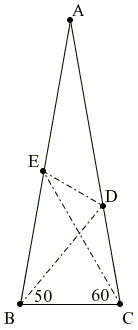
Let ABC be an isosceles triangle
|Contact| |Front page| |Contents| |Geometry| |Up|
Copyright © 1996-2018 Alexander Bogomolny
The proof exploits the ideas used by Mariano Perez de la Cruz in solving a related problem.
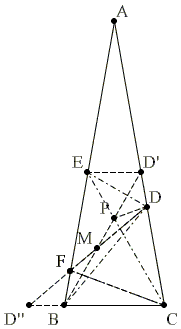
Draw CF, F on AB, with ∠BCF = 20°. Then ΔBFC is isosceles: BC = CF.
ΔBCD is also isosceles because
∠BDC = 180° - 80° - 50° = 50° = ∠CBD
Hence, BC = CD and so CD = CF.
It follows that ΔCDF is isosceles with the apex ∠DCF = 60°. Hence, ΔCDF is in fact equilateral.
Let ∠CBD' = 60°, with D' on AC. P the intersection of BD' and CE. ΔCPB is equilateral and maps by a rotation around C onto ΔCDF. Therefore, if M is the intersection of DF and BP, CM is the bisector of ∠ACB.
Now, consider a reflection in CM: D maps onto B, P onto F; let D' map on D'', D'' is on the extension of BC. Angle CFD'' (= ∠CPD') = 120°, ∠FCD'' = 20°. Thus
Since ΔEPD' is equilateral, the quadrilateral EPDD' is a kite, its diagonals are perpendicular. It follows that ED is the bisector of angles PED' and PDD'. In particular, ∠PED = 30°.
In other words, ∠CED = 30°.

The 80-80-20 Triangle Problem
- Solution #1
- Solution #2
- Solution #3
- Solution #4
- Solution #5
- Solution #6
- Solution #7
- Solution #8
- Solution #9
- Solution #10
- Solution #11
- Solution #12
|Contact| |Front page| |Contents| |Geometry| |Up|
Copyright © 1996-2018 Alexander Bogomolny
74724611