
An Inequality with Cycling Sums
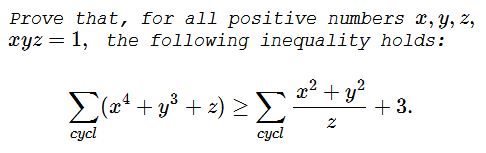
The following problem and its solution have been communicated to me by Dan Sitaru along with Proof 1. Proof 2 has been added by Imad Zak.
Proof 1
We use the two special cases of Schur's inequality:
$\displaystyle\begin{cases} t=1: & \sum_{cycl}x^3+3xyz\ge\sum_{cycl}xy(x+y),\\ t=2: & \sum_{cycl}x^4+xyz\sum_{cycl}x\ge\sum_{cycl}xy(x^2+y^2). \end{cases}$
The two inequalities are simplified by noting that $xyz=1.\;$ Add the two:
$\displaystyle\begin{align} \sum_{cycl}(x^4+x^3+x)+3&\ge\sum_{cycl}\frac{x^2+y^2}{z}+\sum_{cycl}\left(\frac{x}{z}+\frac{y}{z}\right)\\ &=\sum_{cycl}\frac{x^2+y^2}{z}+\sum_{cycl}\left(\frac{x}{z}+\frac{z}{x}\right)\\ &\ge\sum_{cycl}\frac{x^2+y^2}{z}+6, \end{align}$
which proves the required inequality.
Proof 2
First note that by the AM-GM inequality, $\displaystyle\sum_{cycl}y^3\ge 3xyz=3.\;$ Thus (where we also used Schur's inequality with $t=2$),
$\displaystyle\begin{align} \sum_{cycl}(x^4+y^3+z) &= \sum_{cycl}x^4+\sum_{cycl}y^3+\sum_{cycl}z\\ &\ge\sum_{cycl}x^4+\sum_{cycl}z+3\\ &=\sum_{cycl}x^4+xyz\sum_{cycl}x+3\\ &\ge\sum_{cycl}xy(x^2+y^2)+3\\ &=\sum_{cycl}\frac{1}{z}(x^2+y^2)+3. \end{align}$
Equality holds when $x=y=z=1.$

Inequalities with the Product of Variables as a Constraint
- An Application of Schur's Inequality II $\left(\sum (x^4+y^3+z) \ge \sum \left(\frac{x^2+y^2}{z}\right)+3\right)$
- Problem 1 From the 2016 Pan-African Math Olympiad $\left(\displaystyle \sum_{cycl}\frac{1}{(x+1)^2+y^2+1}\le\frac{1}{2}\right)$
- A Cyclic But Not Symmetric Inequality in Four Variables $\left(\displaystyle 5(a+b+c+d)+\frac{26}{abc+bcd+cda+dab}\ge 26.5\right)$
- Problem 2, the 36th IMO (1995) $\left(\displaystyle \frac{1}{a^3(b+c)}+\frac{1}{b^3(c+a)}+\frac{1}{c^3(a+b)}\ge\frac{3}{2}\right)$
- An Inequality with Two Cyclic Sums $\left(\displaystyle \sum_{cycl}(a+\sqrt[3]{a}+\sqrt[3]{a^2})\ge 9\sum_{cycl}\frac{1}{1+\sqrt[3]{b^2}+\sqrt[3]{c}}\right)$
- The Roads We Take $(x(x-3(y+z))^2+(3x-(y+z))^2(y+z)\ge 27)$
- Long Huynh Huu's Inequality and Solution $\left(\displaystyle \sum_{i=1}^n\arctan x_i\le (n-1)\frac{\pi}{2}\right)$
- An Inequality with Integrals $\left(\Omega=\int_0^u\frac{u^4+7x^3-25x^2+37x+4}{x^4-3x^3+5x^2-3x+4}dx,\;\Omega(a)+\Omega(b)+\Omega(C)\ge3+5\ln\prod_{cycl}(1+a^2)\right)$
- An Inequality with Cycling Sums
- Two Products: Constraint and Inequality $\left(\displaystyle\prod_{k=1}^n(1+a_k)\ge 2^n\right)$
- Leo Giugiuc's Cyclic Inequality with a Constraint $\left(\displaystyle a^3+b^3+c^3+\frac{16}{(a+b)(b+c)(c+a)}\ge 5\right)$
|Contact| |Front page| |Contents| |Algebra|
Copyright © 1996-2018 Alexander Bogomolny
74710836