Cut the knot: learn to enjoy mathematics
A math books store at a unique math study site. Learn to enjoy mathematics.
Google
Web CTK
Best sites for teachers
Sites for teachers
Sites for parents
Terms of use
Awards

Interactive Activities
CTK Exchange
CTK Insights - a blog

Games & Puzzles
What Is What
Arithmetic/Algebra
Geometry
Probability
Outline Mathematics
Make an Identity
Book Reviews
Eye Opener
Analog Gadgets
Inventor's Paradox
Did you know?...
Proofs
Math as Language
Things Impossible
Visual Illusions
My Logo
Math Poll
Cut The Knot!
MSET99 Talk
Other Math sites
Front Page
Movie shortcuts
Personal info
Privacy Policy

Guest book
News sites

Recommend this site

Best sites for teachers
Sites for teachers
Sites for parents

Education & Parenting

Manifesto: what CTK is about Search CTK Buying a book is a commitment to learning Table of content Things you can find on CTK Chronology of updates Email to Cut The Knot Recommend this page

The 80-80-20 Triangle Problem, Solution #6
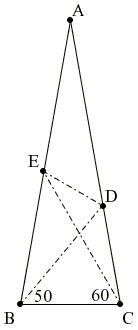
 
  Let ABC be an isosceles triangle (AB = AC) with BAC = 20°. Point D is on side AC such that CBD = 50°. Point E is on side AB such that BCE = 60°. Find the measure of CED.

Solution

Copyright © 1996-2008 Alexander Bogomolny


This is Solution 5 from [Knop] and is due to Aleksey Borodin, a high school student at the time.

Let O be the circumcenter of ΔBDE.


The inscribed angle DBE = 30° and is subtended by the same arc as the central angle DOE. Thus DOE = 60° and ΔDOE is equilateral. In particular, DEO = 60° and EO = DE.

Triangles BDO and BCD are both isosceles implying that CO bisects BCD. Thus DCO = 40°. Since DCE = 20°, CE bisects DCO.

Now, in triangles CDE and COE, EO = ED, CE is a common side and DCE = OCE. We are in a position to claim the equality of the triangles CDE and COE by a non-existent criterion SSA - by two sides and an angle opposite one of them. Usually the SSA does not work as there are two possible angles at E for the given sides and angles at C: one is less, the other greater than 90°. However, in our case, we know from the preceding paragraphs that in both triangles the angles at E are less than 60°, which makes the conclusion valid: ΔCDE = ΔCOE, with the consequence that CE bisects also DEO such that CED = 30°.

Reference

  1. C. Knop, Nine Solutions to One Problem, Kvant, 1993, no 6.

Copyright © 1996-2008 Alexander Bogomolny

29284626Page copy protected against web site content infringement by Copyscape


Search:
Keywords:


Latest on CTK Exchange
calculator suitable for high scho ...
Posted by albert1950
1 messages
10:42 AM, Jun-17-08

Constucting a triangle instructions
Posted by Gerald B.
3 messages
01:32 PM, May-20-08

Missing information
Posted by roboknight
2 messages
07:32 AM, Jun-22-08

An Interesting Formula And Algorithm
Posted by ddixonslc
1 messages
01:44 PM, Jun-19-08

Mistake on the page (an aside, Be ...
Posted by Max
4 messages
10:28 AM, Feb-28-08

Statistical estimation question
Posted by Ralph
2 messages
02:21 PM, Jul-01-08

fusc pseudocode
Posted by azi
1 messages
08:02 PM, Jun-29-08