
The Changing Shape of Geometry:
|
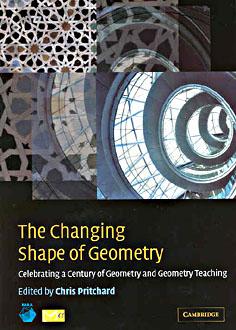
|
The book is an expanded collection of 57 articles published in Mathematical Gazette and Mathematics in School — two journals of The Mathematical Association, a British organization for teachers of mathematics — over about one hundred years. The Mathematical Association is the name taken by the Association for the Improvement of Geometrical Teaching in 1897. The latter was created in 1871. At the time, school and university geometry curricula were entirely based on Euclid's Elements and geometry was universally "viewed as the ideal vehicle for developing an understanding of formal proof" (p. 3). The first Teaching Committee was formed thirty years later (1902) to help design curriculum, assist mathematics teachers with advice and resources, and "to seek to influence national policies on mathematics education." This book celebrates the first centenary of Teaching Committee.
The tone for the book is set in the General Introduction by C. Pritchard. "This book celebrates the best of geometry in all its simplicity, economy and elegance. ... If I were to add a fourth attribute, it would be 'surprise'." Pritchard surprises the reader then and there by offering two simple and elegant problems. Solution to the second one is postponed till the end of the introduction, so as to give the reader a chance to ponder it and, perhaps, to suggest that this is what geometry is about — problem solving.
The articles have been grouped into six parts. The selection of articles is excellent, starting with the two presidential addresses What Is Geometry? that constitute Part I. For G. H. Hardy (1925), geometry is a collection of logical systems, while "the elementary geometry of schools and universities is not this or that geometry, but a most disorderly and heterogeneous collection of fragments from a dozen geometries or more." For M. Atiyah (1982), "...geometry is that part of mathematics in which visual thought is dominant. ...geometry is not so much a branch of mathematics as a way of thinking that permeates all branches."
C. Pritchard designates Hardy's view that "...the elementary geometry of schools is a fundamentally and inevitably illogical subject, about whose details agreement can never be reached" as pessimistic. I'd call it insightful. Given a century of a deliberate effort to improve geometry teaching, I am inclined to think of Atiyah's implicit belief that the matter can be settled after detailed debate as unjustifiably naïve. "The exact balance [between the two modes of thinking] is naturally a subject for detailed debate and must depend on the level and ability of the students involved."
Part II, The History of Geometry, gathers articles on Babylonian, Greek, Chinese, Islamic, Indian mathematics and the role of more recent mathematicians, Girard Desargues and Henri Brocard. A short article by J. H. Webb took me by surprise. I was unaware of the popular English definition of a straight line as "the shortest distance between two points." Webb traces the usage to a mistranslation of Legendre's Éléments de Géométrie.(1)(2)
Curiously, in Part III, on Pythagoras' Theorem, most articles are of a recent origin, written in the 1990s. Simple results, like Larry Hoehn's generalization of the Pythagorean theorem (and to which it is in fact equivalent) provide a compelling elementary argument against a widespread view on geometry as a petrified collection of axioms, definitions and theorems. In Part IV, The Golden Ratio, I liked best, in part for the same reason, J. F. Rigby's discovery of the famous number in the diagram depicting an equilateral triangle inscribed in a circle.
Part V (which contains the largest number of articles) is on Recreational Geometry. It contains several wonderful dissection and tessellation articles. In particular, an introductory essay by Brian Bolt is followed by James Brunton's paper-folding construction of a pyramid, three copies of which combine into a cube. Unfortunately, it also contains several articles whose inclusion I may only explain as due to an unhealthy trend that seeks entertainment as a goal in itself. The mathematical contents of one of Tony Orton's articles end with the very first sentence to the effect that "There are many ways of dividing a square into two shapes of equal area." From here and the natural tessellation of the plane by congruent squares, one can obtain a multitude of "attractive" designs: cogs, lightning, cats, mountains... Doing this in class would be a horrendous waste of students' time.
An article by Helen Morris provides a long list of games from around the world most of which could be played with nothing more than, say, pebbles and draft paper. These could tremendously enhance a geography lesson. But geometry?
Part VI, The Teaching of Geometry, is remarkable as much for what it contains as for what it lacks. The focus is on geometry teaching in England starting with the last quarter of the 19th century. As C. Pritchard mentioned in General Introduction, "The Mathematical Association (MA) came into existence in 1871 at a time when geometry teaching was in something of a tumult. So completely was the curriculum determined" by Euclid's Elements that "Sylvester sarcastically referred to the Elements as 'one of the advanced outposts of the British Constitution'." Originally called Association for the Improvement of Geometry Teaching, the MA played a leading role in attempts to make geometry teaching more suitable for mass education.
This part makes for an absorbing reading. However, the picture of a century-long sequence of educational reforms that emerges makes one feel that the subtitle of the book, Celebrating a Century of Geometry and Geometry Teaching, may not be quite adequate. Indeed, by the end of the 20th century geometry teaching called for anything but celebration. A 2001 Report of a Royal Society working group says in particular, "We believe that geometry has declined in status within the English mathematics curriculum and that this needs to be redressed. It should not be the 'subject which dare not speak its name'."
How come? The book documents the milestones of the evolution but, unfortunately, provides no answers. Over more than a hundred years of deliberate activity, there is no hint of any attempt to document the failures, shortcomings or successes of a reform. Writing in 1956, A. W. Siddon could say, "...I do claim that my generation has done something for the improvement of the teaching of Mathematics." Other articles in the selection left me with little doubt that, compared to what followed, the dethroning of Euclid at the beginning of the 20th century might have been the easy chapter in the history of geometry teaching.
If not a feast for geometry teaching, the book is a true celebration of geometry proper. The selection from the two MA journals has been greatly enhanced with Foreword by D. Hofstadter and a collection of 30 "Desert Island Theorems." Hofstadter tells a very personal story of a gifted youth thrown aback by the formality and abstractness of geometric literature only to recover his love for geometry at a ripe age with the help of dynamic geometry software.
The Desert Island Theorems are small gems chosen by a constellation of notable mathematicians. From An Isoperimetric Theorem (and I'd bet it's not the one you might be thinking about) by John Hersee to Two Right Tromino theorems by Solomon Golomb to Tait Conjectures by Ruth Lawrence, the collection is charming and the expositions are lucid.
I found very few errors in the book. None was overly annoying; one that
reminded me of Montaigne's On Custom was rather amusing. Jack Oliver
formulates the Pythagorean theorem for a right triangle with sides b
and c and hypotenuse a, and arrives at a correct identity
To sum up, this book is a delightful collection of articles that belongs, I think, on the bookshelf of every math teacher, present and future. Most of it could be enjoyed by high school students and geometry fans. I'd keep the book in a travel bag. Should a misfortune land you on a desert island, the book might provide much needed consolation and hours of entertainment.

For a sample of topics check A Sampling from a Geometry Collection
The Changing Shape of Geometry: Celebrating a Century of Geometry and Geometry Teaching, edited by Chris Pritchard. Cambridge University Press and MAA, 2002. Softcover, 541 pp, $40.00. ISBN 0-521-53162-4.
(1) The orginal Legendre wording was, "La ligne droit est le plus court chemin d'un point à un autre."
(2) However, I came across the following in [N. A. Court, Mathematics: In Fun and In Earnest, Mentor Books, 1961, p. 20]: We may, for instance define a straight line as the shortest distance between two points. The book has been first published in 1935 when the English influence might have been stronger in the U.S. than it is now. Which may explain the wording.
|Up| |Contact| |Front page| |Contents|
Copyright © 1996-2018 Alexander Bogomolny74186132