
Right Isosceles Triangles on Sides of a Quadrilateral
What is this about?
A Mathematical Droodle

|Activities| |Contact| |Front page| |Contents| |Geometry|
Copyright © 1996-2018 Alexander BogomolnyThe applet may suggest several related properties of a quadrilateral formed by the centers of the squares constructed on the sides of a quadrilateral.
Let P, Q, R, S be the centers of the squares constructed on the sides of a quadrilateral. Then
The quadrilateral PQRS is orthodiagonal and the diagonals are equal in length.
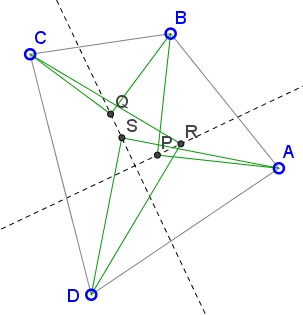
If the squares are drawn on the sides of quadrilateral with successive apexes P, Q, R, S - internal to the quadrilateral and neither P and R nor Q and S coincide, then PR is orthogonal to QS.
If the squares are drawn on the sides of quadrilateral with successive apexes P, Q, R, S - internal to the quadrilateral, then P and R coincide iff Q and S coincide.
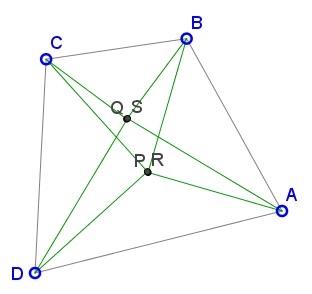
If the squares are drawn on the sides of quadrilateral with successive apexes P, Q, R, S, so that P and R are internal whilst Q and S are external to the quadrilateral, then if P, Q, S are collinear then so are R, Q, S. In particular, if P and R coincide then P, Q, R, S are collinear.
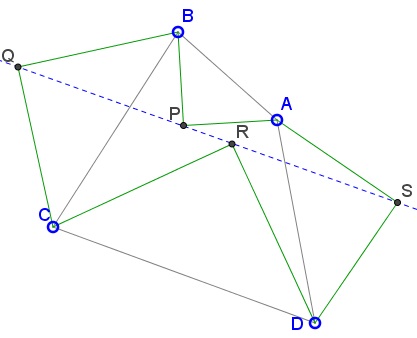
Complex numbers come in handy to help solve this problem. Let a, b, c, d be the complex numbers corresponding to the vertices A, B, C, and D and, similarly, p, q, r, s for the points P, Q, R, S. In general, we underscore this relationship as A(a), B(b), etc.
For two points U(u) and V(v), define W(w) via
| (1) | w = (1 - μ)u + μv, |
where μ = (1 + i)/2, is the apex of the right isosceles triangle with base UV such that UVW is oriented counterclockwise. Thus, assuming ABCD presents the positive orientation, we express points (or rather the corresponding complex numbers) P, Q, R, S in terms of the vertices as follows
| (2) |
p = (1 - μ)a + μb, q = (1 - μ)b + μc, r = (1 - μ)c + μd, s = (1 - μ)d + μa. |
The diagonals ac and bd are found to be (I use the underline to distinguish say the number uv = v - u corresponding to the segment joining points U and V from the product uv = u·v)
| (3) |
ac = c - a and bd = d - b. |
The two are orthogonal iff
| (4) | i·ac = bd. |
Similarly, the segments PR and QS joining the apexes of our isosceles triangles are represented by
pr = (1 - μ)(c - a) + μ(d - b) and
qs = (1 - μ)(d - b) + μ(a - c),
or,
| (5) |
pr = (1 - μ)ac + μbd and qs = (1 - μ)bd - μac. |
The two are orthogonal iff i·pr = qs. In view of (4), we see that
| (6) |
|
So (4) implies (6). Conversely, assume i·pr = qs. Then from (5)
| (7) |
|
Using
i·μ = -(1 - μ) and
i·(1 - μ) = μ
we reduce (7) to
or,
| (8) |
|
But μ/(1 - μ) = (1 + i)/(1 - i) = (1 + i)2/2 = 2i/2 = i. So (8) implies
Finally, assume Q(q) and S(s) are defined so that BCQ and DAS have negative orientation causing Q and S outside ABCD. In this case (2) is replaced by
| (2') |
p = (1 - μ)a + μb, q = μb + (1 - μ)c, r = (1 - μ)c + μd, s = μd + (1 - μ)a. |
P = R is still equivalent to (4). We observe from (2') that (p + r)/2 = (q + s)/2, and, since
(It also appears that in the latter case, the point of intersection of the diagonals also lies on QS. How come?)
Remark
When all four triangles have the same orientation it was shown elsewhere that PR and SQ are equal and perpendicular. However, the argument falls through when either has zero length.
(There is an additional exploration of this configuration.)
|Activities| |Contact| |Front page| |Contents| |Geometry|
Copyright © 1996-2018 Alexander Bogomolny74282870