
Sierpinski Gasket Via Chaos Game
The Chaos Game is a process of generating an approximation to a deterministic set by random means. It could be used with any Iterated Function System F to approximate its fixed point AF. The process is iterative. Starting with a point x0, form a sequence
xk+1 = Fr(xk), k = 0, 1, 2, ...
where Fr is a member of the IFS randomly selected for every iteration. If x0 AF, the same holds for all successive points xk. In this case it follows from Elton's Ergodic Theorem [Barnsley, p. 370] that, with probability 1, the set {xk} is dense in AF. Following [The Science of Fractal Images, Ch. 5.3, Chaos and Fractals, Ch. 6], another explanation is available.
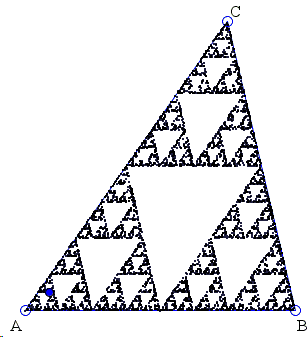
The applet below demonstrates the emergence of the Sierpinski gasket as the result of the chaos game.
| Buy this applet |
There are three contractions FA, FB, FC, each towards one of the vertices of ΔABC. For a given point x,
References
- M. Barnsley, Fractals Everywhere, Academic Press, 1988
- The Science of Fractal Images, H.-O. Peitgen and D.Daupe (eds), Springer-Verlag, 1988
- H.-O. Peitgen, H. Jürgens, D. Saupe, Chaos and Fractals: New Frontiers of Science, Springer-Verlag, 1992

About Fractals
- Dot Patterns, Pascal Triangle and Lucas Theorem
- Sierpinski Gasket Via Chaos Game
- The Chaos Game: Address Space vs IFS
- Sierpinski Gasket By Common Trema Removal
- Sierpinski Gasket By Trema Removal
- Sierpinski's Gasket and Dihedral Symmetry
- Collage Theorem And Iterated Function Systems
- Variations on the Theme of (Triangular) Tremas
- Variations on the Theme of (Rectangular) Tremas
- Sierpinski Gasket and Tower of Hanoi
- Fractal Curves and Dimension
- Color Cycling on the Mandelbrot Set
- Iterations and the Mandelbrot Set
- Mandelbrot and Julia sets
- Emergence of Chaos
- Logistic Model
- Weird curves bound normal areas
- Exercise with Square Spiral
|Activities| |Contact| |Front page| |Contents| |Geometry|
Copyright © 1996-2018 Alexander Bogomolny74286041