
Cantor Set and Function
A continuous function may grow considerably virtually without changing.
The function with this property is easily constructed on the Cantor set C0. So I'll proceed in two steps. First we'll look into C0 and then define the promised function.

| When I was a freshman, a graduate student showed me the Cantor set, and remarked that although there were supposed to be points in the set other than the endpoints, he had never been able to find any. I regret to say that it was several years before I found any for myself. |
|
Ralph P. Boas, Jr |
Cantor set C0
First of all C0 is a subset of the closed unit interval
- Divide the remaining intervals each into three equal parts.
- Remove the open middle interval.
- Repeat 1.
Thus first we remove the open interval (1/3, 2/3). This leaves a union of two closed intervals:
Observe that we started with the interval [0, 1] of length 1. After removing d1,1, the total length of the remaining intervals became 2/3. d2,1 and d2,2 each contributed 1/3 to the total. So after their removal, the four remaining intervals had the total length of (2/3)2. Next we remove 4 middle intervals
For example
C0 = {x: x = (0.a1a2a3...)3, where each aj = 0 or 2}.
Applying the diagonal process we immediately see that C0 is not countable.
Thus, this is the Cantor set C0 which has many remarkable properties. For example, the Cantor set has no isolated points. In other words, every neighborhood of every point in C0 contains infinitely many other points from C0. (A point of a set is isolated if in some of its neighborhoods there are no other points from that set.) This makes C0 a perfect set (since it is obviously closed.) I'll use C0 as a basis for the construction of the function announced at the beginning of the page.
Remark
1/4∈C0. Indeed, (0.25)10 = (0.020202...)3. Similarly, since
(0.75)10 = (0.202020...)3, 3/4∈C0. The reciprocal of 13 also happens to be sufficiently "lucky" to be a member of C0:1/13 = (0.002002002...)3. A similar construction yields Cantor sets of positive measure.
Cantor function
Let x = (0.a1a2a3...)3∈C0 which means that all ai's are either 0 or 2. Let define a function
let bi = ai/2, then define f(x) = (0.b1b2b3...)2, where x = (0.a1a2a3...)3.
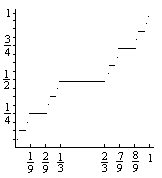
What's interesting is that at the end points of the intervals dp,k so defined function takes on equal values. Consider, for example,
f(1/3) = f(0.0222...) = (0.0111...)2 = (0.1)2 = 1/2.
On the other hand, f(2/3) = f(0.2) = (0.1)2. Therefore
Remark 1
Cantor function is as famous as it is useful for other exceptional constructs. For example,
let
Remark 2
Cantor's function serves a very specific example for Lebesgue's Theorem
Every monotone function has a well defined finite derivative almost everywhere.
Cantor's function is monotone increasing and is also continuous - a condition not required by Lebesgue's Theorem. It has a derivative everywhere except at Cantor's set which is a set of (Lebesgue) measure zero. This explains the term "almost everywhere".
References
- B.R.Gelbaum and J.M.H.Olmsted, Counterexamples in Analysis, Holden-Day, 1964
- B.R.Gelbaum and J.M.H.Olmsted, Theorems and Counterexamples in Mathematics, Springer-Verlag, 1990
Cantor Set
- Cantor set and function
- Cantor Sets
- Difference of two Cantor sets
- Difference of two Cantor sets, II
- Sum of two Cantor sets
- Plane Filling Curves: the Lebesgue Curve
|Contact| |Front page| |Contents| |Did you know?| |Geometry|
Copyright © 1996-2018 Alexander Bogomolny74683151