
 |
Cut The Knot!by Alex Bogomolny |
Dot Patterns and Sierpinski Gasket
February 1998

In the last column, we looked into simple patterns exhibited by addition and multiplication tables. The next logical step would be to investigate the tables corresponding to various operations in modular arithmetic. But let's, for a change, look into things triangular.
So, how many ways are there to define the Sierpinski gasket (also, the Sierpinski triangle)? I counted a respectable 11 but undoubtedly there are more. I would be happy to be advised of additional ones.
- From Pascal's Triangle. Replace the terms of Pascal's triangle with their residues modulo 2 [GAR, PIC, WEL]. (So we are still into modular arithmetic.)
- Iterated Function Systems. In complex notations, the Sierpinski gasket is the fixed point (attractor) of the system: f1(z) = z/2, f2(z) = z/2 + 1/2, f3(z) = z/2 + (
 3 + I)/2 [BAR, EDG, MAN].
- Image of a code space. Identify a point with a string (possibly infinite) of symbols 1,2,3 such that finite substrings are interpreted as successive applications of function f1, f2, and f3 starting with the origin. The resulting sequence of points will converge to (or coincide with) the given point [BAR, EDG]. The Chaos Game is an entertaining introduction into this coding.
- L-Systems. L-Systems have originally been known as recursive sets. Objects are combinations of linear segments. Starting with an initiator, segments on any given step are replaced in the manner prescribed by a generator [EDG, MAN].
- Trema removal (common construction). The most common construction of the Sierpinski gasket is by splitting a triangle into four by the midlines and removing the middle triangle and then applying the same procedure recursively to the three remaining triangles.
- Trema removal. Alternatively, it's possible to arrive at the Sierpinski gasket by removing square tremas.
- Barycentric coordinates. A point in a triangle is uniquely defined by three nonnegative numbers u,v,w such that u + v + w = 1. In the binary system, triplets (u,v,w) = (0.v1v2..., 0.u1u2..., 0.w1w2...) correspond to a point from Sierpinski's gasket iff the three numbers u,v,w have between them a binary representation such that for every index n exactly one of un, vn, or wn is equal to 1 [EDG].
- A curve. Being a uniform limit of curves (for it's defined by an L-System), the Sierpinski gasket is known to be the image of a continuous map from [0,1]. Does anyone know how to define such a curve explicitly?
- 1-dimensional automata. Consider an infinite string of cells that might be of two kinds (say, 0 and 1). At discrete times, cells transition depending on their kind and the kind of their immediate right neighbors. The like kinds produce 0. Two unlike kinds result in 1 [WEL]. Depict consecutive states of a string in rows growing downwards.
- Puzzle Graphs. There is an interesting relation between the puzzle graph of the Tower of Hanoi puzzle and Pascal's triangle, and hence the Sierpinski gasket [AHA, STE].
- Finite Automata. Similar to, but different from, the discussion below, the Sierpinski gasket could be obtained as a result of a step by step automation taken modulo 2.
- Bitwise operations. The non-zero entries in the table of the bitwise operation AND form the Sieprinski gasket.
In the drawing area of the applet below, we have either rows of digits or circles with colors corresponding to the digits. Patterns in the drawing area are defined row-by-row starting from the upper row which consists of clickable digits (or circles.) The value p of a node is defined by values (q1 and q2) of the two nodes immediately above it according to the following formula:
p = q1 + q2 (mod N),
where N is the modulus of the arithmetic used. Think of the applet as presenting a finite view of an infinite lattice of nodes filling the lower half plane. All omitted nodes are assigned the value of 0. The applet has the following controls:
- Every dot in the upper row is clickable. With every click the digit (or the corresponding color) cycles through the sequence of residues 0, 1, 2, 3, ..., N-1.
- When creating a new pattern, you can select to get a single nonzero digit in the upper row, or a random pattern, or the whole upper row carrying the same digit (1).
- By checking "Multiplies" you request to associate all nonzero digits with a single color. In this case, the pattern consists of two colors only with 0 using the foreground color. So that the colors are in a sense reversed.
- You can also choose to see a pure triangle with a single node in the upper row. The apex of the triangle is still clickable.
(Please note that when the number of rows is close to the maximum of 50, the drawing is slow. Be patient.)
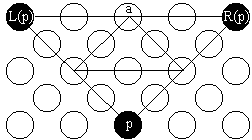
I'll make just a few observations related to the binary system (N = 2). Assume the rows are numbered from 0, the next being 1, and so on. For every node p, only dots in the upside down triangle above it, may affect its value. However, dots in rows 1,2,4,... - all powers of 2 - only depend on the values of their extreme ancestors - L(p) and R(p). The proof is by induction and uses the simple identity a + a = 0 (mod 2). This is why in the rows corresponding to the powers of 2 there are only 2 nonzero dots. Each of these two dots propagates in exactly the same pattern as in the triangle above them. The two patterns do not interfere until they meet at a row that is the next power of 2, and so on. We see the birth of the self-similarity characteristic of the Sierpinski gasket.
In row 1, two nonzero dots are next to each other. In row 2, they are one dot apart. In row 4, there are 3 zero dots. In row 2n, there are 2n-1 of them. Therefore, we may generate lower rows of the Sierpinski gasket by repeating these patterns in the upper row. Each nonzero dot in the upper row emits a copy of the Sierpinski gasket. The whole pattern is a superposition of the gaskets.
Obviously, if the upper row contains only zero dots, all the dots below it are zero. The same is true when the upper row is filled with nonzero dots. So there are two starting arrangements for the upper row that result in the same pattern from the first row downwards. Is this true of any such pattern? Yes, of course. Two arrangements in the upper row complementary to each other (i.e., never having the same dot in the same position) generate the same pattern from the first row down.
Starting with a single nonzero dot, this is always the case that rows 2n-1 consist of a contiguous segment of nonzero dots whereas rows 2n-2 contain an alternating pattern.
If N is prime, each row number Nn contains only 2 nonzero dots. For composite N, the situation is not that simple. Much depends on the value at the apex of the triangle. With N = 6, we may observe patterns from both N = 2 and N = 3.
References
- [AHA] I.Aharoni, From Tower of Hanoi to Pascal's Triangle, Alefefes, #4, 1996 (in Hebrew)
- [BAR] M.Barnsley, Fractals Everywhere, Academic Press, 1988
- [EDG] G.A.Edgar, Measure, Topology, and Fractal Geometry, Springer, 1990
- [GAR] M.Gardner, Mathematical Carnival, Vintage Books, 1965-1977
- [HIL] P.Hilton, D.Holton, J.Pdersen, Mathematical Reflections, Springer, 1997
- [MAN] B.Mandelbrot, Fractal Geometry of Nature, W.H.Freeman & Co, 1983
- [PIC] C.A.Pickover, Computers, Patterns, Chaos, and Beauty, St. Martin's Press, 1990
- [STE] I.Stewart, Another Fine Math You've Got Me Into, W.H.Freeman & Co, 1992
- [WEL] D.Wells, You Are a Mathematician, John Wiley & Sons, 1995
- Dot Patterns and Sierpinski Gasket
- Sierpinski Gasket By Common Trema Removal
- Sierpinski Gasket Via Chaos Game
- Sierpinski Gasket By Trema Removal
- Sierpinski's Gasket and Dihedral Symmetry
- Collage Theorem And Iterated Function Systems
- The Chaos Game: Address Space vs IFS
- Sierpinski Gasket and Tower of Hanoi
- Variations on the Theme of Tremas
- Barycentric Coordinates
- Similarity Dimension
- Iterations and the Mandelbrot Set
- Mandelbrot and Julia sets
- Emergence of Chaos
|Contact| |Front page| |Contents| |Algebra| |Geometry| |CTK|
Copyright © 1996-2018 Alexander Bogomolny
74314282