
The Means
Consider two similar problems:
Problem 1
A fellow travels from city $A\;$ to city $B.\;$ For the first hour, he drove at the constant speed of $20\;$ miles per hour. Then he (instantaneously) increased his speed and, for the next hour, kept it at $30\;$ miles per hour. Find the average speed of the motion.
Problem 2
A fellow travels from city $A\;$ to city $B.\;$ The first half of the way, he drove at the constant speed of $20\;$ miles per hour. Then he (instantaneously) increased his speed and traveled the remaining distance at $30\;$ miles per hour. Find the average speed of the motion.

The two problems are often confused and the difference between them may not be immediately obvious. The second one, as a mathematical conundrum, has been included in many math puzzles books.
By definition, the average speed S of the motion that lasted time T over the distance D is
$\displaystyle\text{Average speed} = \frac{\text{Total distance}}{\text{Total time}}\;$ or $\displaystyle S = \frac{D}{T}.$
The definition applies directly to the first problem. The fellow was on the road for the total of $T=2\;$ hours. Going at $20\;$ mi/h for the first hour the fellow covered the distance of $20\;$ miles. Similarly, in the second hour he covered the distance of $30\;$ miles. Therefore, in $2\;$ hours he traveled the total of $D=20+30=50\;$ miles. The average speed then is found to be $\displaystyle S=\frac{50}{2}=25\;$ m/h.The second problem is only a little more complex. There are three ways to write the formula above: $\displaystyle S=\frac{D}{T},\;$ $D=ST,\;$ $\displaystyle T=\frac{D}{S}.\;$ I apply the latter one. Let $d\;$ be half the distance between the two cities. The first leg of the journey took $\displaystyle\frac{d}{20}\;$ hours, the second $\displaystyle\frac{d}{30}.\;$ Therefore, on the whole, the fellow was on the road $\displaystyle T=\frac{d}{20}+\frac{d}{30}\;$ hours. During that time he covered $D=2d\;$ miles. It follows that his average speed is given by $\displaystyle S=\frac{2d}{\displaystyle\frac{d}{20}+\frac{d}{30}}\;$ or, after cancelling out the common factor $d,\;$ and a few arithmetic operations $S=24\;$ m/h. If the distance between the cities were, as in the first problem, $50\;$ miles, then the journey would take $T=\displaystyle\frac{50}{24}\;$ hours or $2\;$ hours and $5\;$ minutes, of which $1\;$ hour and $15\;$ minutes $(=\displaystyle\frac{25}{20}\;$ hours) were spent on the first $25\;$ miles and $50\;$ minutes $(=\displaystyle\frac{25}{30}\;$ hours) on the second $25\;$ mile stretch.
What we found is that, depending on the circumstances, to determine the average speed of motion, computations based on the same basic formula $\left(S = \displaystyle\frac{D}{T}\right)\;$ may have to follow different routes.
Now there are three means in music: first the arithmetic, secondly the geometric, and thirdly the subcontrary, the so-called harmonic.
Archytas, cited by Porphyry in his Commentary on Ptolemy's Harmonics
I. Thomas, Greek Mathematical Works, v1,
Harvard University Press, 2006, p 113
For the given two quantities, $20\;$ and $30,\;$ the number $\displaystyle\frac{20+30}{2}\;$ is known as their arithmetic mean while $\displaystyle\frac{2}{\displaystyle\frac{1}{20}+\frac{1}{30}}\;$ is the harmonic mean of the two numbers. Of course the are more general definitions. For convenience, it is customary to group a finite sequence of numbers $a_{1},a_{2}, \ldots, a_{n}\;$ in a vector form $\mathbf{a}=(a_{1},a_{2},\ldots, a_{n}).\;$ Then I am going to use the following shorthands:
$\displaystyle A(\mathbf{a}) = \frac{1}{n}\sum\mathbf{a} = \frac{1}{n}\sum_{i=1}^{n}a_{i}\;$ and $\displaystyle H(\mathbf{a}) = \frac{n}{\sum\displaystyle\frac{1}{\mathbf{a}}} = \frac{n}{\displaystyle\sum_{i=1}^{n}\frac{1}{a_{i}}},$
Observe that $\displaystyle H(\mathbf{a})=\frac{1}{A(\frac{1}{\mathbf{a}}}).\;$ (For those who are not very comfortable or familiar with the summation formulas, it might be useful to verify this statement for small values of $n,\;$ say $2,\;$ $3,\;$ and $4.)\;$ This leads to a more general definition
$M_{r}(\mathbf{a}) = (\frac{1}{n}\sum_{i=1}^{n}\mathbf{a}^{r})^{1/r} = (\frac{1}{n}\sum_{i=1}^{n}a_{i}^{r})^{1/r}$
where I assume that all $a_{i}$'s are non-negative and $r\;$ is a real number different from $0.\;$ For example, $A(\mathbf{a}) = M_{1}(\mathbf{a})\;$ whereas $H(\mathbf{a}) = M_{-1}(\mathbf{a}).\;$
In general, $M_{r}(\mathbf{a})\;$ is the mean value of numbers $a_{1}, a_{2}, \ldots, a_{n}\;$ with the exponent $r.\;$ $M_{2}(\mathbf{a})\;$ is known as the quadratic average. It differs by a factor of $n^{1/2}\;$ from the Euclidean distance from the end of the vector $\mathbf{a}\;$ to the origin. Do other means have special names? Not that I am aware of. Are they of any use? I must say that I dislike this question. I am appalled by the current tendency to place an emphasis (while teaching and learning) on the so-called useful things. (Should, for example, a math teacher be concerned with how and whether factoring is used in real world? I do not know whether superellipses were of any use until Piet Hein discovered their esthetic properties.)
In the case of the means, considering $M_{r}(\mathbf{a})\;$ for nonzero real $r\;$ almost immediately proves to be a nice idea. It appears that once the means were defined for nonzero exponents, it becomes also possible to define $M_{0}(\mathbf{a}).\;$ A 2-step proof is very simple but needs an application of what's known as the L'Hôpital Rule, a subject covered in any Calculus I course. By the L'Hôpital Rule, it follows that the limit, $\displaystyle\lim_{r\rightarrow 0}M_{r}(\mathbf{a})\;$ exists and is equal to the geometric mean of numbers $a_{1}, a_{2}, \ldots, a_{n}.\;$ Thus the following complements the definition of $M_{r}(\mathbf{a}):$
$M_{0}(\mathbf{a}) = (a_{1}a_{2} \ldots a_{n})^{1/n}=\sqrt[n]{a_{1}a_{2} \ldots a_{n}}.$
Lemma
For $r > 0,\;$ $M_{r}(\mathbf{a}) < M_{2r}(\mathbf{a}),\;$ provided not all $a_{i}$'s are equal. If they are then $M_{r}(\mathbf{a}) = M_{2r}(\mathbf{a}).\;$
Proof
Inequality $M_{r}(\mathbf{a}) < M_{2r}(\mathbf{a})\;$ can be rewritten as $M_{1}(\mathbf{a}^{r}) < M_{2}(\mathbf{a}^{r}),\;$ where, by convention, $\mathbf{a}^{r}= (a_{1}^{r},a_{2}^{r}, \ldots, a_{n}^{r}).\;$ The latter follows from a beautiful identity
$\displaystyle\sum_{i=1}^{n}a_{i}^{2}\sum_{i=1}^{n}b_{i}^{2} - (\sum_{i=1}^{n}a_{i}b_{i})^{2} = \frac{1}{2}\sum_{i=1}^{n}(a_{i}b_{j} - a_{j}b_{i})^{2}$
whose right-hand side is non-negative and is equal to zero only when vectors $\mathbf{a}\;$ and $\mathbf{b}\;$ are proportional. The lemma follows from the latter with $b_{i} = 1\;$ for all $i = 1, 2, \ldots, n.\;$
Applying Lemma repeatedly we get
$\displaystyle M_{r}(\mathbf{a}) > M_{\frac{r}{2}}(\mathbf{a}) > M_{\frac{r}{2^{2}}}(\mathbf{a}) > M_{\frac{r}{2^{3}}}(\mathbf{a}) \ldots\;\rightarrow\;M_{0}(\mathbf{a}),$
as above (remember the L'Hôpital Rule!). From here it follows that for any $r \gt 0,\;$ $M_{r}(\mathbf{a}) \gt M_{0}(\mathbf{a})\;$ (except, of course, for the case where all $a_{i}$'s are equal). This is a generalization of the Arithmetic mean - Geometric mean inequality $M_{1}(\mathbf{a}) \gt M_{0}(\mathbf{a}).\;$
On the other hand, if $r \lt 0\;$ and $s = -r,\;$ we can write
$\displaystyle M_{r}(\mathbf{a}) = M_{-s}(\mathbf{a}) = \frac{1}{M_{s}(\frac{1}{\mathbf{a}})} \lt \frac{1}{M_{0}(\frac{1}{\mathbf{a}})} = M_{0}(\mathbf{a}).$
Therefore, for any two real $s\;$ and $r,\;$ $s \lt r,\;$ we have a further generalization: $M_{s}(\mathbf{a}) \lt M_{r}(\mathbf{a}).\;$
The applet below illustrates this property of the means. The number bars are draggable up and down, while the exponent r can be changed by dragging the horizontal slider.
| What if applet does not run? |
It's also easily seen that, unless all $a_{i}$'s are the same,
$\min\{a_{i}\} \lt M_{r}(\mathbf{a}) \lt \max\{a_{i}\}$
Furthermore, it can be shown that $M_{r}(\mathbf{a})\;$ approaches $\max\{a_{i}\}\;$ as $r\;$ grows without limit. Also, $M_{r}(\mathbf{a})\;$ approaches $\min\{a_{i}\}\;$ as $r\;$ tends to $-\infty.\;$ For this reason, we also define
$M_{-\infty}(\mathbf{a}) = \min\{a_{i}\}\;$ and $M_{\infty}(\mathbf{a}) = \max\{a_{i}\}.\;$
Finally we can claim that, for any two real $s\;$ and $r,\;$ $s < r,\;$ and not all $a_{i}$'s equal,
$M_{-\infty}(\mathbf{a}) \lt M_{s}(\mathbf{a}) \lt M_{r}(\mathbf{a}) \lt M_{\infty}(\mathbf{a}).$
Here's a proof for $M_{s}(\mathbf{a}) \lt M_{r}(\mathbf{a}):$
Hölder's inequality tells us that: $\sum \mathbf{u}^{\alpha}\mathbf{v}^{1-\alpha}\le \left(\sum \mathbf{u}\right)^{\alpha}\cdot\left(\sum \mathbf{v}\right)^{1-\alpha},\,$ for $\alpha\in (0,1).$
Let $s=r\cdot\alpha,\,$ $\mathbf{u}=\displaystyle \frac{1}{n}\mathbf{a}^r,\,$ $\mathbf{v}=\displaystyle \frac{\mathbf{1}}{n}:$
$\mathbf{u}^{\alpha}=n^{-\alpha}\mathbf{a}^s,\,$ $\sum \mathbf{u}^{\alpha}\mathbf{v}^{1-\alpha}=\sum n^{-\alpha}\mathbf{a}^s\cdot n^{\alpha-1}=\displaystyle \frac{\sum \mathbf{a}^s}{n}.$
$\displaystyle\begin{align}\left(\sum \mathbf{u}\right)^{\alpha}\cdot\left(\sum \mathbf{v}\right)^{1-\alpha}&=\left(\sum \mathbf{a}^r\right)^{\frac{s}{r}}\cdot\left(\sum\frac{1}{n}\right)^{1-\frac{s}{r}}\\ &=\left(\frac{\sum \mathbf{a}^r}{n}\right)^{\frac{s}{r}}\cdot\left(\sum\frac{1}{n}\right)\\ &=\left(\frac{\sum \mathbf{a}^r}{n}\right)^{\frac{s}{r}}. \end{align}$
The combination yieds $\displaystyle \frac{\sum \mathbf{a}^s}{n}\le\left(\frac{\sum \mathbf{a}^r}{n}\right)^{\frac{s}{r}},\,$ and the conclusion follows.
Remark
A question is often raised whether or not it is useful to study continuous functions that are not given by a single formula like $\displaystyle f(x) = \frac{x^{2} - 1}{x^{5} + 1}.\;$ For a fixed $\mathbf{a},$ $f(x) = M_{x}(\mathbf{a})\;$ serves an example of a continuous function that can't be represented in such a manner. As we saw above, $f(0)\;$ requires an essentially different formula than other values of $x.\;$
A Nice Exercise
Given a trapezoid with bases of lengths $a\;$ and $b.\;$ Consider 4 line segments parallel to the bases. Prove that
- the length of the segment that divides the trapezoid into two of equal area is the quadratic mean of $a\;$ and $b,\;$
- the length of the segment half way between the bases is the arithmetic mean of $a\;$ and $b,\;$
- the length of the segment through the point of intersection of diagonals is the harmonic mean of $a\;$ and $b,\;$
- the length of the segment that divides the trapezoid into two similar ones is the geometric mean of $a\;$ and $b.\;$.
Another Variant
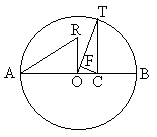
In the diagram on the right, $AB\;$ is a diameter of the semicircle $ATB\;$ with center $O.\;$ $CT\perp AB,\;$ $CF\perp OT,\;$ $OR\perp AB.\;$ Let $AC=a,\;$ $BC=b,\;$ $OR=\displaystyle\frac{a-b}{2}.\;$ Then
- $CT\;$ is the geometric mean of $a\;$ and $b,\;$
- $OT\;$ is the arithmetic mean of $a\;$ and $b,\;$
- $TF\;$ is the harmonic mean of $a\;$ and $b,\;$
- $AR\;$ is the quadratic mean of $a\;$ and $b.\;$
Obviously, $AR \ge AO=OT\ge CT\ge TF.$ It is worth remembering that, unless all $a_{i}$'s are equal

When all $a_{i}$'s are equal, so are the means.
References
- E. F. Beckenbach, R. Bellman, Introduction to Inequalities, Random House, 1975
- S. L. Greitzer, Arbelos, v6, MAA, 1988
- G. H. Hardy, J.E.Littlewood, G.Pólya, Inequalities, Cambridge Univ Pr., 1998
- O. A. Ivanov, Easy as p, Springer, 1998
|Contact| |Front page| |Contents| |Algebra|
Copyright © 1996-2018 Alexander Bogomolny74282212