Partitioning a Circle

Problem

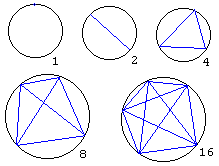
N points are selected on a circle and connected by chords in all possible ways. The points are in a general position, in the sense that no three of those chords are concurrent, i.e., no three of them pass through the same point. Into how many region the chords partition the circle?

Let's denote the number of regions in a partition with N points R(N). As a quick inspection of a few small point sets shows R(1) = 1, R(2) = 2, R(3) = 4, R(4) = 8, R(5) = 16. The pattern appears to emerge: R(N) = 2N-1. However, R(6) = 31. An attempt at inductive reasoning, i.e., an attempt to generalize from a finite sample of verified examples proves to be misleading.

One solution to this problem links it to partitioning of convex polygons. Here I'll give a solution that depends on Euler's formula. We've proven that

F - E + V = 2

for a polyhedron with F faces, E edges and V vertices. Considering a polygon as a projection of a polyhedron with just one face hidden, the Euler's formula for polygons becomes:

F - E + V = 1

This is the one we shall be referring to below. The formula remains valid if edges allowed to be curved so that it applies to general planar graphs.

I'll use the standard notation C(n, r) for the number of all possible unordered selections of r elements out of a set of n elements. These are called r-combinations. C(n, r)'s appear as coefficients in the Binomial Theorem:

C(n, r) = 
n!

r!(n - r)!

As usual, k! = 1·2·3·...·k is the k factorial.

For N points, there are exactly C(N, 4) intersections of chords inside the circle, since each set of 4 points gives rise to just one such intersection. Then the total number of vertices in the figure V = C(N, 4) + N. To count the number E of edges, we count their ends. Four edges meet at each of the internal C(N, 4) vertices and (N + 1) meet at the points on the circle. Since each edge has two ends, this gives 2E = 4C(N, 4) + N(N + 1). Using the Euler's formula:

F = E + 1 - V = (4C(N, 4) + N(N + 1))/2 + 1 - (C(N, 4) + N).

which simplifies to C(N, 4) + C(N, 2) + 1.

References

  1. R. K. Guy, A Strong Law of Small Numbers, in The Lighter Side of Mathematics, R.K.Guy and R.E.Woodrow, eds, MAA, 1994

Related material
Read more...

  • Counting: The Beginning of Mathematics
  • Children's Counting Blocks Are Available
  • The Idea of Counting
  • Tribute to Invariance
  • Dollars in Pockets
  • Counting Triangles
  • Counting Triangles II
  • 100 Grasshoppers on a Triangular Board
  • |Contact| |Front page| |Contents| |Generalizations| |Geometry| |Store|

    Copyright © 1996-2012 Alexander Bogomolny

     40608244

    A math books store at a unique math study site. Shopping at the store helps maintain the site. Thank you.
    Sites for teachers
    Sites for parents
    Terms of use
    Awards
    Interactive Activities

    CTK Exchange
    CTK Wiki Math
    CTK Insights - a blog
    Math Help
    Games & Puzzles
    What Is What
    Arithmetic
    Algebra
    Geometry
    Probability
    Outline Mathematics
    Make an Identity
    Book Reviews
    Stories for Young
    Eye Opener
    Analog Gadgets
    Inventor's Paradox
    Did you know?...
    Proofs
    Math as Language
    Things Impossible
    Visual Illusions
    My Logo
    Math Poll
    Cut The Knot!
    MSET99 Talk
    Old and nice bookstore
    Other Math sites
    Front Page
    Movie shortcuts
    Personal info
    Privacy Policy

    Guest book
    News sites

    Recommend this site

    Sites for parents

    Education & Parenting

    Search:
    Keywords:

    Google
    Web CTK
    Supported by
    3wVentures