
Projective Proof of Maxwell's Theorem
Maxwell's theorem links the sides and cevians in one triangle to the cevians and side lines in another:
Given two triangles ABC and MNP. Assume that the cevians in ΔABC parallel to the sides of ΔMNP are concurrent. Then the cevians in ΔMNP parallel to the sides of ΔABC are also concurrent.
Michel Cabart came up with a generalization that shows that Maxwell's theorem is of projective nature. The main tool is the projective reformulation of Ceva's theorem.

By Michel Cabart
9 May, 2008
Recollect the projective formulation of Ceva's theorem: Given an arbitrary line L, the cevians in ΔABC concur iff
| (1) | R = (CBA'A0)·(ACB'B0)·(BAC'C0) = -1 |
where (WXYZ) denotes the cross-ratio
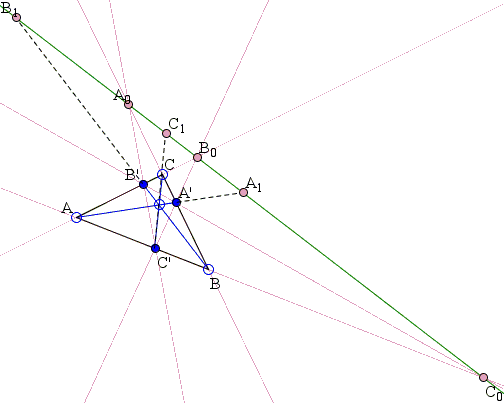
In addition, let A1, B1, C1 be the intersection with L of the cevians AA', BB', and CC'.
Projection from A to the line L send the first quadruple in (1) onto B0, C0, A1, A0:
(CBA'A0) = A(B0C0A1A0)
Similarly,
|
(ACB'B0) = B(C0A0B1B0), (BAC'C0) = C(A0B0C1C0) |
Thus the condition (1) can be written (cross-ratios being unchanged):
| (2) | R = (A0B0C1C0)·(B0C0A1A0)·(C0A0B1B0) = -1 |
Proof of Maxwell's theorem
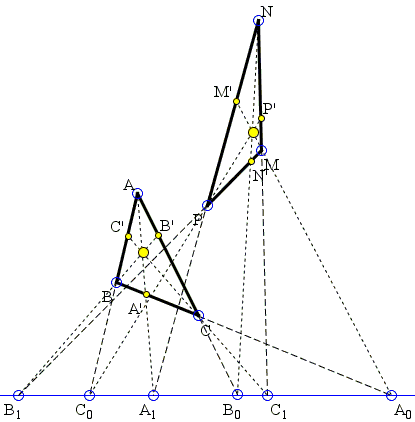
Assume there are two triangles ABC and MNP and two triples of points on L such that A0, B0, C0 are intersections of L with sides of ΔABC and also with cevians of ΔMNP; A1, B1, C1 are intersections of L with sides of ΔMNP and also with cevians of ΔABC.
For ΔABC, we calculate
R0 = (A0B0C1C0)·(B0C0A1A0)·(C0A0B1B0).
For ΔMNP, we calculate
R1 = (A1B1C0C1).(B1C1A0A1).(A1B1C0C1)
We have the identity R0·R1 = 1 (as can be seen by developing cross-ratios). Hence
Note: a dynamic illustration is available on a separate page.
Maxwell Theorem and orthologic triangles
- Maxwell's Theorem
- Gergonne and Medial Triangles Are Orthologic
- Orthologic Triangles in a Quadrilateral
- Pedal Triangle and Isogonal Conjugacy
- Projective Proof of Maxwell's Theorem
- Maxwell's Theorem by Way of Trigonometric Ceva
|Contact| |Front page| |Contents| |Geometry|
Copyright © 1996-2018 Alexander Bogomolny
74284667