
Antiparallel via Three Reflections
What Is It About?
A Mathematical Droodle

|Activities| |Contact| |Front page| |Contents| |Geometry|
Copyright © 1996-2018 Alexander Bogomolny
Antiparallel via Three Reflections
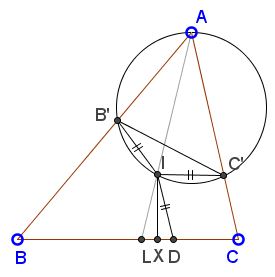
The applet illustrates a problem from the College Mathematical Journal (909, by Francisco Javier García Capitán, Spain)

Let α, β, γ be the angular measures of angles BAC, ABC, ACB:
∠ALB = 180° - α/2 - β = γ + α/2.
Since D is the reflection of L in X (IX⊥BC), ∠IDL = γ + α/2. Also
∠IDB = 180° - (γ + α/2) = β + α.
Next, by the two reflections in BI and CI,
∠AB'I = ∠IDL = γ + α/2 and
∠AC'I = ∠IDB = β + α/2.
It follows that ∠AB'I + ∠AC'I =
From here,
∠IB'C' = ∠IC'B' = α/2.
Further,
∠AB'C' = ∠AB'I - ∠IB'C' = (γ + α/2) - α/2 = γ.
Similarly, ∠AC'B' = β which makes the line B'C' antiparallel to BC. As we know, this implies that quadrilateral BCC'B' is cyclic.
|Activities| |Contact| |Front page| |Contents| |Geometry|
Copyright © 1996-2018 Alexander Bogomolny
74291483