
The Distance Formula
Very often, especially when measuring the distance in the plane, we use the formula for the Euclidean distance. According to the Euclidean distance formula, the distance between two points in the plane with coordinates
dist((x, y), (a, b))
As an example, the (Euclidean) distance between points (2, -1) and (-2, 2) is found to be
| dist((2, -1), (-2, 2)) | = √(2 - (-2))² + ((-1) - 2)² | |
| = √(2 + 2)² + (-1 - 2)² | ||
| = √(4)² + (-3)² | ||
| = √16 + 9 | ||
| = √25 | ||
| = 5. |
The source of this formula is in the Pythagorean theorem. Look at the diagram
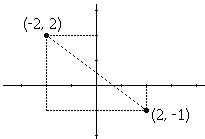
The horizontal distance between the points is 4 and the vertical distance is 3. Let's introduce one more point
How good is the (Euclidean) distance formula for measuring real distances? This depends on the circumstances. In the plane - since the Earth is round, this means within relatively small areas of Earth's surface - it is pretty good, provided the distance is exactly what you want to estimate. If the question is, How fast you can get from one point to another while moving at a given speed, the Euclidean formula may not be very useful providing the answer. Indeed, in a city - just to take one example - it is often impossible to move from one point straight to another. There are buildings, streets busy with traffic, fences and what not, to be accounted for. In a city, one often finds that the taxicab distance formula
dist((x, y), (a, b)) = |x - a| + |y - b|
is more useful. In mathematics, the Euclidean distance is most fundamental. As one of the mechanical proofs of the Pythagorean theorem shows, the same is also true in physics, although in either science it's not the only distance formula used.

Taxicab/City-block Distance.
- Treasure Hunt in a Square Grid
- Treasure Hunt from Outside the Grid
- Objects distant and near
- Farmer and Wife To Catch Rooster and Hen
- Distance Formula
- What Is Geometry?
|Contact| |Front page| |Contents| |Geometry|
Copyright © 1996-2018 Alexander Bogomolny74283466