
C0 - C0 = [-1, 1]
The Cantor set C0, while full of holes, has a remarkable property that for any real number in the interval
For any two sets A and B, the difference set A - B (see also Addition of Shapes) is defined as
A - B = {a - b : a∈A and b∈B}
The aforementioned property of the Cantor set is then expressed concisely:
C0 - C0 = [-1, 1]
In geometric terms, any segment not longer than 1 (unit) can be positioned on the number line such that both its endpoints will rest on the Cantor set. In two dimensions, two such segments can be laid independently - one on the x-axis, the other on y-axis. In other words, any rectangle with side lengths not exceeding 1 can be positioned on the plane so that each coordinate of each of its corners belong to the Cantor set. The same is true for parallelepiped in three dimensions and their generalizations in higher dimensions.
Back to the plane, the set Sx = C0×[0, 1] consists of vertical segments with feet at the Cantor set. (A×B is the direct product of the sets A and B.) Similarly,

Now let's prove the statement C0 - C0 = [-1, 1].
Proof #1
I'll use the ternary characterization of the Cantor set: a real number from
The first step is inductive on the length of the ternary expansion. There are just 3 fractions of length 1:
0.0 = 0.0 - 0.0, 0.1 = 0.2 - 0.0222..., 0.2 = 0.2 - 0.0
Expansions of length 2 are obtained by appending a digit to expansions of length 1. The differences are modified easily if the additional digit is 0 or 2. For example,
0.0 = 0.0 - 0.0 and 0.2 = 0.2 - 0.0 lead to 0.01 = 0.02 - 0.0022... and 0.21 = 0.22 - 0.0022..., respectively.
0.1 = 0.2 - 0.0222... leads to 0.11 = 0.21 - 0.0222... = 0.2 - 0.02.
More generally, let a be a number from [0, 1] with a finite ternary expansion of length n:
- the expansion of b is not longer than that of a, and
- the expansion of c is either infinite or finite. In the latter case, it's no longer than a. In the former case, all digits ci starting with
i = n+1 equal 2.
We may assume that the two numbers with the required properties have already been found for 0.a1a2...an-1:
| (1) | 0.a1a2...an-1 = 0.b1b2...bn-1 - 0.c1c2...cn-1, cn-1≠0 (but bn-1 may be 0), or |
| (2) |
0.a1a2...an-1 = 0.b1b2...bn-1 - 0.c1c2...222..., where ci = 2, for |
If an is 0, no modifications in either (1) or (2) are necessary. If
0.a1a2...an-11 = 0.b1b2...bn-12 - 0.c1c2...cn-10222...
In case (2), set
0.a1a2...an-11 = 0.b1b2...bn-1 - 0.c1c2...cn-1cn
As an example, for a = 0.1202112, we have successively
| 0.1 | = 0.2 - 0.0222... |
| 0.12 | = 0.22 - 0.0222... |
| 0.120 | = 0.220 - 0.0222... |
| 0.1202 | = 0.2202 - 0.0222... |
| 0.12021 | = 0.2202 - 0.02222 |
| 0.120211 | = 0.220202 - 0.022220222... |
| 0.1202112 | = 0.2202022 - 0.022220222... |
This part of the proof is entirely constructive: for any finite ternary fraction a, we have an algorithm that finds two elements - b and c - from the Cantor set such that
Let A be a real number from [0, 1] with an infinite ternary expansion.
The Cantor set is a compact subset of the number line. On the number line (and, more generally, in metric spaces), compactness is equivalent to the following property (known as sequential compactness):
A set S is sequentially compact if every sequence {si}⊂S contains a subsequence {sij} convergent in S.
Consider the sequence {Bi}. It contains a convergent sequence {Bij}. The sequence {Cij}, in turn, contains a convergent subsequence {Cijr}. Since any subsequence of a convergent sequence is also convergent (and to the same limit), the subsequence {Bijr} is also convergent. Denote their limits B and respectively C. B and C are both elements of the Cantor set and, additionally,
Proof #2
We'll show that every line y = x + a, where a belongs to
The product C0×C0 can be constructed similarly to the Cantor set itself. Draw a 1×1 square, and divide it into 9 squares of side 1/3. Remove 5 "central" squares. Repeat the process in each of the remaining four squares. That is, divide each of them into 9 equal squares of size 1/9 and remove 5 "central" squares. And so on.
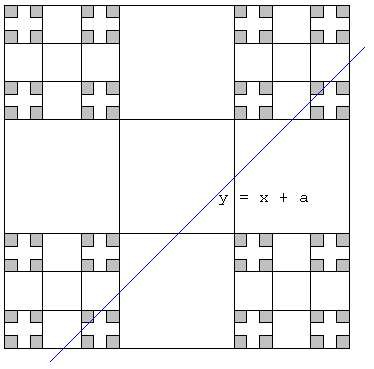
It's not hard to convince oneself that the line y = x + a intersects at least one of the 4 "corner" squares with side 1/3. Denote any of these as S1. By the same token, any line with slope 1 that intersects the square S1 intersects at least one of the corner squares of side length 1/9 that are contained in S1. Denote one of them S2. S2⊂S1. In this manner we obtain a decreasing sequence {Si} of (closed) squares. Since the sequence is decreasing, the intersection of any finite subsequence is not empty. (It's simply the smallest square in the subsequence.) This is another facet of compactness. A sequence of closed sets is said to possess a finite intersection property, if any finite subsequence has a non-empty intersection. A topological space is compact iff the intersection of every sequence of closed sets with the finite intersection property is not empty.
The original unit square being closed and bounded is compact. Therefore, the squares {Si} have a common point. This point belongs to both C0×C0 and the line
Proof #3
This proof by Stuart Anderson appears on a separate page.
Remark
Following an observation by Paolo Di Muccio, Stuart Anderson also showed that the two sequences {Bn} and {Cn} derived algorithmically in Proof #1, are both Cauchy and hence convergent. Since the Cantor set is closed, it contains both limits. The property of compactness of the set appears unnecessary for the proof. In Stuart's words:
The algorithm you use to generate the digit sequences never changes a digit once it has been set. Hence if one wants to think of the finite digit sequences as partial sums of the finished infinite sequence, one may do so.
Then for any N > 0, and for any m and k both > N, the partial sums
References
- B. R. Gelbaum and J. M. H. Olmsted, Counterexamples in Analysis, Dover, 2003
- I. Stewart, Game, Set and Math, Penguin Books, 1989
Cantor Set
- Cantor set and function
- Cantor Sets
- Difference of two Cantor sets
- Difference of two Cantor sets, II
- Sum of two Cantor sets
- Plane Filling Curves: the Lebesgue Curve
|Contact| |Front page| |Contents| |Did you know?| |Geometry|
Copyright © 1996-2018 Alexander Bogomolny74311289