
Five Incircles Theorem: What Is It About?
A Mathematical Droodle
| What if applet does not run? |

|Activities| |Contact| |Front page| |Contents| |Geometry|
Copyright © 1996-2018 Alexander Bogomolny
Five Incircles Theorem
The applet suggests the following theorem:
| (A) | In ΔABE two cevians AC and AD are drawn from the apex A to the base BE. Let the points be located as in the diagram below. Then the incircles of triangles ABC and ADE are equal iff the incircles of triangles ABD and ACE are equal. |
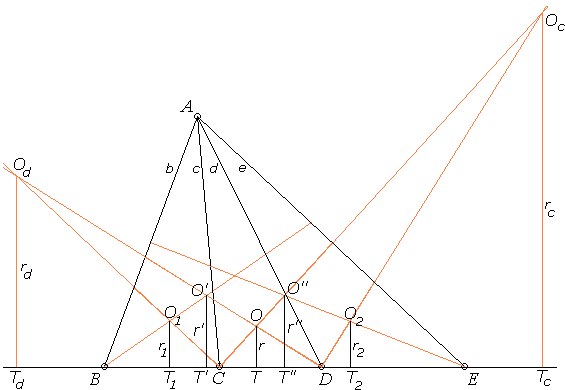
The theorem and the proof are due to J. B. Tabov, (Bulgaria) who responded to the challenge issued by H. Demir (Turkey) to provide a geometric proof (the original proof was trigonometric) to the following statement
| (B) | Assume under the conditions of (A), triangles ABC, ACD, and ADE have equal incircles. Then the incircles of triangles ABD and ACE are equal. |
(B) is clearly more restrictive and its assertion is less satisfying.
Proof of (A)
Since triangles ODT and OdDTd are similar,
| (1) | r/r1 = DT/DTd · CTd/CT1. |
Now, in addition to the notions used in the diagram, denote for convenience
r/r1 = (s - c)/s · (s - a)/(s1 - b).
Similarly,
r/r1 = (s - d)/s · (s - a)/(s2 - e).
Hence r1 = r2 iff
| (2) | (s - d)(s1 - b) = (s - c)(s2 - e). |
We can do something similar for triangles ABD and ACE. Indeed, since triangles ODT and O'DT' are similar,
| (3) | (s - d)(s' - b) = (s - c)(s" - e), |
where s' and s" are the semiperimeters of triangles ABD and ACE, respectively. But clearly
| = (s - d)(s + s1 - c - b) - (s - c)(s + s2 - d - e) | |
| = (s - d)(s - c) + (s - d)(s1 - b) - (s - c)(s - d) - (s - c)(s2 - e) | |
| = (s - d)(s1 - b) - (s - c)(s2 - e) |
Consequently, (2) and (3) are equivalent, which proves the theorem.
The theorem has bearing on the Equal Incircles Theorem. A more general statement admits even a simpler proof.
References
- H. Demir, Incircles within, Math Magazine, v 59 (1986), 77-83
- J. B. Tabov, A Note on the Five-Circle Theorem, Math Magazine, v 63 (1990), 92-94
|Activities| |Contact| |Front page| |Contents| |Geometry|
Copyright © 1996-2018 Alexander Bogomolny
74689982