
Proofs of the Pythagorean Theorem via Heron's Formula II
I was reminded of this proof by José Antônio Fabiano Mendes from Rio de Janeiro, Brazil. It appears as the algebraic proof 107 in Loomis' collection.

Join two copies of the base right triangle with legs $a,$ $b$ and hypotenuse $c$ as shown in the diagram. The result is an isosceles triangle with side lengths of $2b,$ $c$, $c$ and area $S = ab,$ obviously. To this triangle we apply Heron's formula. With the semiperimeter $p = b + c,$ we have
$S^{2} = (b + c) b^{2} (c - b).$
Substituting $S^{2} = (ab)^{2}$ and dividing by $b^{2}$ we obtain
$a^{2} = c^{2} - b^{2}.$
This is indeed a much shorter application of Heron's formula than proof #23.
If the length of the derivation is of no concern, note that Heron's formula extension, i.e. Brahmagupta's formula for cyclic quadrilaterals could be used in proof #52; for an isosceles trapezoid is cyclic. To apply Brahmagupta's formula we'll have to use the Socratic version of the Pythagorean theorem as was done in proof #64. The result is lengthier than proof #52 but, otherwise, is much along the lines of the above derivation.
Loomis mentions that Versluys attributes the proof to J. J. Posthumus.
John Molokach found a different way of using Heron's formula. Instead of combining two triangles into an isosceles one, he splits the given triangle into two isosceles:
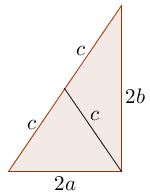
Now, both isosceles triangles have area equal to $S=ab.$ Heron's formula may apply to either. E.g., for the lower one:
$ab=\sqrt{(a+c)\cdot a\cdot a\cdot (c-a)},$
such that $a^{2}b^{2}=a^{2}(c^{2}-a^{2})$ and, subsequently, $b^{2}=c^{2}-a^{2}.$
References
- E. S. Loomis, The Pythagorean Proposition, NCTM, 1968

|Contact| |Front page| |Contents| |Geometry| |Up|
Copyright © 1996-2018 Alexander Bogomolny74282425