
Mechanical Proof of the Pythagorean Theorem
The Pythagorean theorem is arguably one of the most fundamental results in mathematics, with more known proofs than probably any other theorem. It is satisfying to know that the theorem lurks in many mechanical phenomena as demonstrated below. There is clearly more than one sense in which it deserves the designation of fundamental.
Imagine a right triangular prism with a right triangle as a base [Mark Levi, p. 10, and another discussion]. Let the legs of the triangle be a, b, and the hypotenuse c. Imagine the prism filled with water and mounted on a vertical spindle at one of the acute angles of the base triangle. The prism can freely rotate around the spindle. Will it?
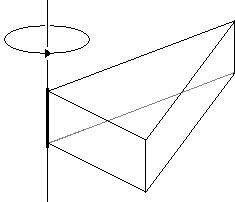
The answer is naturally, No. A prism left to its own devices will not move any way and stay at rest. This means that the forces acting on the prism somehow balance out. Beside the vertical gravitational pull that is balanced by the spindle's resistance, what are other forces that act on the prism?
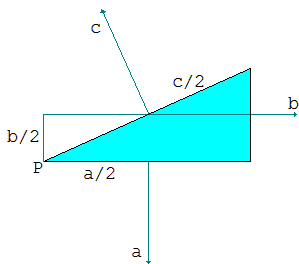
The water pushes from inside on each of the side faces of the prism. The push is proportional to the area of the side and, since all of them are rectangles of the same height, to their lengths. This force at each side generates a torque (momentum) as if it was concentrated at the center of gravity - the center - of the side. The torques on the legs pull the prism in one direction, the torque on the hypotenuse in the other. The torques balance. Each is the product of the distance to the axis times the force applied. As the result,
a² + b² = c².
(For a mathematical framework based on the invariance of the area of a moving body see a separate page.)

Consider now material point C that can slide without friction over a rigid semicircle with a diameter AB and center at O [Mark Levi, pp. 21-23]. Imagine two identical springs that link C to the points A and B and assume that the springs satisfy Hooke's law: F = κx, where x is the elongation of the spring, κ Hooke's constant, and F the tension of the spring, i.e. the force it exerts at both end points. The average force needed to stretch the spring to length x is κx/2 and the work performed is then the product of the distance and the force:
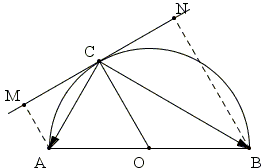
Returning to our configuration, we claim that point C is in equilibrium at any position on the semicircle. Indeed, since the radial forces can't cause it to move along the circle, suffice it to prove that the tangential components of the tension exerted by the two springs balance out.
Let M and N be the projections of A and B onto the tangent to circle at C. The lengths of CM and CN are proportional to the projections of the two forces on the tangent. But
As a consequence, the potential energy of the two springs is the same for any position of C. In particular, for a position with
If a puck of mass
(There is another mechanical proof that also employs Heron's formula.)
References
- M. Levi, The Mathematical Mechanic, Princeton University Press, 2009
|Contact| |Front page| |Contents| |Algebra|
Copyright © 1996-2018 Alexander Bogomolny
74316831