
Point in a Square
Inside a square ABCD, a point P is selected such that
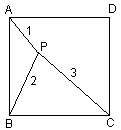
Find ∠APB.
The following solution is by Murray Klamkin.
Rotate the square through 90° around point B. Let P' be the image of P, A' that of A, and D' of D. Connect P and P'.
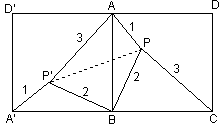
In ΔBPP',
In ΔAPP', PP'2 + AP2 = AP'2
Summing up, ∠APB = ∠BPP' + ∠P'PA = 45° + 90° = 135°.
A similar approach works for a similar problem where point P is at distances 3, 4, 5 to the vertices of an equilateral triangle.
Reference
- R. Honsberger, More Mathematical Morsels, MAA, 1991, pp. 4-5.

|Contact| |Front page| |Contents| |Geometry| |Up|
Copyright © 1996-2018 Alexander Bogomolny
74282875