
Bisecting Arcs
M. Klamkin tells the following story:
The next problem is a very nice one in Polya [2, p. 186]; I managed to catch D.J. Newman on it as well as other mathematicians. A bisecting arc is one which bisects the area of a given region. First, I asked what is the shortest bisecting arc of a circle. Usually, the fast reply is that it is a diameter. Secondly, I asked what is the shortest bisecting arc of a square. Again, a usual fast reply is that it is an altitude through the center. Finally, I asked what is the shortest bisecting arc of an equilateral triangle. By this time, Newman had suspected that I was setting him up (and I was) and almost was going to say the angle bisector. But he hesitated and said let me consider a chord parallel to the base and since this turns out to be shorter than an angle bisector, he gave this as his answer. Unfortunately for him, the correct answer is different.

References
- M. S. Klamkin, Mathematical Creativity in Problem Solving, in In Eves' Circles, J. M. Anthony (ed.), MAA, 1994
- G. Polya, Mathematics and Plausible Reasoning, v 1, Princeton University Press, 1954, p 272
|Contact| |Front page| |Contents| |Geometry| |Up|
Copyright © 1996-2018 Alexander Bogomolny
Answer
A 60° arc of a circle.
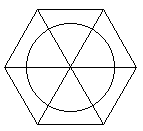
The proof is obtained by reflection of the equilateral triangle in its sides 5 times until a regular hexagon is formed. (The shortest bisector is bound to start at one side and end at another although it may not be altogether obvious. Reflect the triangle in those sides that contain points of the bisector.) Six copies of the bisector curve aided, perhaps, by pieces of the diagonal, form a closed curve whose area is known to be a half of the area of the hexagon. We are looking for such a shape in the hexagon with the shortest perimeter.
According to the Isoperimetric Theorem, among all shapes with the given area, circle has the shortest perimeter. In a single equilateral triangle the circles cuts a 60° arc that solves the original problem.
It's instructive to mention a remark by G. Polya [Mathematics and Plausible Reasoning, Volume 1, p. 272] to the effect that the shortest bisector of any region is either a straight line or an arc of a circle. If the region has a center of symmetry (as the square, the circle, and the ellipse have, but not the equilateral triangle), the shortest bisector is a straight line. (I am grateful to Professor Anany Levitin for bringing this remark to my attention.)
|Contact| |Front page| |Contents| |Geometry| |Up|
Copyright © 1996-2018 Alexander Bogomolny
74502486