Cut the knot: learn to enjoy mathematics
A math books store at a unique math study site. Learn to enjoy mathematics.
Google
Web CTK
Best sites for teachers
Sites for teachers
Sites for parents
Terms of use
Awards

Interactive Activities
CTK Exchange
CTK Insights - a blog

Games & Puzzles
What Is What
Arithmetic/Algebra
Geometry
Probability
Outline Mathematics
Make an Identity
Book Reviews
Eye Opener
Analog Gadgets
Inventor's Paradox
Did you know?...
Proofs
Math as Language
Things Impossible
Visual Illusions
My Logo
Math Poll
Cut The Knot!
MSET99 Talk
Other Math sites
Front Page
Movie shortcuts
Personal info
Reciprocal links
Privacy Policy

Guest book
News sites

Recommend this site

Best sites for teachers
Sites for teachers
Sites for parents

Education & Parenting

Manifesto: what CTK is about Search CTK Buying a book is a commitment to learning Table of content Things you can find on CTK Chronology of updates Email to Cut The Knot Recommend this page

Haruki's Theorem

Ceva's theorem applies to a configuration of three concurrent cevians in a triangle. Hiroshi Haruki made an observation that a similar fact holds in some circumstances when an actual triangle is missing. More accurately, it is known that the common chords of three intersecting circles meet in the radical center of the circles.
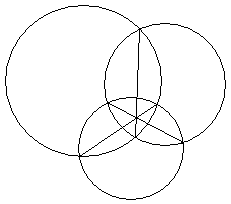
 

The three concurrent "cevians" are present, but where is the triangle? The common points of the circle can still be connected to form a 3-prodded star, the lengths of whose sides we denote successively a, b, c, d, e, f.
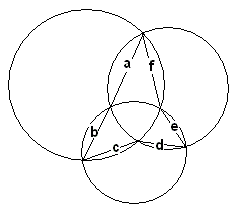
 

Professor Haruki observed that the six lengths satisfy a Ceva-like identity:

(1) a/b·c/d·e/f = 1.

To see why this is so, introduce three additional lengths x, y, z, as in the diagram:


Now imagine the circles separated, each with the inner chords intact. The chords will naturally be inherited by two circles.
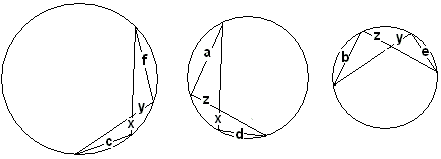
 

Because of the properties of inscribed angles, the chords form similar triangle. We thus derive three proportions:

  c/f = x/y, a/d = z/x, e/b = y/z,

the product of which gives exactly (1).

References

  1. R. Honsberger, The Butterfly Problem and Other Delicacies from the Noble Art of Euclidean Geometry I, TYCMJ, 14 (1983), pp. 2-7.

Copyright © 1996-2008 Alexander Bogomolny

28700949Page copy protected against web site content infringement by Copyscape


Search:
Keywords:


Latest on CTK Exchange
Math
Posted by Laura
2 messages
06:56 AM, Apr-15-08

Divisibility rules - Jargon buste ...
Posted by Carolyn
2 messages
08:35 AM, Apr-04-08

drawing puzzle
Posted by martin gran
31 messages
06:53 PM, May-09-08

Distance to the horizon
Posted by Monty
3 messages
04:38 PM, May-08-08

Mistake on the page (an aside, Be ...
Posted by Max
4 messages
10:28 AM, Feb-28-08

Deriving functions based on diffe ...
Posted by ke_45
1 messages
12:47 PM, May-10-08

A typo in
Posted by alexwajn
1 messages
11:36 PM, Apr-19-08