
Addition of Arbitrary Shapes
You can't add apples and oranges but you can add their shapes.

To avoid ambiguity shapes whose sums I plan to consider will be finite-dimensional sets, say, subsets of a space or a plane or a general vector space V. Talking of apples and oranges, these probably more naturally perceived as sets of points not vectors. Then consider R3 as a set of points and select a point (the origin) so that it would be possible to identify a point with the vector emanating from the origin and ending at the point.
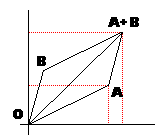
Returning to the sets of vectors, let X and Y be subsets of V. Then
Verification that the addition is associative and commutative is straightforward. Zero is {O}, the set that consists of a single point - the origin.
This addition has some very desirable properties, especially when restricted to the collection of convex sets. Even more so when it's restricted to a pair of convex polygons.
- If any of the sets X, Y is translated (as a whole) so will be their sum
X + Y - If the origin is chosen differently, then the sum X + Y will be translated in the opposite direction but by the same distance as the origin.
- If X and Y are convex, so is X + Y
- Let X = B(A, R) and Y = B(B, S) be balls of radii R and S, respectively. Then
X + Y = B(A + B, R + S) the ball of radiusR + S.
This addition has no inverse element.
However, there is a related operation that very nearly comes to being an inverse. The following also shows that even when equivalent some definitions may (and often are) more fruitful than others. Let's use a new symbol ⊕ to denote the above addition of shapes:
| (1) | A⊕B = {a + b: a∈A and b∈B}. |
Note that if we use a-b in the definition instead of a+b we would gain precious little. Indeed, in case where B is centrally symmetric the result will be exactly the same. Now let's reformulate the definition. First, let's agree to write
| (2) | A⊕B = ∪(A + b), |
where union is taken over all b∈B. The definitions are equivalent (check this) but (2) has a degree of freedom that provides for possible modifications. A curious mind may ask, what if we use a set operation other than the union. Hermann Minkowski (1864-1909) after whom (2) is known as Minkowski addition also defined (Minkowski) subtraction
| (3) |
A = ∩(A + b), = ∩(A + b),
|
Both operations are widely used in image processing or, more specifically, morphological analysis of images, where they are known as dilation (⊕) and erosion ( ). The terminology is due to the fact that B ⊂ A ⊂ A⊕B,
| (4) |
Closing: O(A, B) = (A⊕B)B Opening: C(A, B) = (A B)⊕B |
Assuming B is a circle one may think of the opening as having a ball B roll inside A smoothing its corners (internal angles). More accurately
Theorem
O(A, B) = ∪{B + x: B + x ⊂ A}.
If Dc stands for the complement of D, then
Reference
- E. R. Dougherty and C. R. Giardina, Mathematical Methods for Artificial Intelligence and Autonomous Systems, Prentice Hall, 1988
- I. M. Yaglom and B. G. Boltyansky, Convex shapes, Nauka, Moscow, 1951. (in Russian)
What Can Be Added?
- What Is Addition?
- Addition of Chains
- Addition of Equations
- Addition of Functions
- Addition of Numbers
- Addition of Sets
- Addition of Shapes
- Addition of Spaces
- Addition of Strings
- Addition of Vectors
|Contact| |Front page| |Contents| |Up|
Copyright © 1996-2018 Alexander Bogomolny74409076