
Nagel Point: What Is It About?
A Mathematical Droodle
| What if applet does not run? |

|Activities| |Contact| |Front page| |Contents| |Geometry|
Copyright © 1996-2018 Alexander Bogomolny
The applet may suggest the following statement:
Let E, D, F be the points of tangency of the excircles of ΔABC and its sides, as in the applet below. Prove that AD, BE, CF are concurrent. The point of concurrency is known as the Nagel point of ΔABC.
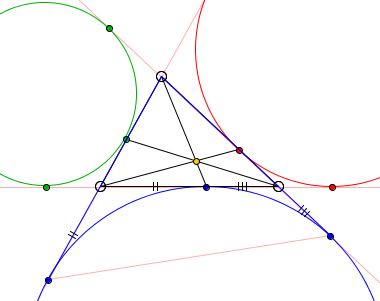
The proof relies on Ceva's theorem.
First, let CC denote the excircle of ΔABC opposite the vertex C. CC is tangent to the side AB and the side lines AC and BC in points F, T and U. Since, CT and CU are the two tangents from C to CC, they are equal in length:
(1)
CT = CU.
For a similar reason
(2)
AT=AF.
(3)
BU = BF.
(1)-(3) immediately imply that F is a perimeter splitter in the sense that
AC + AF = BC + BF.
If a, b, c are the side lengths of the ΔABC and p its semiperimeter in a standard way, then this fact could be rewritten as
b + AF = a + BF = p,
so that
AF = p - b
BF = p - a.
Similarly, we obtain additional four identities:
AE = p - c
CE = p - a
CD = p - b
BD = p - c.
Ceva's identity is then verified directly:
AE/CE·CD/BD·BF/AF = (p-c)/(p-a)·(p-b)/(p-c)·(p-a)/(p-b) = 1.
(A curious fact is that these same points D, E, F arise in a related, yet quite a different construction.)
|Activities| |Contact| |Front page| |Contents| |Geometry|
Copyright © 1996-2018 Alexander Bogomolny
74287051