
A Property of the Line IO
What Is This About?
A Mathematical Droodle

|Activities| |Contact| |Front page| |Contents| |Geometry|
Copyright © 1996-2018 Alexander Bogomolny
A Property of the Line IO
R. Honsberger in [From Erdos to Kiev, pp. 199-201] treats a problem from Crux Mathematicorum, 1987, 160:
As usual, let I and O be the incenter and circumcenter, respectively, of triangle ABC. Suppose angle C is 30°, and that the side AB is laid off along each of the other two sides to give points D and E so that
EA = AB = BD.
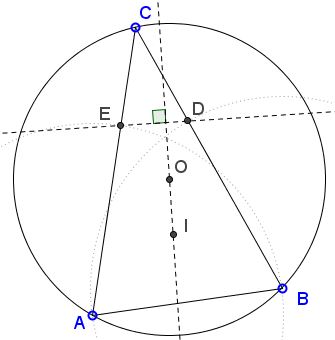
Prove that the segment DE is both equal and perpendicular to IO.
Now, I think that the problem is a mixture of two:
- DE is perpendicular to IO,
- DE = IO.
The first one is independent of the magnitude of angle C: DE is perpendicular to IO anyway, for any angle C. The second one is the consequence of the angle requirement.
As a preliminary, the construction of points D and E can be repeated for the other two sides AC and BC, giving three lines. Perhaps, curiously, the three are parallel, so that IO can't be perpendicular to them for the reason that angles A, B, C are all 30°.
Below I give solutions posted by Darij Grinberg, one by a participant at one of the AoPS forums, and another by Nathan Bowler. (The published solution appears elsewhere.)
Solution 1
I shall adopt the convention
It's well known that BX = p - b, where p is the semiperimeter (a + b + c)/2. Thus
| (1) |
|
On the other hand, CE = b - c. So that CE = 2·XA' = 2·ID', because ID'A'X is a rectangle (angles at D', A', X are right by the construction.). Similarly,
∠IE'D' = ∠CDE.
Since the angles at D' and E' are right, ID'E'O is a cyclic quadrilateral with diameter IO. Angles IE'D' and IOD' are subtended by the same chord ID'. They are thus equal. (For a more accurate derivation see, Darij's original.) Wee see that
∠IOD' = ∠CDE.
Also, one pair of corresponding sides is orthogonal (OD'⊥CD) and, since the angles have the same orientation, so must be the other:
DE ⊥ IO.
We also get some extra information. ∠C = ∠ACB = ∠ECD = ∠D'IE'. In ΔD'IE', by the Law of Sines, we have
DE = 2·IO·sin(∠C),
which, for ∠C = 30°, implies
Solution 2
In the previous notations,
| ∠XIO + ∠YIO | = ∠XIY |
| = ∠180° - ∠C | |
| = ∠CDE + ∠CED. |
Further, with IO = d,
| sin(∠XIO) | = XA'/IO = |b - c|/2d, and |
| sin(∠YIO) | = YB'/IO = |a - c|/2d, |
which combine into
| sin(∠XIO)/sin(∠YIO) | = |b - c|/|a - c| |
| = CE/CD | |
| = sin(∠CDE)/sin(∠CED). |
It follows that ∠XIO = ∠CDE and ∠YIO = ∠CED. Since
DE/CE = sin(∠C) / sin(∠CDE),
we obtain
| DE | = CE·sin(∠C) / sin(∠CDE) |
| = CE·sin(∠C) / sin(∠XIO) | |
| = |b - c|·2d/|b - c|·sin(∠C) | |
| = 2d·sin(∠C). |
Note: This proof depends on the fact that function
Solution 3
(By Nathan Bowler.) This has a neat proof by transformation geometry.
D is the reflection of A in BI, so
| ∠AID | = 2·∠AIB |
| = 2(π - ∠A/2 - ∠B/2) | |
| = 2π - (π - ∠C) | |
| = π + ∠C. |
So letting f be the operation of rotation about I by
| D'E' | = |2·IO·sin(π + ∠C)| |
| = 2·IO·sin(∠C) | |
| = IO |
when ∠C = 30°. This also throws some light on the related theorem mentioned elsewhere. Let O' be the reflection of O in CI. Then OO' is at right angles to the bisector CI of ∠ACB, so to the internal bisector of ∠NOM, so it is the external bisector of that angle. So O' is the midpoint of the longer arc MN and
| ∠MIO' | = ∠O'IN |
| = ∠MIN/2 | |
| = (2π - 2∠C)/2 | |
| = π - ∠C. |
So ∠O'IM = ∠NIO' = π + ∠C, and so M and N are the reflections of D' and E' in CI. Thus MN is equal and antiparallel to D'E', which is equal and parallel to DE. Thus MN, NO and OM are antiparallel to ED, DC and CE respectively, so MNO and EDC are similar. As also MN = ED, they are congruent.
References
- R. Honsberger, From Erdös To Kiev, MAA, 1996.
- A Property of the Line IO
- A Property of the Line IO: Untangling of the Problem
- A Property of the Line IO: A Proof From The Book
- A Circle Related to Incenter and Circumcenter
|Activities| |Contact| |Front page| |Contents| |Geometry|
Copyright © 1996-2018 Alexander Bogomolny
74194098