
A Candy Game
A number of students sit in a circle while their teacher gives them candy. Each student initially has an even number of pieces of candy. When the teacher blows a whistle, each student simultaneously gives half of his or her own candy to the neighbor on the right. Any student who ends up with an odd number of pieces of candy gets one more piece from the teacher. Show that no matter how many pieces of candy each student has at the beginning, after a finite number of iterations of this transformation all students have the same number of pieces of candy.
As of 2018, Java plugins are not supported by any browsers (find out more). This Wolfram Demonstration, The Four-Number Game, shows an item of the same or similar topic, but is different from the original Java applet, named 'Candy'. The originally given instructions may no longer correspond precisely.
(image below from deprecated 'Candy' applet)
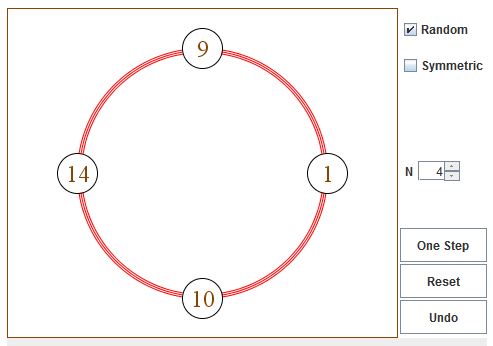
(Number of candies can be set either randomly or by modifying each of the circled entries. To modify a number, click a little to the right or left of its centerline. In the symmetric variant, each fellow shares equally between his/her two neighbors.)
There is another version of the game wherein divides his/her candies into two equal piles discharging (or eating up) one candy if such is left over. One and the same reasoning applies to both variants.

74291486 | Copyright © 1996-2018 Alexander Bogomolny |