
A Stronger Triangle Inequality
In 1997, a retired engineer (H. R. Bailley) and a retired chemist (R. Bannister) published a curious result - a strengthened triangle inequality - that serendipitously incorporated a rather ubiquitous consumer services symbol (24/7). A short while later, the now late math problem solver extraordinaire, Professor Murray Klamkin, gave an elegant 1 page proof of that result. I'll start with the motivation that drove Bailley and Bannister and proceed with Klamkin's proof.
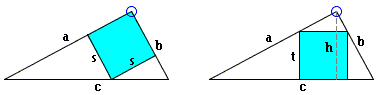
Bailley and Bannister began there investigation with a right triangle and an inscribed square. They compared two ways of inscribing a square into a right triangle. Which of the squares is bigger?
Denote the legs of the triangle as a and b, the hypotenuse c, the altitude to the hypotenuse h, and the sides of the two squares s and t.
|
In both cases, the presence of similar triangles leads to the proportions:
|
(b - s) / s = b / a and (c - t) / t = c / h, |
from which
|
b / s = (a + b) / a and c / t = (c + h) / h, |
and ultimately
|
s = ab / (a + b) and t = hc / (c + h). |
Since, in a right triangle, both ab and hc equal double the area of the triangle,
|
It follows that in a right triangle we always have
| (1) | a + b < c + h. |
Which is equivalent to
In a triangle with side length a, b, c, altitude h and the angle C opposite side c
| (2) | a + b > c + h. |
provided
| (3) | C < arctan(24/7), |
or, as Bailley and Bannister put it, (2) holds for most triangles with
The proof below is due to M. Klamkin and is based on an identity
| (4) | a + b - c = 2h·cos(C/2) / (cos (A-B)/2 + sin C/2), |
where A and B are the angles in the triangle opposite a and b, respectively. (4) holds in any triangle.
For fixed C the ratio 2·cos(C/2) / (cos (A-B)/2 + sin C/2) clearly takes on its minimum when
| 2·cos(C/2) / (1 + sin C/2) = 2(sec C/2 - tan C/2). |
Thus the sharp triangle inequality
| a + b - c ≥ 2(sec C/2 - tan C/2)·h |
is always valid, with equality if and only if
For (2) to hold we must have
It remains only to prove (4). If R is the circumradius of the triangle,
|
a = 2R·sin A, b = 2R·sin B, c = 2R·sin C, and h = a·sin B, |
so that
| a + b - c = (sin A + sin B - sin C) / sin(A)sin(B). |
Using elementary trigonometric identities and
|
2·sin (A+B)/2 / (cos (A-B)/2 + cos (A+B)/2). |
Using (A+B)/2 = π/2 - C/2, the ratio takes the form
| 2·cos C/2 / (cos (A-B)/2 + sin C/2), |
which is (4).
References
- H. R. Bailley, R. Bannister, A Stronger Triangle Inequality, The College Mathematics Journal, vol. 28, no. 3, May 1997, 182-186.
- M. S. Klamkin, A Sharp Triangle Inequality, The College Mathematics Journal, vol. 29, no. 1, January 1998, 33.

|Contact| |Front page| |Contents| |Geometry|
Copyright © 1996-2018 Alexander Bogomolny
74287068