Cut the knot: learn to enjoy mathematics
A math books store at a unique math study site. Learn to enjoy mathematics.
Google
Web CTK
Best sites for teachers
Sites for teachers
Sites for parents
Terms of use
Awards

Interactive Activities
CTK Exchange
CTK Insights - a blog

Games & Puzzles
What Is What
Arithmetic/Algebra
Geometry
Probability
Outline Mathematics
Make an Identity
Book Reviews
Eye Opener
Analog Gadgets
Inventor's Paradox
Did you know?...
Proofs
Math as Language
Things Impossible
Visual Illusions
My Logo
Math Poll
Cut The Knot!
MSET99 Talk
Other Math sites
Front Page
Movie shortcuts
Personal info
Reciprocal links
Privacy Policy

Guest book
News sites

Recommend this site

Best sites for teachers
Sites for teachers
Sites for parents

Education & Parenting

Manifesto: what CTK is about Search CTK Buying a book is a commitment to learning Table of content Things you can find on CTK Chronology of updates Email to Cut The Knot Recommend this page

A Characteristic Property of Centroid
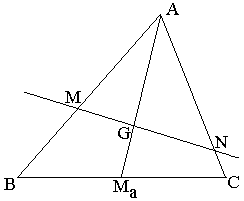
 

In ABC, a line is drawn through centroid G. Assume the line intersects AB in M and AC in N. Then

(1)BM/MA + CN/NA = 1.

Here, BM, MA, CN, NA are considered as signed segments. In a certain sense the identity even holds when the line in question is parallel to, say, AB. In this case, M is a point at infinity and BM/MA = -1 whereas CN/NA = 2. Conversely, if any line through a point P satisfies (1), then necessarily P = G.

Proof.

Copyright © 1996-2008 Alexander Bogomolny


Proof


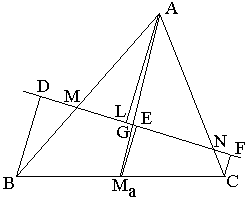
Let Ma be the midpoint of side BC. Drop perpendiculars BD, MaE, and CF onto the given line. Obviosly

(2)MaE = (BD + CF)/2.

Let also AL be perpendicular to MN. Triangles ALG and MaEG are similar and GA = 2·MaG. Therefore, LA = 2MaE, or

(2')LA = BD + CF.

Triangles BDM and ALM are similar, as are triangles CFN and ALN, from where we get

 
BM/MA + CN/NA= BD/LA + CF/LA
 = (BD + CF)/LA
 = LA/LA (from 2')
 = 1.

Let's now tackle the converse. Assume point P is such that

(1')BM'/M'A + CN'/N'A = 1

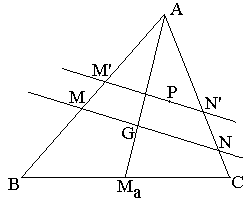
holds for any line through P that intersects AB in M' and AC in N'. We have to show that P = G.. To this end assume that P is different from G and that the line is different from GP. Let MN passes through G parallel to M'N'. Then, with the reference to the diagram above,

(3) BM/MA + CN/NA< BM'/M'A + CN'/N'A.

This is because, in the diagram, BM/MA < BM'/M'A and CN/NA < CN'/N'A. For other locations of P or the straight line, the inequalities may have to be simultaneously reversed. (3) implies

  BM/MA + CN/NA< 1,

which contradicts the proven part.
 

Copyright © 1996-2008 Alexander Bogomolny

28761612Page copy protected against web site content infringement by Copyscape


Search:
Keywords:


Latest on CTK Exchange
Math
Posted by Laura
2 messages
06:56 AM, Apr-15-08

Divisibility rules - Jargon buste ...
Posted by Carolyn
2 messages
08:35 AM, Apr-04-08

drawing puzzle
Posted by martin gran
31 messages
06:53 PM, May-09-08

conway's game of life
Posted by frequency
0 messages
11:52 PM, May-12-08

Mistake on the page (an aside, Be ...
Posted by Max
4 messages
10:28 AM, Feb-28-08

A Riddle
Posted by idavis1
33 messages
06:59 AM, May-15-08

Josephus Flavius (correction)
Posted by David Turner
1 messages
09:42 AM, May-14-08