Cut the knot: learn to enjoy mathematics
A math books store at a unique math study site. Shopping at the store helps maintain the site. Thank you.
Math & English enrichment at SchoolPlus-Online
HoodaMath: games and movies
Sites for teachers
Sites for parents
Terms of use
Awards
Interactive Activities

CTK Exchange
CTK Wiki Math
CTK Insights - a blog
Math Help

III Millennium Olympiad

Games & Puzzles
What Is What
Arithmetic/Algebra
Geometry
Probability
Outline Mathematics
Make an Identity
Book Reviews
Stories for Young
Eye Opener
Analog Gadgets
Inventor's Paradox
Did you know?...
Proofs
Math as Language
Things Impossible
Visual Illusions
My Logo
Math Poll
Cut The Knot!
MSET99 Talk
Other Math sites
Front Page
Movie shortcuts
Personal info
Privacy Policy

Guest book
News sites

Recommend this site

Games to relax

Sites for teachers
Sites for parents

Education & Parenting

Manifesto: what CTK is about Buying a book is a commitment to learning Table of content Things you can find on CTK Chronology of updates Email to Cut The Knot Recommend this page

Sperner's Theorem

We know that if more than a half of subsets of an n-set A have been selected, there are bound to be at least two of which one contains another. This is proven with the help of the Pigeonhole Principle. Below we prove by far a stronger result - the Sperner's Theorem. It appears that a half is a few too many; there is no need to take this many subsets.

A collection B of nonempty subsets of a set A is called an antichain (or clutter or Sperner system) in A if no set in B is (properly) contained in another set from B.

  Prove that, for an n-set A, the number of sets in any antichain in A cannot exceed C(n,n'), where n' = [(n+1)/2].

To remind, C(n, m) is a binomial coefficient
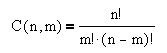
 

that appears in the Binomial Theorem which, for an integer exponent, can be written as

  (x + y)n = C(n,0)xn + C(n,1)xn-1y + C(n,2)xn-2y2 + ... + C(n,n)yn

For an even n, there are an odd number of binomial coefficients with the middle coefficient C(n,n') corresponding to n' = n/2. For n odd, the number of coefficients is even and there are two equal coefficients, one corresponding to n' = (n-1)/2 and the other to n' = (n+1)/2. For even n, [(n+1)/2] = n/2, where [] means "the integer part". At this time, I shall assume the unimodal behavior of the sequence of binomial coefficients: C(n,k) is not decreasing as k changes from k = 0 to k = n' and is not increasing afterwards. Therefore, for any n, C(n,n') with n' = [(n+1)/2] is the largest binomial coefficient:

  For all 0kn, C(n,k)C(n,n').

C(n,k) is the number of ways to select k (unordered) elements out of n. It follows that the number of sets in any antichain in which all sets have the same number of elements is bounded above by C(n,n').

A maximal chain in the n-set A is a sequence X0,X1,...,Xn of subsets of A such that for all i card(Xi), cardinality or the number of elements in the set Xi, is i; and XiXi+1, for i=0,...,n-1. Obviously, there is a 1-1 correspondence between permutations of the set A and its maximal chains: any permutation {x1 x2 ...xn} gives rise to a maximal chain

  {x1}{x1,x2}...{x1,x2,...,xn} = A

and vice versa. Let B = {B1,B2,...,Bt} be an antichain in A, with card(Bi) = bi, i=1,...,t. By definition, any chain in A - maximal or not - can contain at most one of the sets Bi. Now, there are bi! ways of forming a chain from to Bi, and there are (n -bi )! ways of extending this chain to a maximal one. Thus the number of maximal chains that contain the set Bi is bi!(n -bi )!. We therefore have the inequality


Suppose that among the cardinalities {bi} there are p1 1s, p2 2s, ..., pn n's. So that pk's are nonnegative integers that sum up to t. The previous inequality can be rewritten as


This is known as the Lubell-Yamamoto-Meshalkin (LYM) inequality. From here it follows at once that

 
or tC(n,n').

References

  1. V.K.Balakrishnan, Theory and Problems of Combinatorics, Schaum's Outline Series, McGraw-Hill, 1995

Copyright © 1996-2009 Alexander Bogomolny

33062137Page copy protected against web site content infringement by Copyscape


Search:
Keywords:

Google
Web CTK